
What Voice Similarity Scores Mean
Understand best score, top 5 median, matched speech, speaker summaries and technical similarity labels without treating them as identity probabilities.
Updated · Cyber Search MatchA voice similarity score measures technical resemblance to the submitted reference. A displayed percentage is not the probability that two recordings contain the same person.
Separate the score from the amount of speech.
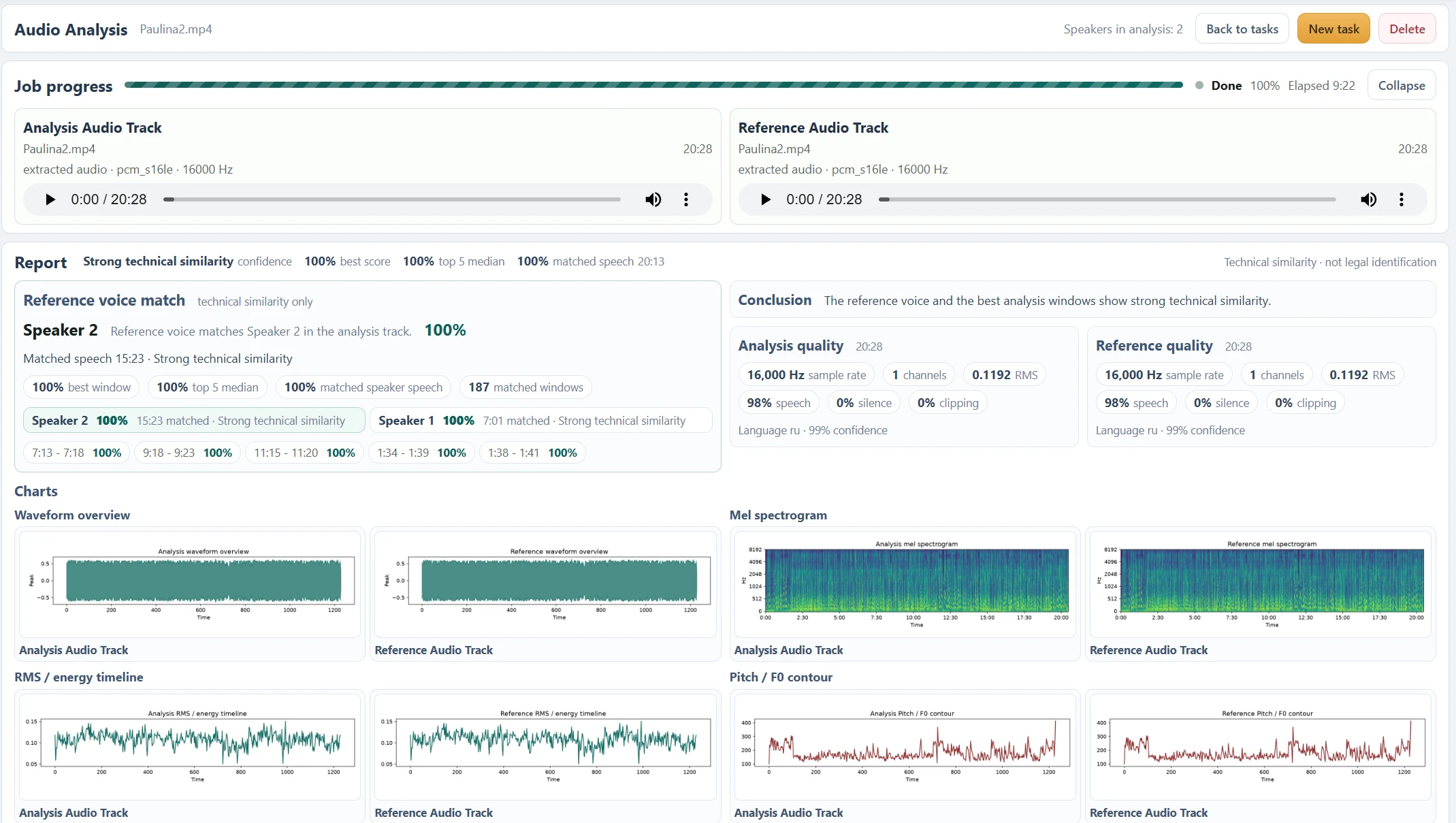
Best score selects the strongest analysis window compared with the reference voice profile. Top 5 median takes the median of up to five strongest available window scores and reduces dependence on one peak. It still summarizes selected evidence rather than the entire recording.
Matched speech and matched ranges describe coverage under the configured match threshold. A duration and a percentage of matching windows are not additional independent identity tests. Overlapping windows and merged ranges should not be counted twice.
| Report item | Read it as |
|---|---|
| Best score | The strongest selected comparison window |
| Top 5 median | A summary of up to five highest-scoring windows |
| Matched speech | Coverage meeting the configured matching rule |
| Speaker summary | Comparison evidence associated with a job-specific speaker group |
| Technical similarity label | A category derived from configured score thresholds |
A confidence label is a technical category.
Strong technical similarity, possible similarity and lower categories are assigned using configured thresholds. They are not calibrated legal confidence levels. Read the score and the underlying windows rather than treating the category name as a verdict.
Recording conditions can lower the score for the same voice or raise resemblance between different voices. Noise, codec artifacts, microphone changes, overlapping speech and the content of the reference all matter. A short or mixed reference may not represent the intended voice well.
Why this example reaches 100%.
The completed screenshot uses Paulina2.mp4 as both analysis and reference. A reference containing the whole analysis recording contains both voices, so several speaker groups can score highly. This setup does not demonstrate which of two people a clean single-speaker reference would match.
Before interpreting your own result, verify the filenames, listen to the reference and inspect several matching and nonmatching moments. Use the report to guide review, not as proof of identity, authenticity or the absence of synthetic speech.
Questions about this workflow
Do I need a reference file just to transcribe?
Yes, in the current workflow. Select an analysis source and a reference source before starting. There is no separate one-file transcription mode yet. For a meaningful voice comparison, use a clean sample of the voice you want to compare.
Can I close the tab?
Keep the tab open until both uploads and submission finish. Processing then continues in the background; return to your Audio task list for progress and the report.
Continue with the next useful step
How to Read an Audio Analysis Report
Understand source players, quality indicators, transcripts, speaker groups, voice similarity and signal charts in the current Audio Analysis report.
Find and Listen to Audio Speaker Segments
Use speaker labels, dialogue turns, matched windows and timestamps to locate and listen to passages in an Audio Analysis report.