
ECAPA-TDNN and VoxCeleb: Training, Checkpoints and Real-World Limits
Understand ECAPA-TDNN training, VoxCeleb trial protocols, pretrained checkpoints, augmentation, reproducibility and the limits of applying benchmark results to real voice comparison.
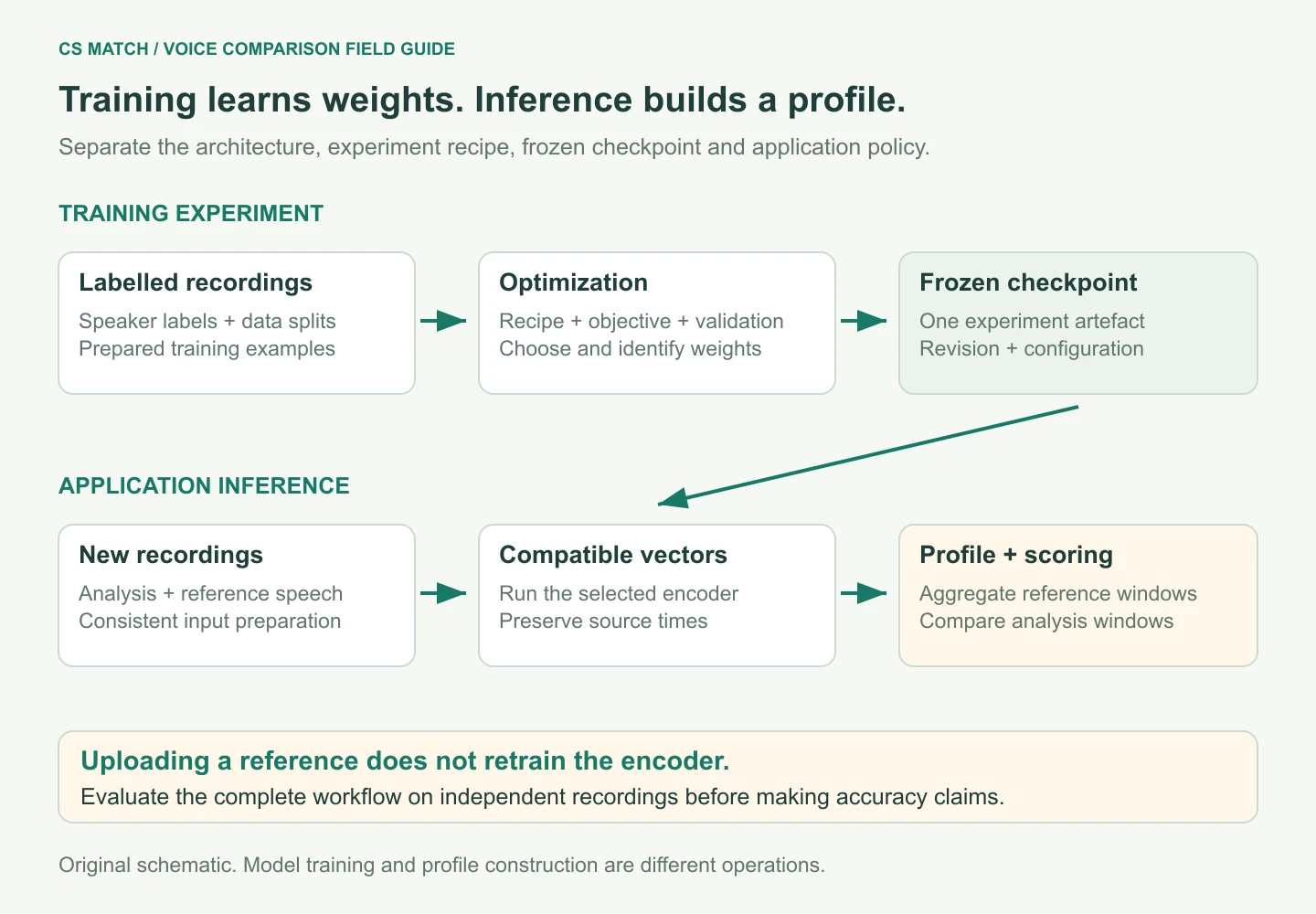
Sources checked · Cyber Search MatchECAPA-TDNN is an encoder architecture; VoxCeleb supplies speaker-labelled training and evaluation material; a checkpoint contains the learned parameters of one particular experiment. Using pretrained weights does not train on your upload. To assess a deployment, identify all three, preserve the evaluation protocol, and test independent recordings under the channels and durations that matter to your application.
Separate the architecture, checkpoint and training recipe
A network diagram describes how information moves through a model. A training recipe adds the data preparation, sampling, objective, optimizer and checkpoint-selection procedure. The checkpoint is the resulting parameter set. Two systems can legitimately use ECAPA-TDNN while having different weights, input conventions and results. Reproducing an architecture is therefore a smaller claim than reproducing a published experiment.
This distinction matters when reading a repository today. Its development branch can change after a model was released, including dependency interfaces and augmentation code. Record the checkpoint revision separately from the recipe commit. An example that runs successfully with current packages establishes an inference path; it does not establish that the current training configuration produced historical weights.
For an evaluation record, keep the model identifier, downloaded artefact hashes, configuration, package versions and scoring settings together. Describe any substitutions explicitly. If an original component is unavailable, an adapted reproduction can still be useful, but its measurements belong to that adapted system. This prevents a familiar model name from carrying an accuracy claim across untested changes.
Understand what VoxCeleb represents and what it leaves open
The official VoxCeleb project describes speech clips extracted from online interview videos, with unconstrained conditions including background sound and overlapping speech. It provides VoxCeleb1 and VoxCeleb2, with speaker identities and multiple utterances. This makes it valuable for learning variation across recordings of known training speakers and for constructing same-speaker and different-speaker evaluation trials.
Those origins also define a domain. Interview audio does not automatically represent a short telephone response, a distant surveillance microphone or every language and speaking condition. Dataset size alone cannot answer those questions. A broad source population can support a useful baseline while still leaving gaps in the channels and durations encountered by a particular deployment.
Start a target-domain inventory before proposing additional training. List the microphones, codecs, typical speech duration, background voices and ways references are collected. Include recordings that the application should decline to interpret. The goal is to discover where the baseline is reliable and where evidence is weak, rather than assume that more training examples guarantee coverage of every recording condition.
Keep speaker separation and trial definitions explicit
A verification trial pairs an enrollment or reference side with a test side and a same-speaker or different-speaker label. A list of pairs is part of the experiment, not just a convenient collection of files. Changing which speakers, sessions or durations appear in those pairs changes the difficulty and the meaning of the resulting error estimate.
The current SpeechBrain recipe explicitly warns that the VoxCeleb1-E and VoxCeleb1-H trial lists draw from VoxCeleb1 training material. Training with those files and then reporting those trials as unseen evaluation would introduce leakage. A generic claim that a model was evaluated on VoxCeleb1 is insufficient: preserve the named list, cleaned version and training exclusions.
Apply the same discipline to your own recordings. Keep separate calls or sessions across reference and test where that reflects the intended task. Avoid placing adjacent windows of the same recording on both sides and calling the result independent verification. Duplicate sources, shared background audio and repeated processing can make an apparently large trial set much less informative than its pair count suggests.
How the frame encoder builds speaker-related information
The ECAPA paper develops the TDNN speaker-embedding approach with one-dimensional Res2Net-style modules, squeeze-and-excitation channel weighting, aggregation across hierarchical layers and channel-dependent attention in statistics pooling. These are architectural mechanisms for representing temporal and channel information; they are not a list of human-readable voice traits that can be inspected one coordinate at a time.
Think of successive frame representations as learned summaries of local speech context. Combining information at several levels can give the later pooling stage access to complementary patterns. What those patterns capture depends on optimization and training material. The architecture does not guarantee that microphone characteristics, room sound or other nuisance information disappear from every extracted embedding.
This leads to a useful diagnostic order. First verify the input signal and preprocessing; then verify the exact checkpoint; then inspect performance under the relevant conditions. Replacing an architectural block is a research intervention, not the first response to a silent input or incompatible feature configuration. Keep a simple working baseline so architectural changes can be evaluated against something reproducible.
Pooling turns a variable passage into a fixed representation
Recordings have different lengths, but comparison needs a consistent output shape. Statistics pooling summarizes frame-level information over time. Attention changes how frames contribute, and channel-dependent attention can use different weight patterns for different channels. The learned summary remains dependent on the speech actually supplied; it cannot recover a speaker who was absent from the selected passage.
A deliberately simplified teaching example uses scalar frame values 1, 3 and 5 with weights 0.2, 0.3 and 0.5. Their weighted mean is 3.6, compared with an unweighted mean of 3. This is arithmetic only, not an implementation of the full ECAPA pooling layer, a real embedding or a prediction of recognition accuracy. Its purpose is to make unequal contributions concrete.
In practice, a passage with two voices or persistent noise can still produce a correctly shaped vector. Shape validation catches a broken interface, not a contaminated reference. Listen to the contributing speech and retain its timing. When a reference performs poorly, selecting a cleaner independent passage can be more informative than trying to interpret individual embedding coordinates or the attention mechanism as an explanation of identity.
Teaching example: 0.2 × 1 + 0.3 × 3 + 0.5 × 5 = 3.6; unweighted mean = 3.Speaker classification teaches an embedding, not a closed identity list
Supervised speaker training uses labels to encourage representations that separate training speakers. At inference, verification can compare people outside that training label set. The training classifier and the reusable embedding extractor therefore have different roles. A checkpoint does not need a new class added for every uploaded reference, and the application should not present its training identities as its searchable user database.
As checked in October 2026, SpeechBrain's development recipe specifies additive angular margin loss with margin 0.2 and scale 30, 80 mel bins and a 192-dimensional embedding. These describe that inspected recipe. The released model card uses broader additive-margin wording; neither wording alone proves that a present development configuration reproduces the earlier released experiment.
Treat an objective as an optimization rule with tradeoffs. Changing a margin, batch composition or training duration can alter both convergence and the score distribution. Keep validation independent and compare the resulting checkpoints through the intended verification protocol. A lower training classification loss is useful diagnostic information, but it is not sufficient evidence of better separation on unseen voices or different recording channels.
Augmentation broadens training conditions without repairing evidence
Training augmentation exposes a model to altered examples while retaining their intended speaker label. The inspected recipe includes added noise, reverberation, frequency removal and time removal. Its configuration belongs to the recipe revision being read. An augmentation policy should be documented alongside the data because it changes the observations from which the encoder learns its representation.
The practical aim is robustness to selected variations, not immunity to all corruption. A simulated room response may not capture a distant microphone with overlapping conversation. Training with noise does not make heavily clipped source audio contain information it has lost. Keep the distinction between learning tolerance during training and transforming a submitted recording during inference.
For adaptation experiments, change one family of conditions at a time and inspect the cases that improve or regress. Include clean recordings so robustness gains are not purchased through an unnoticed loss elsewhere. Preserve augmentation seeds and parameters where possible, and retain an unmodified evaluation set. Artificially corrupting the test files can answer a controlled question, but it should be reported as a separate condition from naturally difficult recordings.
Reproduction requires an experiment record, not just a seed
A seed helps control selected random choices, but the complete result also depends on available files, their preparation, software versions and execution details. Record the actual training manifest and exclusions rather than a dataset name alone. If sources were missing or replaced, describe that change. Reproducibility begins with knowing what was consumed by the run.
Checkpoint selection deserves the same care. Decide which validation criterion chooses the exported model before looking at final evaluation results. Repeatedly selecting on the final test set turns it into part of development. Keep logs and save the chosen weights with their configuration so a later evaluation can identify the precise system rather than a moving directory called best.
A practical experiment ledger has one row per system version, with immutable identifiers for input preparation, encoder, backend and decision policy. Store runtime measurements with the hardware and workload used. This makes an unsuccessful reproduction useful: you can localize a discrepancy to data, training or evaluation instead of debating whether two broadly similar implementations count as the same model.
| Record | Reason |
|---|---|
| Data manifest and exclusions | Defines the training population and leakage checks |
| Recipe commit and package versions | Defines executable preparation and optimization |
| Checkpoint hash and selection rule | Identifies the exported system |
| Trial list and scoring configuration | Makes the reported result interpretable |
Read 0.80% EER as a scoped benchmark result
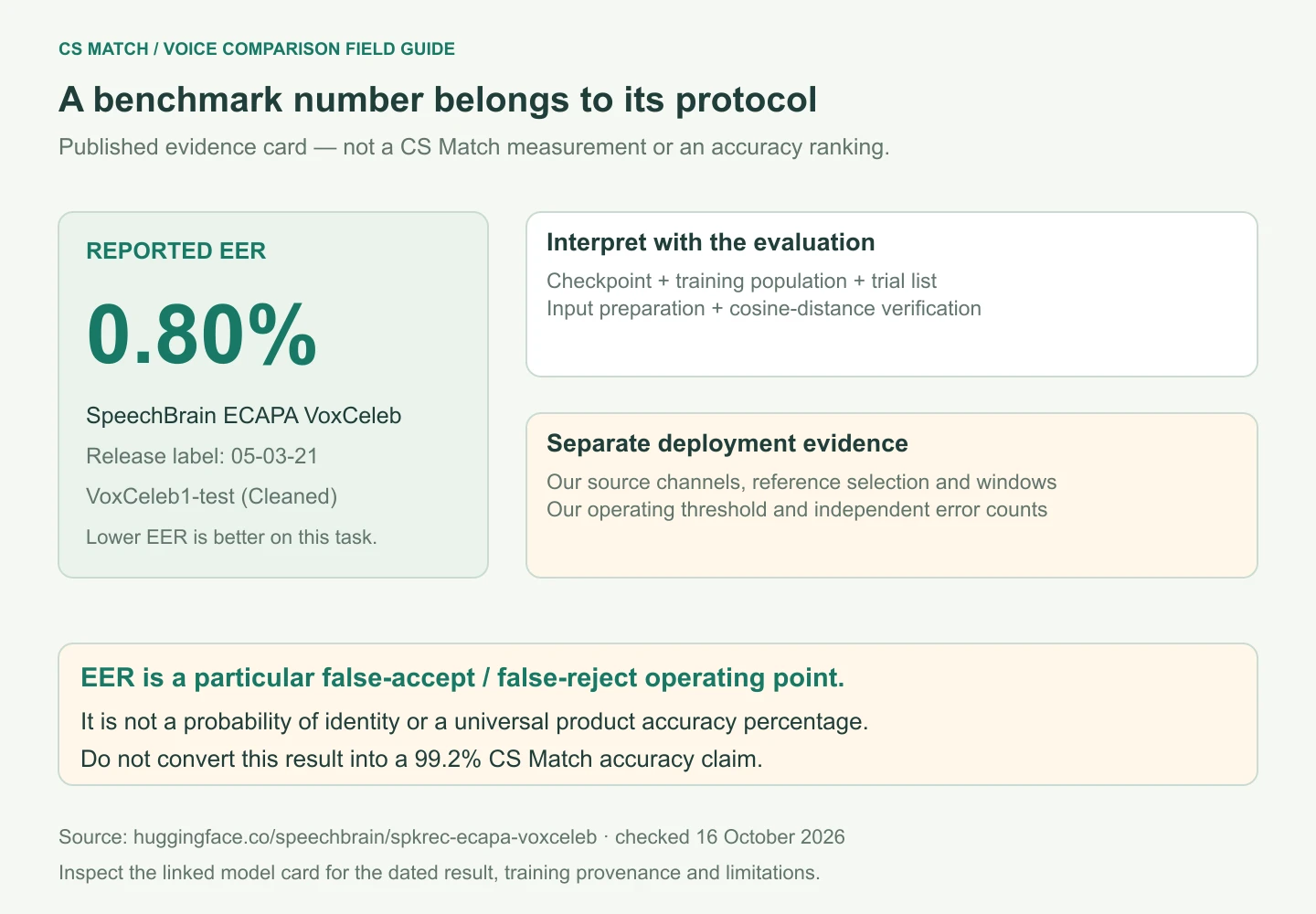
The SpeechBrain checkpoint card reports 0.80% equal error rate for its dated release on VoxCeleb1-test (Cleaned), with cosine-distance verification. It identifies training on VoxCeleb1 and VoxCeleb2 and links the training recipe. This is evidence about that released system under the stated evaluation, not a measurement collected from CS Match uploads or from a bank's telephone traffic.
Equal error rate summarizes the operating point where false-accept and false-reject rates meet, or are numerically estimated to meet. It does not say that every decision threshold has that error rate. Subtracting it from 100 and advertising 99.2% product accuracy would hide the trial population, decision rule and source conditions that made the reported number meaningful.
Use the result as a reproducible baseline reference, then measure what your workflow requires. Short references, mixed speakers, domain shifts and window aggregation can change the score distributions. A local evaluation should name its target and non-target trials, selected operating threshold and error counts. Keep benchmark evidence beside its protocol rather than attaching it to every feature that happens to use the same encoder family.
Decide whether adaptation is justified by independent failures
Before fine-tuning, establish a baseline on representative independent recordings and categorize its errors. A reference containing another speaker calls for source correction. An embedding generated by an unintended fallback calls for engine investigation. Neither issue is automatically evidence that the main model needs retraining. Adaptation is most useful when a repeatable domain problem remains after these checks.
If training is warranted, separate adaptation speakers and sessions from final evaluation according to the intended generalization claim. Preserve a broader baseline test so improvement on one narrow condition does not conceal regressions elsewhere. Track changes in reference construction and scoring as separate interventions. Otherwise a better result cannot be attributed confidently to the adapted encoder.
Include the option to retain the existing checkpoint. A smaller model, better reference instructions or a clearer insufficient-evidence state may solve the operational problem with less complexity. Fine-tuning brings maintenance costs: versioned weights, a compatible environment, renewed threshold selection and a repeatable evaluation. Those costs are justified by demonstrated improvements, not by the assumption that a customized model is inherently more suitable.
Pretrained inference still needs a precise input and output contract
The model card specifies 16 kHz single-channel input for its pretrained path. A file extension does not establish those properties. The application must decode and prepare the waveform consistently, preserve duration and time offsets, and reject unusable content. Supplying more samples or a different sample rate without the expected conversion changes what the model sees.
After encoding, record the engine and checkpoint that produced the vector. A shared dimension is not proof of a shared coordinate system. Updating weights can invalidate stored profiles even when an output remains 192 numbers long. A migration should regenerate compatible profiles or use a separately developed and validated mapping; truncating vectors is not a replacement for that work.
Runtime also belongs to the contract. Measure cold initialization, warm processing, memory use and failure behaviour on the intended host. Training resources and inference resources are separate questions. A pretrained encoder can be useful on CPU without implying that training the same model is cheap, or that concurrent requests will fit within an application's latency and memory budget.
What the current CS Match baseline does and still needs to prove
Our worker defaults to SpeechBrain's ECAPA VoxCeleb checkpoint on CPU. It encodes selected speech windows, normalizes the vectors and constructs a normalized reference centroid. Analysis windows are compared with that profile using cosine similarity. These choices give us an inspectable baseline with source times and supporting passages, rather than requiring a newly trained model for each reference.
There are important implementation boundaries. SpeechBrain failure can lead to librosa acoustic features and then a basic RMS representation; forced basic mode uses RMS directly. Those paths are not equivalent pretrained speaker encoders. Engine provenance must remain part of result interpretation. Our helper functions do not establish a learned mapping between those spaces or calibrated identity probabilities.
The defensible reason to retain this baseline is its fit to our two-recording review workflow and the ability to test improvements component by component. We have not established universal superiority over alternative encoders or banking systems. Independent target-domain trials, clear failure handling and compatible profile versioning are the evidence needed before making stronger deployment claims.
Questions about this workflow
Does uploading a reference train ECAPA again?
No. The current workflow runs a pretrained encoder and builds a reference profile from its outputs. Model training and per-upload reference construction are separate operations.
Does the published 0.80% EER mean 99.2% accuracy here?
No. It is a reported result on a named VoxCeleb trial protocol. Our recording conditions, windowing and decision policy need their own independent evaluation.
Can the current development recipe reproduce the historical checkpoint exactly?
Do not assume so. Preserve the historical code, configuration, data and artefacts; inspect changes before calling a new run an exact reproduction.
When should we fine-tune rather than change the reference?
First correct source and engine problems. Consider adaptation when representative independent trials show a repeatable domain failure and a controlled experiment can measure improvement without hidden regressions.
Continue with the next useful step
Speaker Recognition Libraries Compared: SpeechBrain, NeMo, WeSpeaker, Kaldi and pyannote
Compare five speaker-audio toolkits by task, checkpoints, training recipes, scoring, diarization, deployment contracts and evaluation, with the reasons behind the current CS Match baseline.
Speaker Embeddings Explained: From i-Vectors to ECAPA-TDNN and WavLM
Understand how speech becomes a speaker vector, how i-vectors, x-vectors, ECAPA, residual networks and WavLM differ, and why compatible checkpoints, aggregation and evaluation matter more than a vector label.
How Voice Comparison Works: From Recording to Reference Match
Follow the complete voice-comparison pipeline: source preparation, speech detection, windows, speaker embeddings, reference profiles, similarity scoring and source-linked review, with the current CS Match implementation explained.