
How Voice Comparison Works: From Recording to Reference Match
Follow the complete voice-comparison pipeline: source preparation, speech detection, windows, speaker embeddings, reference profiles, similarity scoring and source-linked review, with the current CS Match implementation explained.
Sources checked · Cyber Search MatchVoice comparison transforms speech from an analysis recording and a reference sample into compatible representations, then scores their resemblance over selected intervals. Its usefulness depends on the source, speech selection, model and decision policy together. Keep comparison separate from transcription and speaker grouping, inspect the supporting passages, and treat a strong score as a technical result rather than a verified identity.
Define the comparison task before interpreting a match
Comparing two supplied recordings is different from identifying an unknown person among a database of enrolled voices. Searching a long conversation for passages resembling one reference is another variation: many candidate windows are examined, and the result includes when the resemblance occurred. These tasks share components but require different evaluation units and acceptance policies.
Text-independent comparison does not require the two people to say the same phrase. That does not mean language, spoken content or duration have no effect. A short utterance may contain limited acoustic variety, while a noisy passage can emphasize the channel more than the intended voice. Specify the conditions the comparison is meant to handle before choosing a threshold.
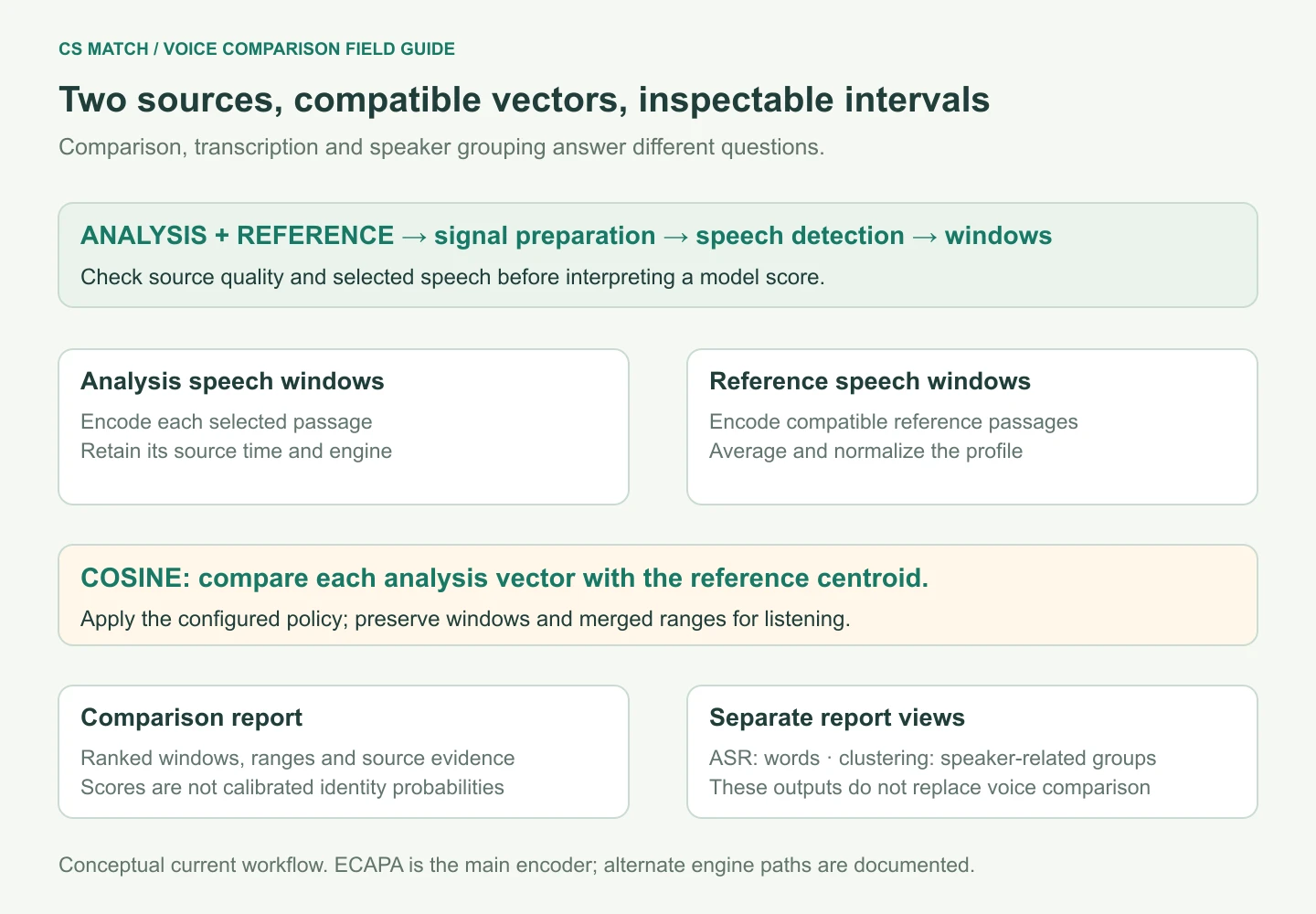
CS Match's current workflow takes one analysis source and one reference source. It locates technical resemblance within the submitted material and connects results to time ranges. It does not search a public voice-identity index or supply a bank's enrollment and authentication process. This boundary makes the report useful for reviewing recordings without silently expanding its meaning.
Prepare a consistent signal while preserving source context
An uploaded audio or video file is a container for a particular recorded signal. The worker extracts and prepares mono audio at 16 kHz for its speech-processing path. Resampling changes the representation used by the models; it does not restore frequencies removed by a telephone channel or detail lost through clipping, noise or repeated compression.
Inspect source quality before interpreting a score. Duration, channel count, energy, detected speech and clipping describe different aspects of the input. A loud file can still contain little usable speech, and a long file can be dominated by music. Keep the original available when you need to check what the extracted working track contains.
Times belong to the submitted or extracted recording, not automatically to a wall-clock event. If the source was trimmed or assembled before upload, record those changes when relating report intervals to another copy. A technically reasonable comparison becomes harder to review when its reference, source offset or surrounding conversation has been lost.
Speech activity detection chooses what reaches comparison
Voice activity detection estimates where speech occurs. Silero VAD provides speech timestamp extraction; it does not determine whether the speech belongs to the reference speaker. In the current worker, VAD output feeds subsequent speech-region and window construction. A missed quiet phrase or a retained background voice can therefore affect the evidence available to comparison.
Distinguish detected speech from intelligible or single-speaker speech. A detector may retain overlapping voices, and an audible voice may be too weak or distorted to provide a stable representation. Check selected intervals against the sound instead of treating a high speech proportion as a general quality certificate. Silence removal is useful, but not a complete source assessment.
A configuration change at this stage changes the candidate population. More permissive detection can include useful quiet speech and more unwanted material at the same time. Evaluate the full result on representative recordings and retain the VAD engine information. The code also supports an energy-based fallback, which should not be described as identical to the neural detector.
Windowing balances local evidence against duration
The worker constructs speech windows rather than comparing every sample independently. Its default window settings use a two-second minimum, a five-second maximum and half-second overlap, with additional speech-region handling. These are processing choices that can be configured; they are not universal durations required for reliable speaker recognition or a guarantee that every resulting window contains one person.
Longer windows can provide more phonetic variety but may cross a change of speaker. Shorter windows can localize a resemblance more closely while offering less stable evidence. Overlap reduces hard boundaries, yet neighbouring windows then share recorded speech. Several adjacent high scores can reflect one underlying passage rather than several independent observations.
For an invented example, windows covering 10–14, 13–17 and 16–20 seconds each have four-second duration. Adding their lengths gives twelve seconds, but their combined covered interval is ten seconds. This arithmetic illustrates overlap only; these are not the current default window boundaries or measured matching results. Preserve individual windows and their time relationships when reading summaries.
Invented intervals: [10,14), [13,17), [16,20). Sum of lengths = 12 s; union = [10,20) = 10 s.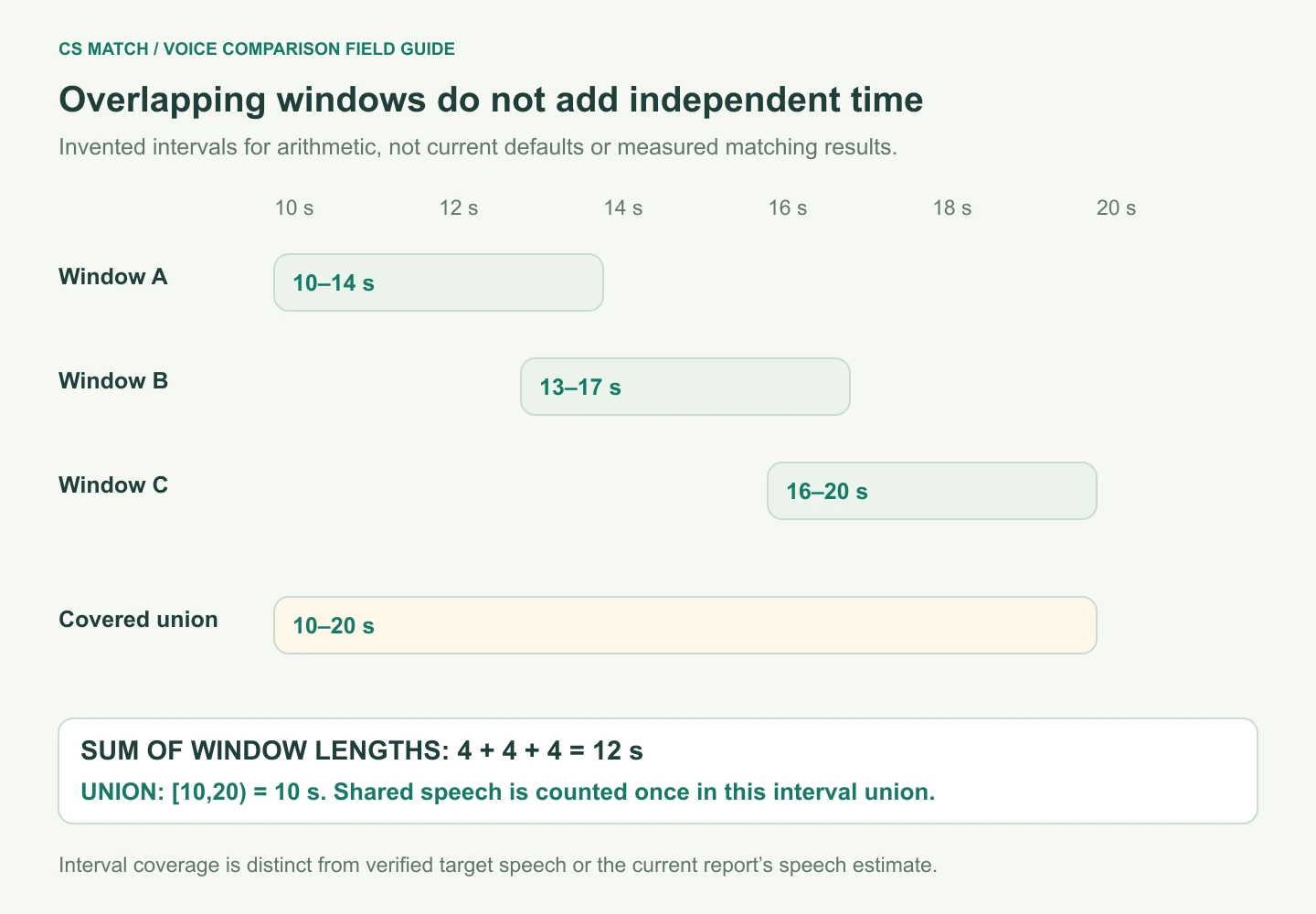
Encode each selected passage with a speaker model
A speaker encoder maps a variable-duration speech passage to a fixed-dimensional vector. The intended representation emphasizes information useful for comparing speakers while tolerating some variation in wording and recording conditions. It is learned from data, so its behaviour depends on the trained checkpoint and the population and channels used to evaluate it.
The main configured path uses SpeechBrain's pretrained ECAPA-TDNN checkpoint, with CPU inference and normalized output vectors. The checkpoint's model card describes speaker embeddings and its VoxCeleb training context. That establishes what component is selected, not a measured accuracy for CS Match's full pipeline on arbitrary uploaded calls or multilingual conversations.
Keep the model and preprocessing compatible between reference and analysis. A vector of the expected length is not enough if a different engine generated it. Representation, normalization and score scale belong together. Inspect the recorded engine when diagnosing an unexpected result before assuming that a change in speaker or source quality alone explains the score.
A reference profile summarizes selected reference speech
The current reference profile averages available window vectors and normalizes the resulting centroid. It also records window counts and dispersion-related diagnostics. This supports comparison with several reference passages rather than relying exclusively on one crop, but it remains a summary of the supplied sample. The application does not independently establish who provided that sample.
If the reference contains two different voices, the centroid can lie between their representations. Even one speaker can produce a heterogeneous reference through edits, distant microphones or changing background conditions. Review what speech entered the profile and whether it serves the intended comparison. More reference duration is helpful only when the added material improves relevant evidence.
A reference-to-itself diagnostic describes consistency under the current representation. It is not an independent test of distinguishing different people. A sample containing multiple speakers can also contain passages that score highly against themselves. Use a clean intended voice and inspect several source passages before interpreting a very strong headline result.
Score windows against the reference using a defined rule
For each analysis window, the current implementation computes cosine similarity to the normalized reference centroid. It also calculates the strongest similarity to individual reference windows as an additional diagnostic. The main window score is the centroid comparison; the existence of another diagnostic should not be mistaken for an undisclosed blend of scoring algorithms.
Cosine compares vector direction after accounting for vector magnitude. Its mathematical range is not a calibrated identity-probability scale. Two implementations can use different preprocessing, embeddings and score normalization even if both call their output similarity. Read the actual score definition and the source conditions before comparing numbers between products or model versions.
Retain the supporting interval when ranking windows. A maximum tells you which selected window scored highest, not whether every speaker in the recording resembles the reference. Longer recordings create more opportunities to obtain an extreme score. Evaluate this search behaviour using full recordings and independent references rather than a collection containing only preselected best matches.
Thresholds organize results; calibration needs evidence
The worker uses configurable thresholds to place scores into technical-similarity categories and select windows for merged ranges. These categories are application rules. A cutoff such as the current default possible-similarity threshold does not mean the system has measured that numerical probability of the reference speaker being present in an arbitrary upload.
A lower threshold can retain more candidate passages and more irrelevant resemblance. A higher threshold can suppress incorrect candidates and useful quiet or short passages. Measure both errors under a defined task. NIST's speaker-recognition evaluation plan specifies trials and detection-cost measurement, illustrating why a declared protocol matters when making performance claims.
For recorded review, keep uncertain and disagreeing passages inspectable. If a policy is tuned, use separate development and assessment material and record its model version. A successful self-comparison or an attractive example cannot establish a general acceptance threshold. The present report does not supply a calibrated probability that the complete task has identified a person.
Read merged intervals and coverage with their definitions
The current implementation groups qualifying windows when they overlap or fall within the configured merge gap. A merged interval extends from its first retained start to its latest retained end. It can therefore contain a short intervening gap. Its duration is a navigational span, not necessarily an exact annotation of uninterrupted target-speaker speech.
The report also summarizes the strongest score, the median of up to five strongest scores and matched-speech coverage. These use different calculations and answer different questions. Coverage is derived from retained windows and estimated speech, with bounds applied by the implementation; it is not an independently labelled measure of how long a verified person actually spoke.
Listen within and around the displayed range, especially near interruptions and edits. Keep merged spans separate from the underlying windows when counting observations or preparing notes. The best score can come from one short region, while the rest of the conversation remains unrelated. Reading both levels prevents one favourable passage from becoming a claim about the entire recording.
Transcription and diarization add separate views
Transcription estimates words; diarization groups speech into speaker-related turns; reference comparison measures resemblance to a supplied voice. The current worker uses faster-whisper for transcription and its own window-embedding clustering for speaker groups. It does not use Whisper's text output as a substitute for speaker embeddings or silently treat numbered clusters as enrolled identities.
The dialogue view associates transcript intervals with speaker windows. Those boundaries can disagree, particularly with overlapping speech or a short interjection. Review the sound around a label change instead of interpreting Speaker 1 as a persistent real-world identity. Supplying a known speaker count constrains grouping, but does not make the assignment infallible.
These complementary views help locate evidence: text finds a topic, speaker turns organize the conversation, and similarity highlights candidate passages. An ASR error does not by itself prove a comparison failure, and a clear transcript does not prove correct grouping. Diagnose the stage that answers your actual question before changing unrelated settings.
Use the report as an inspectable evidence trail
Begin with the analysis and reference sources, then inspect quality, candidate windows and surrounding sound. Check whether the reference predominantly contains the intended voice and whether a high-scoring analysis window spans another participant. The acoustic charts can suggest noise or changing conditions, but a similar pitch curve or spectrogram shape is not a separate identity test.
The existing product screenshot uses the same recording as both sources. That demonstrates where metrics and controls appear, while naturally favouring very strong similarity. It is not an independent recognition benchmark. For a meaningful assessment, use different recording sessions from the intended speaker and comparison material from other speakers under relevant conditions.
Keep the original context when documenting a finding. Note the source names, selected intervals, model or engine information and anything uncertain about the audio. The current workflow supports inspection within its report; it does not add a public voice search, verified enrollment, transcript editing or an automatic bank authentication decision.
| Report element | Useful question | What it does not establish |
|---|---|---|
| Best window | Where is the strongest selected resemblance? | Identity throughout the recording |
| Merged range | Which nearby candidates can I review together? | Exact uninterrupted target speech |
| Speaker label | Which windows were grouped in this job? | A verified name |
| Transcript | What words may have been spoken? | Who spoke them with certainty |
Check the actual engine and current limitations
The code supports fallback paths when a main component is unavailable. After a SpeechBrain failure, it can try librosa-based acoustic summaries; if that path fails or a forced basic mode is selected, it can use RMS-derived features. These are different representations from ECAPA embeddings. Continued processing does not establish equivalent speaker-comparison quality.
Read the engine information associated with the task and its windows. A robust evaluation should distinguish main-model results from degraded-mode output and verify that compared vectors come from compatible representations. This article describes the current code paths; it does not claim a newly implemented cross-engine calibration or a completed accuracy study for every fallback configuration.
The practical next step is a short representative two-source task with useful reference speech. Inspect the result before increasing duration, and preserve unresolved outcomes when the source is insufficient. The strongest justification for this modular workflow is traceable intermediate evidence and targeted improvement. Any claim of better accuracy requires a separate matched evaluation on the recordings it is intended to serve.
Questions about this workflow
Is voice comparison the same as speech recognition?
No. Speech recognition estimates words. Voice comparison uses speaker-related representations to score resemblance between sources. The current report provides both views through different components.
Do repeated matching windows provide independent confirmation?
Not necessarily. Overlapping or adjacent windows share recorded speech and can repeat the same channel or background effect. Retain their time relationships and inspect the source.
Why does comparing a recording with itself produce a very high score?
It repeats the same captured evidence. This checks a particular processing path but does not measure the ability to distinguish independent recordings or different speakers.
Does every completed task necessarily use ECAPA embeddings?
No. The worker has alternate acoustic and basic feature paths. Inspect the reported engine; those outputs should not be represented as equivalent to the main pretrained speaker model.
Continue with the next useful step
Speaker Embeddings Explained: From i-Vectors to ECAPA-TDNN and WavLM
Understand how speech becomes a speaker vector, how i-vectors, x-vectors, ECAPA, residual networks and WavLM differ, and why compatible checkpoints, aggregation and evaluation matter more than a vector label.
What Voice Similarity Scores Mean
Understand best score, top 5 median, matched speech, speaker summaries and technical similarity labels without treating them as identity probabilities.
How to Read an Audio Analysis Report
Understand source players, quality indicators, transcripts, speaker groups, voice similarity and signal charts in the current Audio Analysis report.