
How to Choose a Reference Voice Sample
Choose a useful voice reference: one speaker, sufficient usable speech, independent recordings, appropriate channels and source context. Understand the current CS Match profile and its limitations.
Sources checked · Cyber Search MatchChoose a reference with clearly audible speech from the intended speaker, little overlap, natural delivery and a documented source. Judge usable speech rather than file length. Keep evaluation recordings independent, preserve an original copy, and inspect the passages that form the profile. A reference is an input to a defined comparison system; a longer or louder file is not automatically a better representation of a person.
Define what the reference is supposed to represent
A reference sample supplies speech against which other recorded speech will be compared. It is not a transcript prompt or a list of words to find. In a text-independent workflow, the two sides do not need identical sentences. The useful question is whether the reference contains representative information about the intended voice under conditions relevant to the comparison.
Decide whether you are reviewing one conversation, locating similar passages in another recording or assessing a repeatable operational process. Those goals require different evidence. A convenient excerpt may help navigate one file without supporting a claim about performance across new calls. Write down the intended task before choosing the excerpt so the easiest available recording does not silently redefine the question.
The current CS Match wizard takes an analysis source and a reference source. It builds a profile from the reference and scores analysis windows against that profile. It does not enroll a verified customer or search a public voice-identity database. This boundary helps you select an appropriate sample and interpret the report as source-linked technical resemblance.
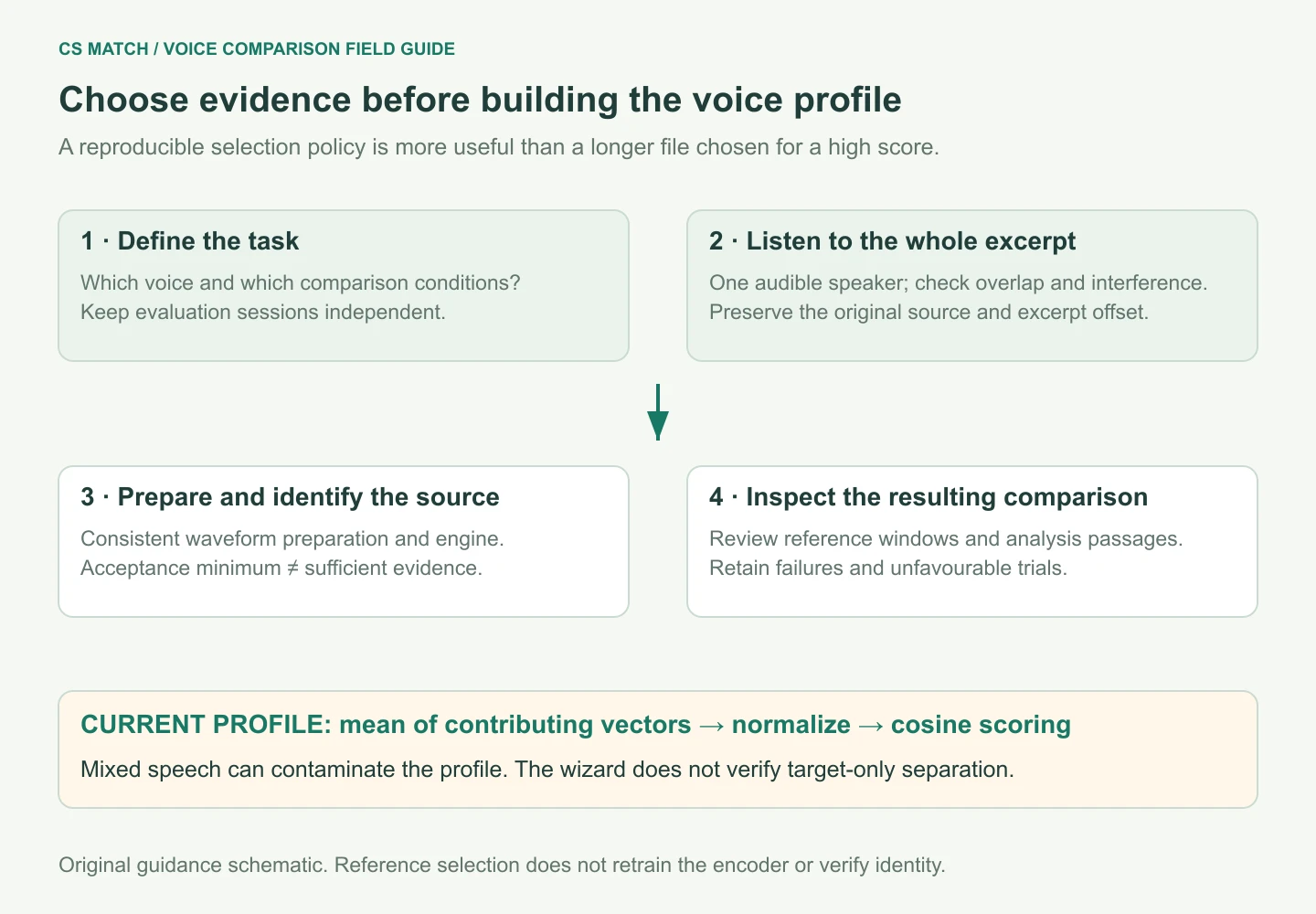
Prefer one clearly audible speaker over a longer conversation
Listen through the proposed reference, including its beginning and end. An interviewer, announcement or background television can introduce another voice even when the file is named after the intended speaker. Overlap is especially problematic because both voices occupy the same time. A speech detector identifies speech activity; it does not certify that every retained moment belongs to your target.
Choose a passage in which the intended person speaks continuously and other voices are absent or clearly separated. Avoid a lively exchange merely because it contains more total speech. If you prepare an excerpt outside the application, keep its original source and offset. The current upload flow should not be described as a dedicated reference editor with automatic target-only extraction.
When every available passage contains interference, record that limitation rather than silently treating the mixture as a clean standard. Trying several plausible references can reveal sensitivity, but selecting whichever produces the highest desired score would bias interpretation. Decide how references will be selected before reviewing their match results, and retain cases where no adequate sample is available.
Count usable target speech, not container duration
A thirty-second file may contain only a short greeting followed by silence. Another file may contain abundant speech from several people. Neither duration alone tells you how much useful reference evidence exists. Distinguish total recording length, detected speech and speech that is both attributable to the intended voice and sufficiently clear for the task.
The worker's default acceptance minimum is three seconds of detected reference speech. That is a configurable processing gate, not a validated guarantee that three seconds are sufficient for every comparison. Passing it does not resolve overlap, channel mismatch or an unusual speaking style. Conversely, adding silence to an inadequate reference does not add relevant speech information.
In the invented timeline below, a thirty-second file contains four seconds of clear target speech, six seconds of mixed speech and twenty seconds of silence. Even if a detector retained all ten speech seconds, only four meet the example's clear-target criterion. These durations illustrate different denominators; they are not actual detector output, recommended limits or measured recognition performance.
Invented file: 4 s clear target + 6 s mixed speech + 20 s silence = 30 s total.Detected speech could include 10 s; clear target speech in this example is only 4 s.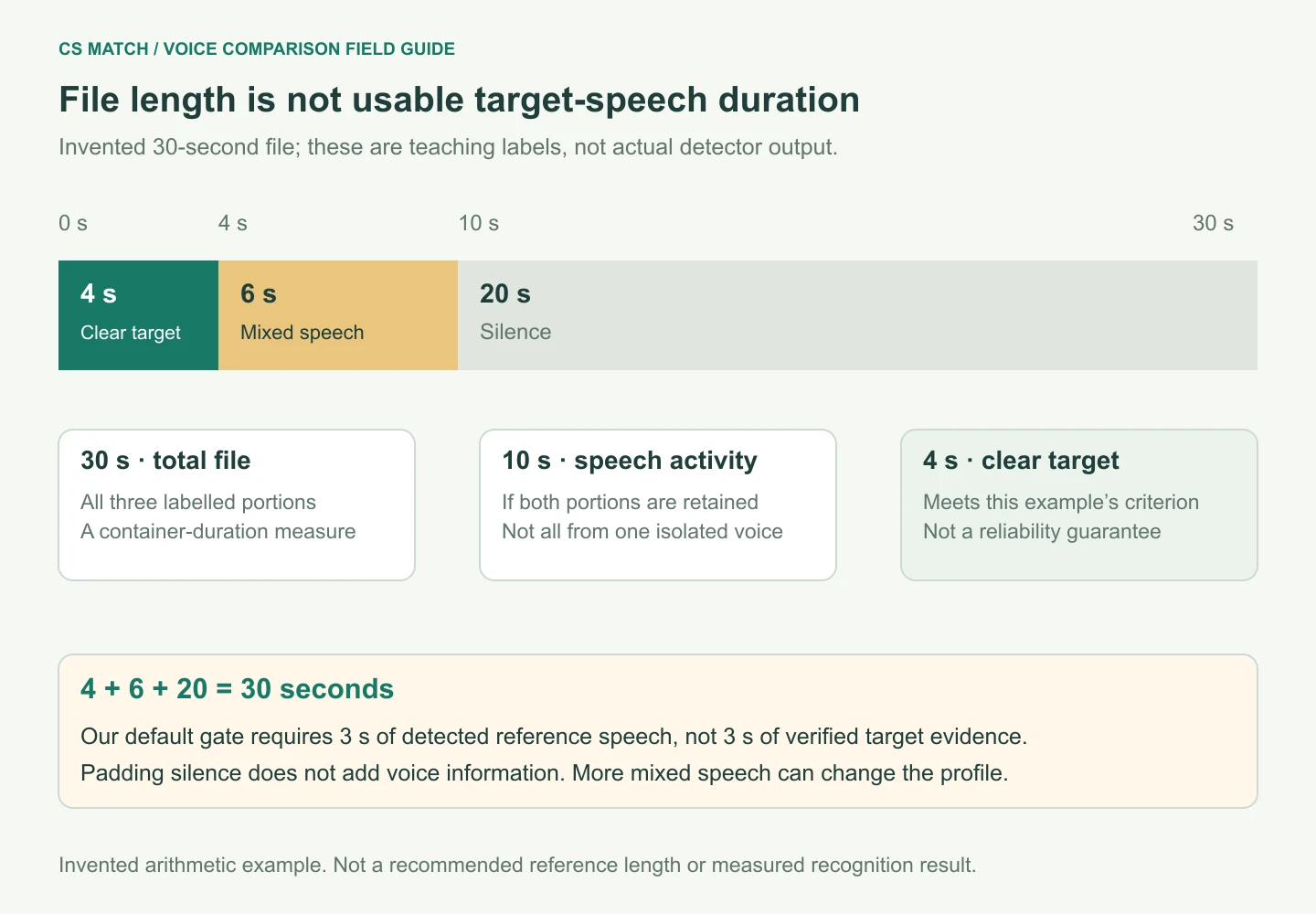
Use natural speech with some variety, without scripting a magic phrase
A repeated short word offers less variety than several natural phrases. When recording a new reference, let the speaker use an ordinary pace and comfortable voice, with more than one sentence if practical. Avoid turning this into a prescribed universal duration or vocabulary. The best amount of speech depends on the model, task and recording conditions and should be evaluated.
Prefer material that resembles the delivery you expect to compare. Shouting, whispering, laughter and sustained singing can change the acoustic evidence substantially. A sample consisting mainly of those sounds may answer a different question from ordinary conversational speech. If expressive speech is the actual target condition, include it deliberately in evaluation rather than assume a neutral reference covers it equally well.
The current encoder is a pretrained text-independent speaker model; the reference does not teach the transcript system new names or vocabulary. Clear wording can help a listener inspect content, but intelligible text and stable speaker evidence are separate properties. Check both when selecting a sample, and avoid using a good transcript as proof that a voice comparison must also be reliable.
Capture a clean reference without overproducing it
For a new recording, begin with a quiet setting and a microphone position that remains reasonably stable. Make a short trial and listen for rubbing, breath blasts, distant voices and overload. Move the microphone or adjust recording level when necessary. These straightforward checks address the captured evidence before software has to work around avoidable interference.
Keep the voice comfortably audible without forcing the waveform to the largest possible level. Increasing gain raises background sound as well as speech, and overload can alter the waveform. A recording that sounds louder is not necessarily more informative. Check ordinary phrases and stronger syllables, because a level that works during a quiet introduction may fail during emphatic speech.
Retain the original capture when possible and note how the submitted version was prepared. A studio-quality reference is not always representative of a telephone task, but deliberately degrading it without a defined experiment is not a solution either. Start with a clean, documented source, then investigate channel mismatch through controlled comparisons rather than aesthetic judgments about how polished the file sounds.
Treat channel similarity as an evaluation condition
A close microphone and a telephone recording can capture the same speaker differently. Matching channel types may reduce one source of mismatch, but the same device name does not guarantee identical processing. Applications can change noise suppression, microphone routing and codec settings. Note the actual acquisition path when known, and keep unknown processing history visible in the evaluation record.
Where several valid references exist, compare their behaviour on independent test recordings chosen in advance. Include both similar-channel and different-channel cases if both matter to the application. NIST's SRE21 plan explicitly separates source types and includes matched and mismatched conditions. That is a useful model for defining evaluation, not a promise that our workflow reproduces its results.
Do not choose a reference merely because its background noise resembles the analysis recording. Shared music, room sound or repeated source material can create misleading dependence. A channel-aware selection policy should still prioritize the intended speaker and independent evidence. If a reference works only for one capture route, describe that scope instead of presenting it as a universally transferable voice standard.
Prepare the file while preserving its information and time mapping
Use a decodable source with speech that remains audible after preparation. The worker's analysis path prepares mono audio at 16 kHz for subsequent processing. This normalizes the expected representation, not the quality of the original capture. Upsampling a restricted signal does not recreate lost frequencies, and converting an already compressed source to a larger file does not restore discarded detail.
If you trim externally, save a working copy and record the offset from the full source. Avoid concatenating isolated syllables or rearranging phrases to manufacture a reference. Such editing changes temporal context and complicates review. A straightforward continuous excerpt is easier to relate to the original and to compare consistently across later runs.
Test any enhancement as a separate version, keeping the unmodified reference for comparison. Denoising, equalization and level processing may improve listening while changing model evidence. Do not repeatedly process the file until a desired score appears. Define what the change is intended to fix, apply it consistently and evaluate its effect on independent target and non-target trials.
Understand how the current reference profile is assembled
The worker encodes selected reference windows and computes their arithmetic mean, then normalizes that centroid. This gives each contributing vector an equal contribution to the mean before final normalization; it is not an explicit weighting by speech quality or speaker certainty. The selected windows therefore matter as much as the fact that a profile was successfully generated.
A mixed reference can pull the centroid toward several voices. A changing channel can also make its windows less consistent. Adding more material is helpful only when the additional evidence is appropriate for the task. It can instead amplify an unwanted voice or repeatedly represent the same contaminated passage, especially when neighbouring windows overlap.
The profile stores window information, engine provenance and consistency diagnostics. Those diagnostics describe vectors within this processing setup; they do not certify a known identity or prove reference purity. The main comparison score uses the centroid, while the strongest individual reference-window score is retained separately. A strong individual resemblance does not replace the profile's main rule or repair an unsuitable sample.
Keep an independent reference when evaluating accuracy
Comparing a recording with itself is useful for checking that upload, processing and report navigation work. It is not an independent demonstration that the system distinguishes people. Cropping two adjacent passages from the same session can still share the microphone, room and background. Describe such checks as workflow checks or same-session conditions rather than broad verification evidence.
For a meaningful performance study, use separate sessions when that matches the deployment question. Include different-speaker comparisons as well as same-speaker ones, and decide the trial list before inspecting results. Otherwise a collection of favourable similarities can look persuasive while saying little about false matches or difficult target recordings.
Keep reference selection separate from final evaluation. If you try ten excerpts and retain the best-performing one on the final test set, that set has influenced development. Use a development portion to choose the policy, then assess it on untouched trials. This procedure does not require a huge study to be useful, but it does require honest boundaries around what was selected and measured.
Use the report to investigate the reference, not only the match
Begin with the reference player and the source-quality summary. Check whether the recorded voice is the one you intended and whether detected speech corresponds to meaningful passages. Inspect obvious silence, overlap or clipping alongside the quality indicators. A single summary number is not a substitute for listening to the intervals that contributed to the profile.
Then compare several analysis windows, including lower-scoring passages and boundaries around stronger ones. If the reference contains a brief unwanted speaker, examine whether favourable windows correspond to that voice rather than the intended target. The current diarization groups are recording-relative estimates; they do not automatically assign a verified identity to either the reference or a numbered speaker.
Check engine information when results look unexpected. The preferred SpeechBrain path can fall back to acoustic features and then a basic RMS representation. These are different representations, not equivalent ECAPA checkpoints. A result produced in a degraded path should trigger a processing investigation before you conclude that the speaker changed or that a new reference-selection strategy failed.
Compare candidate references with a fixed small experiment
Suppose you have two clear references: one recorded through a call service and one through a nearby microphone. Keep them separate. Compare each against the same preselected analysis passages, including independent same-speaker and different-speaker cases. Record source conditions and failures. This tests the effect of choosing a reference without simultaneously changing every part of the workflow.
Look for a pattern across conditions rather than the largest single similarity. A reference that raises both target and non-target scores may not improve separation. One that helps telephone trials but harms room recordings may be useful for a restricted policy. Retain these distinctions before choosing an operating threshold or describing one reference as better overall.
The current interface does not provide a multi-reference benchmark manager or automatic reference selection. You can inspect separate jobs and maintain an external experiment record. Keep filenames and preparation details unambiguous so the comparison can be repeated. If no candidate behaves adequately, preserve that outcome and investigate the source or processing instead of manufacturing a winner through selective reporting.
| Keep fixed | Vary deliberately | Inspect |
|---|---|---|
| Analysis trial set | Reference A versus B | Target and non-target behaviour |
| Encoder and score policy | Known capture channel | Failures and condition-specific changes |
| Source preparation rules | Documented excerpt choice | Independent sessions and source offsets |
A practical selection sequence for the current workflow
First identify the intended voice and a continuous passage where it is clearly audible alone. Listen to the entire excerpt, note its source and check that usable speech is not merely silence padding or a mixed conversation. If making a new recording, test the microphone and ordinary speaking level before capturing the final sample.
Next preserve the original and prepare a clearly named working file if necessary. Add the analysis and reference sources to the current wizard, confirm video-audio extraction when prompted and review the input pair. Remember that the minimum detected-speech check establishes processability, not adequacy for every task. An accepted file still needs contextual review.
Finally listen to the report's supporting passages and retain both favourable and unfavourable evidence. If the source is unsuitable, replace it for a documented reason and keep evaluation independent of that choice. A useful reference policy is reproducible: another reviewer should be able to understand why the sample was selected, what it represents and where its limitations begin.
Questions about this workflow
Is a three-second reference always enough?
No. Three seconds of detected speech is the default processing minimum, not a universal reliability guarantee. Usable single-speaker evidence, channel conditions and the intended task still require evaluation.
Should the reference and analysis contain the same words?
The current model is text-independent, so identical sentences are not required. Use natural representative speech and assess separate recordings rather than relying on repeated wording as proof of identity.
Is a longer reference always better?
No. Extra silence adds no voice evidence, and other speakers or unsuitable channels can contaminate the profile. Inspect the contributing speech and compare candidate references on fixed independent trials.
Can the application automatically extract only the intended person from a mixed reference?
Do not assume that. The current profile uses selected speech-window embeddings and normalized averaging; it is not a verified target-only separation or reference-editing service. Choose a clear sample and review the source.
Continue with the next useful step
Why the Same Voice Sounds Different Across Phones and Recordings
Explore how microphones, bandwidth, resampling, codecs, rooms, gain control and stereo handling affect speaker comparison. Learn to evaluate channel mismatch without confusing it with identity.
How Voice Comparison Works: From Recording to Reference Match
Follow the complete voice-comparison pipeline: source preparation, speech detection, windows, speaker embeddings, reference profiles, similarity scoring and source-linked review, with the current CS Match implementation explained.
Speaker Embeddings Explained: From i-Vectors to ECAPA-TDNN and WavLM
Understand how speech becomes a speaker vector, how i-vectors, x-vectors, ECAPA, residual networks and WavLM differ, and why compatible checkpoints, aggregation and evaluation matter more than a vector label.