
Why the Same Voice Sounds Different Across Phones and Recordings
Explore how microphones, bandwidth, resampling, codecs, rooms, gain control and stereo handling affect speaker comparison. Learn to evaluate channel mismatch without confusing it with identity.
Sources checked · Cyber Search MatchA recording contains the speaker plus the capture and processing chain: microphone, room, gain, bandwidth, codec and any later edits. Speaker embeddings aim to tolerate some variation, but that tolerance has limits. Compare independent recordings under declared conditions, keep signal preparation consistent, and investigate channel mismatch before interpreting a changed similarity score as a change of person.
A recorded voice includes more than its speaker
Speech reaches a microphone through a room or other acoustic environment, then passes through electronics, software and sometimes a communication network. The resulting file is evidence of that whole path. A headset call and a distant camera can therefore produce different signals for the same person, even when the spoken words and broad voice characteristics remain recognizable to a listener.
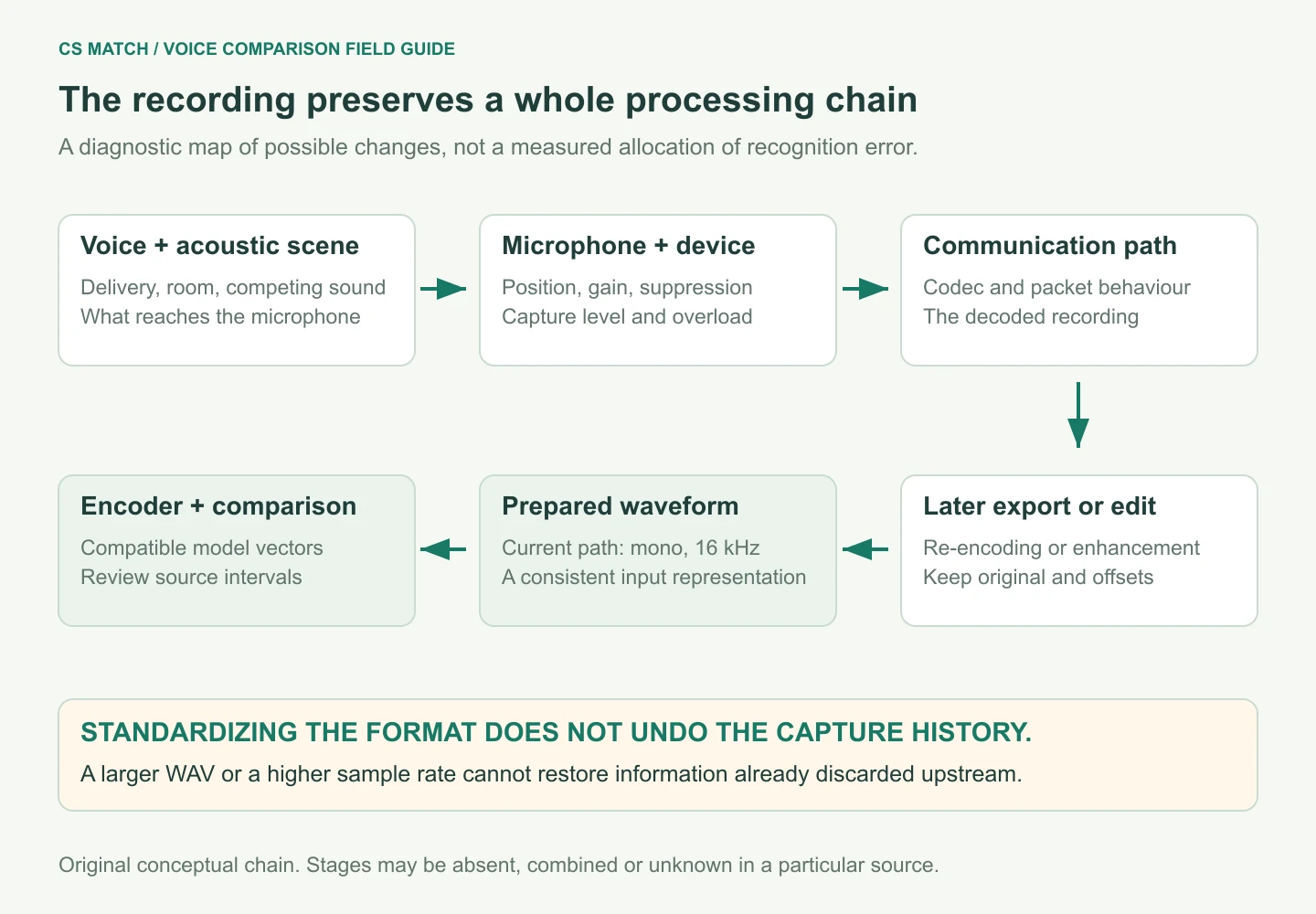
A useful conceptual chain separates capture, device processing, transmission and later export. Each stage can alter timing, frequency content or noise. Some changes are approximately linear, while clipping, adaptive suppression and codec decisions need more complex descriptions. Do not assume that one fixed equalizer can invert an unknown chain or recover information removed earlier.
Speaker models learn representations intended to emphasize speaker-related information despite some variation. That is an empirical capability, not a mathematical guarantee of channel invariance. When comparison fails, identify which recording conditions differ and test a specific explanation. The chain diagram is a diagnostic map; it does not allocate a measured amount of score loss to each component.
Separate captured bandwidth from the sample-rate label
Sample rate describes the time grid of the stored waveform. Captured bandwidth describes the frequency information that survived the microphone, filters and communication path. Those are related but distinct properties. A file saved at 48 kHz can still contain a restricted telephone signal; its high sample-rate label does not establish that higher-frequency voice information is present.
The current worker prepares mono audio at 16 kHz for processing. Resampling supplies the expected grid and uses filtering appropriate to the conversion. SciPy's resampling documentation provides a concrete example of upsampling, low-pass filtering and downsampling as separate operations. It does not claim that changing the rate reconstructs frequencies that the original source never captured.
If a narrow-band source compares poorly with a broader-band reference, converting both to the same file type is not sufficient evidence that the mismatch disappeared. Keep the source history and inspect the actual condition. Avoid repeatedly resampling intermediate versions. Prepare a consistent working signal from the best available original, and evaluate whether the remaining bandwidth difference matters to the selected model.
A codec name does not specify one fixed quality level
A codec compresses and reconstructs audio under particular settings. Its name alone does not identify bitrate, bandwidth, frame behaviour or the application's preprocessing. Opus, for example, explicitly supports several bandwidths and control parameters for interactive speech and audio. Two Opus recordings can therefore represent different operating conditions; the extension or codec label is not a complete quality description.
Lossy transcoding can alter an already reconstructed signal again. Exporting a compressed recording as an uncompressed waveform preserves the decoded version, not the original pre-compression detail. It can be useful for consistent processing without being a restoration step. Keep the earliest available source and avoid unnecessary encode-decode cycles between downloading, editing and uploading.
Network effects deserve separate attention. Lost or late packets can lead to concealment or interruptions in the rendered audio, depending on the system. The final file may not retain a complete record of those events. Listen for discontinuities and document the capture route when known. Do not infer a specific network problem solely from a low speaker similarity or a visually unusual spectrogram.
Microphone position changes the balance of voice and environment
A microphone close to the mouth receives a different balance of direct speech and surrounding sound from one across a room. Direction, movement, obstructions and device placement can change that balance during a recording. A phone held near the face, placed on a desk or switched to speakerphone should not be assumed to produce interchangeable reference evidence.
For a repeatable capture, keep the position reasonably stable and listen to a short trial. Check for rubbing against clothing, handling noise and strong breath sounds. Improving placement can address a problem at its source without introducing another transformation. The aim is an audible, representative voice, not the loudest possible waveform or a perfectly flat-looking frequency display.
Evaluate position changes as explicit conditions. If a close reference is compared with far-field audio, include that pairing in the test set rather than judging only close-to-close recordings. Device brands are poor substitutes for these observations. Two recordings from one device can differ substantially, while different devices can sometimes provide sufficiently comparable evidence for the intended model and task.
Reverberation is different from additive background noise
Room reflections spread speech energy over time and colour its frequency structure. Background noise adds other sound, while another talker introduces competing speech information. These effects can occur together but are not interchangeable. Lowering a noise floor does not necessarily remove reverberation, and detecting speech does not establish that only the intended person contributes to a window.
The VOiCES from a Distance Challenge was designed specifically around single-channel distant speech in noisy conditions for speaker recognition and ASR. Its existence illustrates why far-field evaluation is a distinct problem rather than a cosmetic variation of clean speech testing. It does not supply a performance guarantee for our encoder, our recordings or a particular enhancement method.
When investigating a difficult room recording, inspect a passage with clear turn boundaries and another with interference. Keep the original and any processed version separate. Report the microphone distance or room condition when known, without pretending to reconstruct an exact acoustic history from the file. A useful diagnosis narrows the plausible failure mechanism and identifies the next controlled comparison.
Loudness, automatic gain and clipping have different effects
Multiplying a nonzero embedding by a positive constant leaves its cosine direction unchanged. That mathematical property does not mean increasing waveform amplitude has no effect on the encoder. Signal preparation and feature extraction intervene before the vector exists. Treat recording gain, feature normalization and vector normalization as separate stages rather than interchangeable ways to make a comparison fair.
Automatic gain control can change level over time, sometimes raising background sound during quieter passages. Hard overload can flatten waveform peaks and alter the signal instead of simply making it louder. Reducing the volume of an already clipped file does not reconstruct its original peak shape. A quieter working copy may be easier to hear without restoring lost evidence.
Our quality summary includes a configured high-amplitude sample indicator labelled clipping percentage. Inspect it alongside the source: it is not a complete history of upstream overload, and a later attenuation can hide previously saturated peaks from that threshold. Avoid diagnosing capture quality from one number alone. Check emphatic syllables, quieter phrases and any transitions where device gain appears to change.
Noise suppression and enhancement need task-specific evaluation
A call application may apply suppression, echo control and other processing before saving audio. An editor can add further denoising or spectral shaping. These operations can improve intelligibility while changing fine structure used by a speaker encoder. Better listening quality is valuable, but it does not automatically establish better separation of same-speaker and different-speaker trials.
Keep an unprocessed baseline and define the purpose of a candidate transformation. If the problem is persistent fan noise, compare a documented denoising setting against the original on a fixed trial set. Include clean sources and non-target comparisons so an improvement in one difficult example does not conceal regressions or higher false similarities elsewhere.
The current product should not be described as automatically equalizing every channel or learning a mapping between enhanced and original voices. Its preparation and models provide a defined processing path with practical limits. If an external tool changes speed, pitch or timing, record that separately; the transformed file is a new condition and its report timestamps may no longer map directly to the original.
Two channels can contain two speakers, not a better mono signal
Some recordings place different participants on separate channels. Others use stereo microphones to capture one shared scene. These are different structures despite both being labelled stereo. Mixing separate participants into mono can introduce overlap that was not present within either individual channel. Inspect channel content before assuming a two-channel source is simply a higher-quality version of one voice.
The current worker prepares a mono working signal. It does not offer a per-channel target-selection workflow in the standard wizard. If separate channels are relevant, prepare and document appropriate working sources externally rather than assume the upload automatically chooses the intended side. Preserve the original channel arrangement and offsets so later review can relate the result to the capture.
Phase and balance can also matter when channels are combined. Opposite-polarity copies can partially cancel, while an uneven mix can emphasize one participant or background source. These are possibilities to investigate, not conclusions drawn from a disappointing match. Listen to the prepared signal as well as the original, and keep channel handling identical across repeated tests unless it is the factor being studied.
Distinguish channel changes from changes in how the person speaks
A different microphone is not the only reason two recordings differ. Speaking effort, pace, emotional delivery, illness or vocal strain can alter the observed speech. A clipped greeting and a relaxed conversation also provide different amounts and kinds of evidence. Record known circumstances where relevant, but do not infer a person's health or emotional state from an embedding or comparison score.
Language changes affect phonetic content as well. NIST's SRE21 plan includes same-language and cross-language trials alongside source-type conditions. That separation is useful because a cross-language comparison can also be cross-channel; changing both at once makes the cause of an error harder to localize. A text-independent model does not require identical words, but it still needs evaluation under the languages used.
Keep the interface language separate from speech recognition language and speaker comparison. Translating a report does not change the source waveform or establish model support for a new acoustic population. When testing delivery or language, hold the recording route stable where possible and use independent sessions. Attribute improvements to the declared condition rather than a vague claim that the system recognizes every voice equally.
Use a paired channel experiment to locate the mismatch
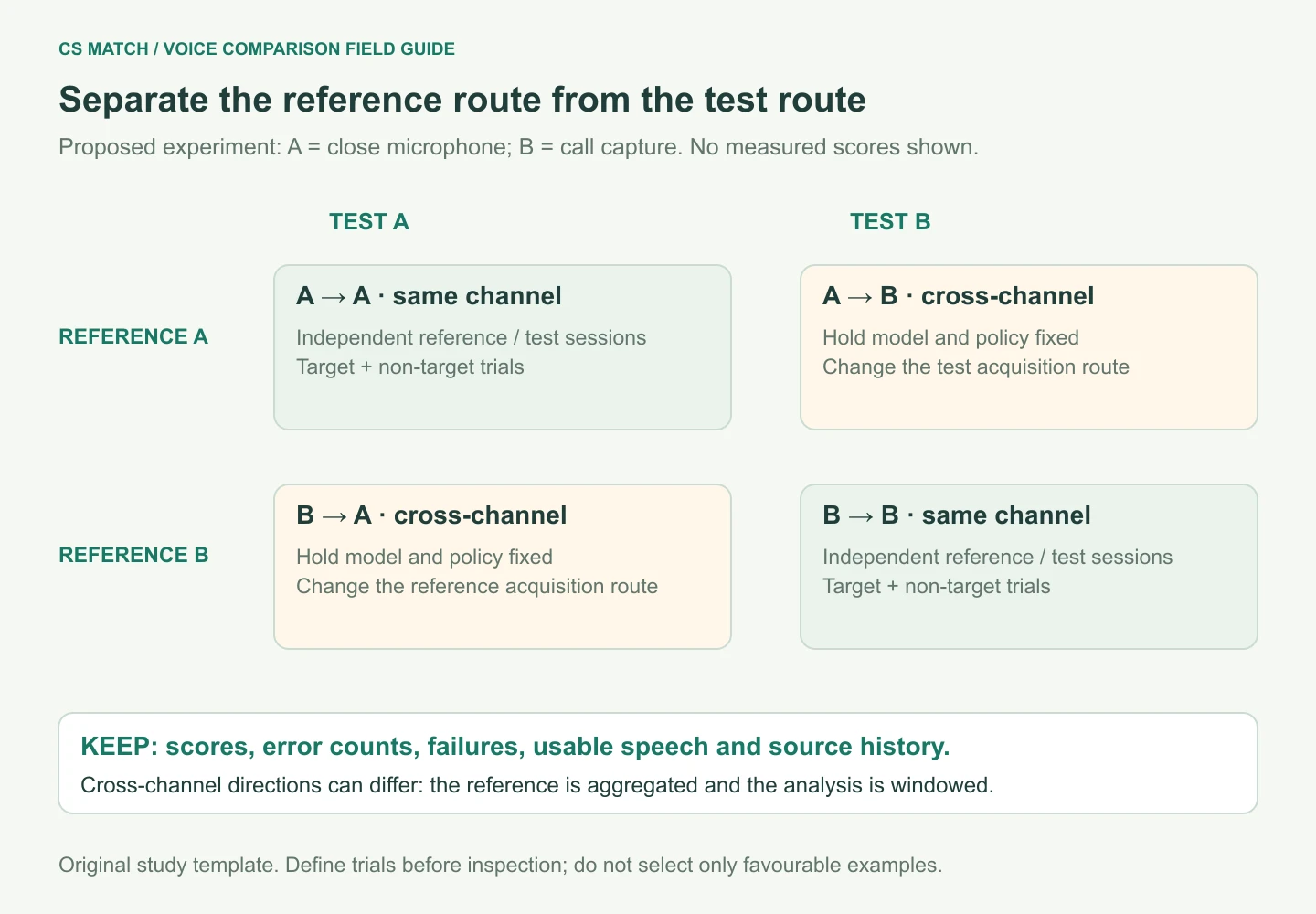
Choose a small set of independent recordings with known speaker relationships. For an illustrative design, define channel A as a close microphone and channel B as a call capture. Evaluate A-reference to A-test, A-reference to B-test, B-reference to A-test and B-reference to B-test. Use separate sessions on both sides; these labels describe conditions, not existing benchmark results.
Include target and non-target trials within the relevant cells and keep the encoder, reference rule and scoring configuration fixed. A shared rise or fall in all scores is different from improved separation. The two cross-channel directions can behave differently because the reference is aggregated and the analysis is windowed. Preserve that distinction rather than averaging away a useful diagnostic.
Also record failed jobs, usable speech and source selection. A candidate that looks strong only after difficult files are excluded has a different operational scope. The matrix below is a study template without invented accuracy numbers. Its purpose is to organize evidence before choosing a channel policy, not to imply that any cell is intrinsically reliable.
| Reference → test | Question | Evidence to retain |
|---|---|---|
| A → A | Independent same-channel baseline | Target/non-target scores and failures |
| A → B | Effect of changing the test route | Speech selection and channel history |
| B → A | Effect of changing the reference route | Profile composition and source quality |
| B → B | Second same-channel baseline | Separate sessions and consistent policy |
A changed score distribution is not solved by chasing a threshold
A threshold belongs to a defined model, preparation rule and trial population. Channel mismatch can shift target scores, non-target scores or both. Lowering the threshold after seeing missed matches may recover some target trials while accepting more non-target ones. Examine both error types before treating a more permissive setting as a quality improvement.
Our current comparison uses cosine scores to the reference centroid with configured buckets and matching policy. It does not supply calibrated identity probabilities or an automatic channel-specific decision model. The best individual reference-window score is a separate diagnostic, not a hidden correction for microphone or codec mismatch. Keep those meanings stable when reviewing different recordings.
If a channel-aware policy is proposed, choose it on development data and evaluate it independently. Avoid repeatedly adjusting the final test threshold until the examples look convincing. Preserve an insufficient-evidence outcome where appropriate. A useful review system can expose a difficult recording and its supporting passages without pretending that every channel problem can be converted into a confident identity decision.
What the current implementation handles and what remains empirical
The current path standardizes the working waveform, detects speech, creates windows and encodes them with a configurable SpeechBrain ECAPA checkpoint. It then averages reference vectors and scores analysis windows. This provides a consistent baseline and inspectable source times. It does not reconstruct an unknown recording chain or establish that microphone, codec and room effects have been removed.
Architectural attention and training augmentation can support robustness, but their benefit belongs to particular trained systems and evaluated conditions. The ECAPA paper describes its architectural mechanisms; our training guide separates those from checkpoint provenance and deployment evidence. A research result on one corpus should guide investigation rather than substitute for tests of the recording channels we actually accept.
For practical use, keep the best available original, choose a clear independent reference and inspect the prepared speech and engine information. For development, use the paired experiment to identify a repeatable failure before changing preprocessing, weights or thresholds. This order makes improvements attributable and keeps the report useful when a source remains too restricted or contaminated for a strong conclusion.
Questions about this workflow
Does converting both files to WAV remove channel mismatch?
No. It can standardize the container or decoded working representation, but it does not recover discarded bandwidth or undo microphone, room and codec effects.
Can the same speaker have a lower score on another phone?
Yes, recording and delivery conditions can affect the representation. Investigate the source and test declared channel conditions; a changed score alone does not establish a different person.
Should we always denoise before comparison?
No universal rule follows. Preserve the original and compare a documented enhancement against a baseline on independent target and non-target trials, including clean recordings.
Does the current system automatically calibrate for every channel?
No. It applies its configured waveform preparation, encoder and cosine policy. Channel-specific calibration, profile compatibility controls and independent deployment accuracy are separate engineering and evaluation tasks.
Continue with the next useful step
How to Choose a Reference Voice Sample
Choose a useful voice reference: one speaker, sufficient usable speech, independent recordings, appropriate channels and source context. Understand the current CS Match profile and its limitations.
ECAPA-TDNN and VoxCeleb: Training, Checkpoints and Real-World Limits
Understand ECAPA-TDNN training, VoxCeleb trial protocols, pretrained checkpoints, augmentation, reproducibility and the limits of applying benchmark results to real voice comparison.
How Voice Comparison Works: From Recording to Reference Match
Follow the complete voice-comparison pipeline: source preparation, speech detection, windows, speaker embeddings, reference profiles, similarity scoring and source-linked review, with the current CS Match implementation explained.