
Audio Preprocessing for Speaker Verification: What Helps and What Changes the Voice
Distinguish consistent audio preparation from filtering, denoising, dereverberation and separation. Preserve timing, inspect model contracts and evaluate whether transformations improve speaker comparison.
Sources checked · Cyber Search MatchPreprocessing should first make the signal decodable, compatible with the encoder and traceable to the original recording. Enhancement is an additional intervention that can change speaker evidence, timing or both. Preserve a baseline, document each transformation and compare independent target and non-target trials before declaring an improvement. Better listening quality alone does not establish better voice verification.
Start with the input contract and a preserved source
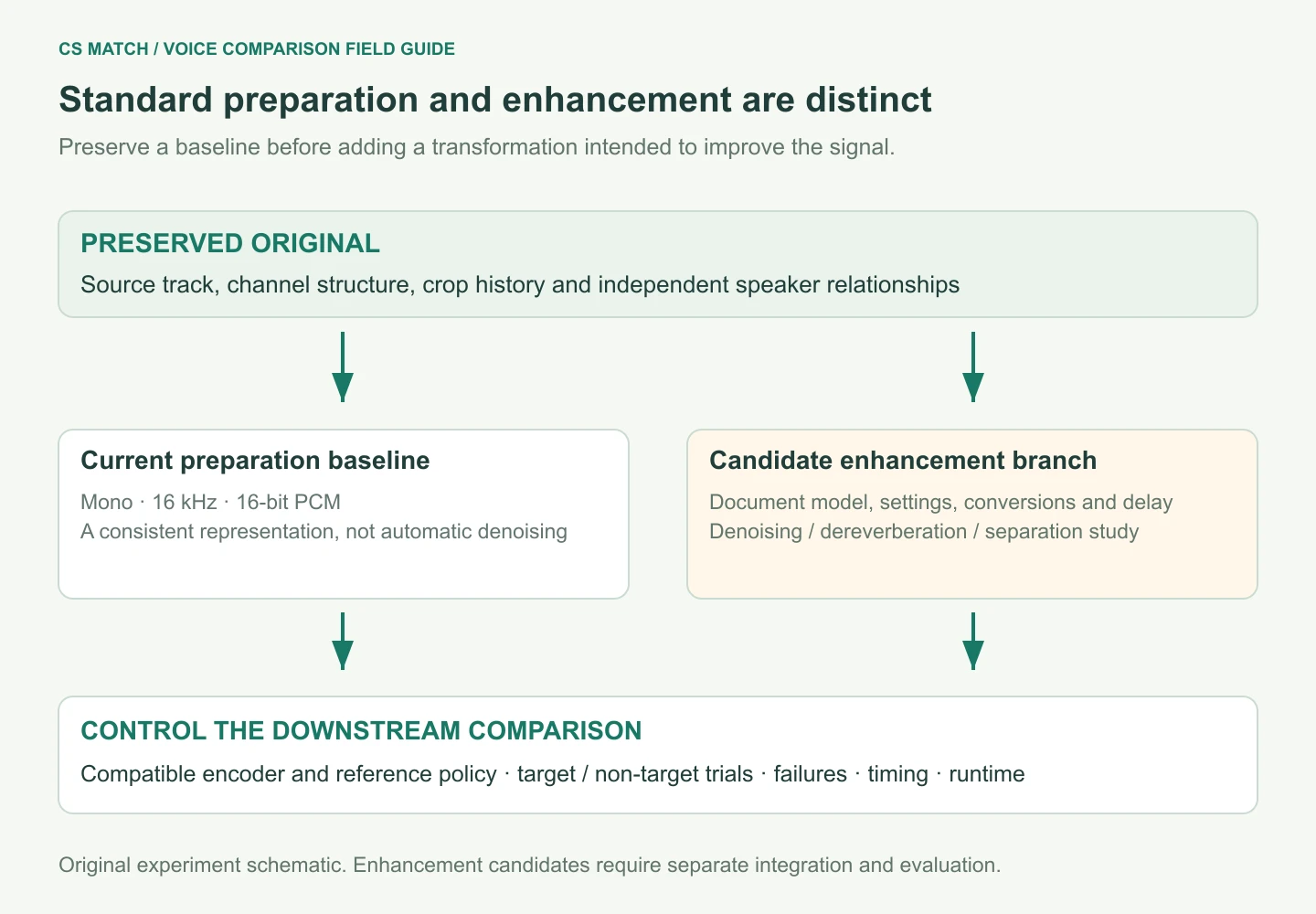
Preparation answers whether the model receives the signal it expects. Enhancement tries to improve some property of that signal. These purposes overlap operationally but should remain distinct in an experiment. A resampled working waveform and a denoised estimate are different artefacts, even when both are saved with the same extension and accepted by the application.
Our worker prepares a mono, 16 kHz, 16-bit PCM waveform from the uploaded source before its analysis stages. The function name normalize does not imply a loudness-normalization or enhancement service. This path standardizes a representation for processing; it cannot certify that only one speaker is present or reconstruct detail missing from the original capture.
Keep the original and identify the working version by its preparation rules. Record source channel selection, crop offsets and any later transforms so report times and results remain interpretable. When testing a proposed change, retain the current preparation path as a baseline. Without it, a cleaner-sounding output can be mistaken for an improvement whose effect on comparison was never measured.
Decode, handle channels and resample deliberately
A container extension does not specify the audio stream's codec, channel structure or actual speech content. Verify that decoding produces the intended track before investigating a model score. If the source has separate participants on separate channels, a mono combination is a substantive decision. It can introduce mixed speech even when each original side was relatively clean.
Resampling changes the sample grid using filtering appropriate to the conversion. SciPy's polyphase documentation illustrates the upsample, filter and downsample sequence. It is not a bandwidth-restoration algorithm. A restricted telephone signal converted to 16 kHz still carries the limitations of its capture path. Repeated intermediate resampling adds processing without creating new speaker information.
Choose a consistent preparation route from the best available source, and listen to the resulting waveform. Check duration, silence and channel balance before encoding. Keep these rules fixed when testing another transformation. Otherwise a denoising comparison can quietly become a comparison of different tracks, sample rates or participants, making any apparent benefit difficult to attribute.
Preserve the relationship between processed time and source time
Cropping changes the origin of a recording's timeline. With a single continuous excerpt and no timing transformation, an offset is enough to relate report time to source time. In an invented example, a crop beginning at 12.5 seconds has a report event at 7.25 seconds; the event belongs at 19.75 seconds in the full original.
Removing internal silence creates a different problem. Later samples shift by the amount removed before them, so one constant offset no longer describes the whole file. Concatenating several excerpts similarly needs a piecewise mapping. Keep an edit log if that preparation is necessary and preserve the unedited source. Do not present compressed-timeline timestamps as direct positions in the original conversation.
Enhancement can also introduce delay, buffering or boundary padding. Inspect the selected tool's timing behaviour and validate alignment on a known event. The current report refers to its submitted or prepared recording; it does not automatically reconstruct arbitrary external edits. Traceable time mapping is part of evidence quality, not a cosmetic detail added after a promising score appears.
Invented continuous crop: original time = 12.5 s crop offset + 7.25 s report time = 19.75 s.Internal cuts, speed changes or unaccounted processing delay require a different mapping.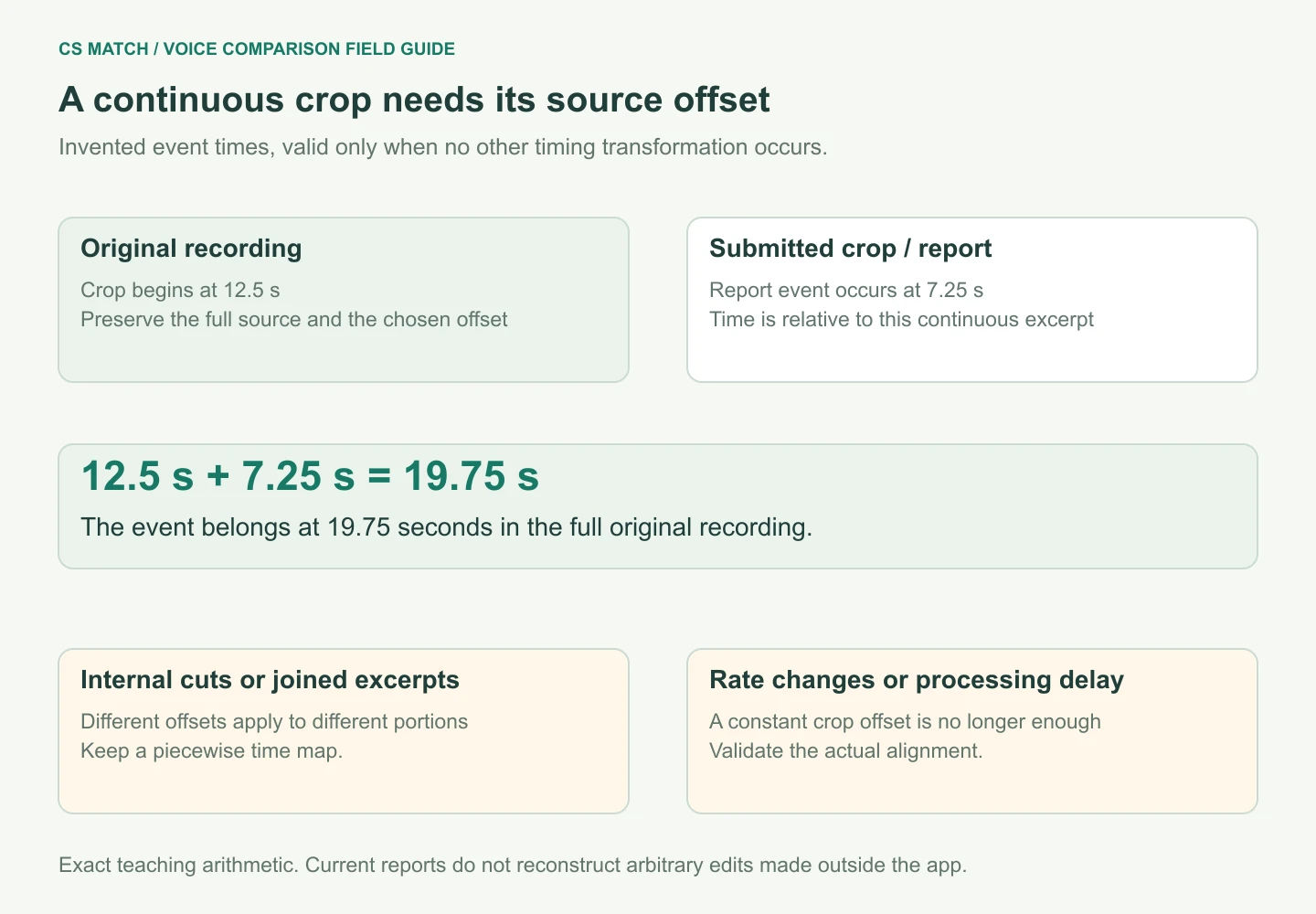
Speech selection is not the same as waveform cleanup
Voice activity detection estimates where speech occurs and decides which regions become candidates for later processing. It does not remove noise from the retained speech, attribute a voice to a person or separate two simultaneous talkers. A cleaned recording can still contain mixed speech, while a noisy recording can contain useful single-speaker passages worth evaluating.
The current worker uses speech timestamps to build windows while retaining recording positions. That is different from joining all detected speech into a new gap-free waveform. Preserve this distinction when preparing files externally. Silence between turns can supply contextual boundaries even when it is excluded from embedding input, and removing it changes later time interpretation.
Evaluate selection errors explicitly. Aggressive thresholds can miss a quiet response; permissive ones can retain interference. Include both in a controlled test and inspect the passages that change. A higher detected-speech total is not automatically a better result. It may reflect more useful evidence, more irrelevant material or a different segmentation policy that changes the number of comparison opportunities.
Gain normalization cannot undo overload or guarantee invariance
A level adjustment can make a quiet file easier to inspect, but it raises noise along with speech unless another operation intervenes. Peak normalization, loudness normalization and dynamic gain control are different policies. Document which one is used rather than call every amplitude change normalization. The current standard decoding path should not be described as implementing all of them.
Once a capture has clipped, reducing its level does not restore the original peak shape. Similarly, cosine invariance to positive scaling of a finished vector does not imply invariance to arbitrary waveform gain before feature extraction. The encoder, input normalization and nonlinear processing sit between those stages. Test the actual recording transformation instead of extending a vector identity beyond its assumptions.
Inspect the source and prepared version together, especially strong syllables and quiet gaps. A high-amplitude sample indicator can flag one condition without detecting every upstream distortion. If a gain change helps decoding or listening, record that benefit accurately. A claim that it improves speaker discrimination still needs independent same-speaker and different-speaker comparisons under the intended channel conditions.
Filters remove selected content rather than knowing what belongs to a voice
A high-pass, low-pass or notch filter can suppress particular frequency regions. It acts according to its transfer function, not a semantic understanding of speaker identity. Unwanted hum and useful speech can occupy related parts of the spectrum. A visually cleaner spectrogram after filtering therefore does not establish that the remaining representation is more discriminative for the encoder.
Reproducible filtering specifies filter type, order, cutoff units, sample rate and application method. SciPy's Butterworth documentation makes these parameters explicit and recommends suitable numerical representations for filtering. Treat a filter designed for one sample rate carefully when applying it to another. A preset name such as voice cleanup hides too much information for a controlled verification experiment.
Start with a specific observed problem and compare a conservative candidate against the unchanged baseline. Preserve both outputs and evaluate clean recordings too, because a filter useful for one interference pattern may remove evidence elsewhere. Do not build a universal preprocessing chain by stacking individually plausible filters without measuring their combined effect and any resulting timing changes.
Neural denoising estimates speech under its own model assumptions
A learned enhancement model estimates a cleaner signal from an observed mixture. It can suppress background noise while altering low-energy consonants or fine spectral detail. That tradeoff may improve intelligibility without improving speaker separation. Compare the output with the original and state which downstream task is being optimized; enhancement quality and verification accuracy are different measurements.
DeepFilterNet is an example of a documented speech-enhancement framework. Its repository describes a full-band 48 kHz path and timing-related options for its command-line tool. Those requirements differ from our 16 kHz analysis input. Integrating a candidate would require a defined conversion route, model revision and delay policy, not merely adding a library name to the existing worker.
CS Match does not currently run that enhancement stage. A future study should hold the verification model fixed, retain clean and noisy trials and check whether target and non-target scores change together. Record runtime and failures as well. If a model suppresses a speaker's quiet contribution entirely, a pleasant-sounding result can still remove the evidence the comparison was meant to examine.
Dereverberation addresses temporal reflections, not every kind of interference
Reverberation spreads sound over time through reflections, whereas additive noise and competing speech introduce other contributions. A denoiser is not automatically a dereverberator. Weighted prediction error is a specific dereverberation approach, and the NARA-WPE project provides offline and online implementations. Its existence gives us a concrete method to investigate without implying that it belongs in every recording pipeline.
Choose the actual configuration and verify its channel and signal assumptions. A multichannel method cannot be assumed to retain all of its benefit after the source is reduced to mono. Windowing, prediction settings and numerical behaviour also belong to the experiment record. Inspect speech beginnings and transitions where processing can change the material available to later segmentation.
Evaluate far-field conditions independently and keep a clean baseline condition. Improvement in a dereverberation or transcription study does not directly establish improved speaker verification with our selected encoder. The current product does not apply NARA-WPE or promise automatic room removal. Adoption would require measured gains, maintained timing alignment and resource costs justified by the recordings we actually need to support.
Separating sources creates estimates that need their own validation
When two people speak simultaneously, noise suppression alone does not define which voice to retain. Source separation estimates component waveforms, while target extraction additionally needs a policy for choosing the intended component. A two-output model does not automatically name either output or establish a stable participant assignment across every part of a recording.
Asteroid provides research tooling, architectures and recipes for audio source separation. It is a relevant place to study candidate systems, not evidence that separation is already installed in our application. A chosen checkpoint has its own training mixtures and output assumptions. Inspect leakage, missing speech and artefacts on the actual source instead of accepting every separated stream as clean ground truth.
Reference comparison after separation adds another dependency: the estimated waveform may alter the speaker representation. Evaluate separation quality and downstream matching separately, using independent references and known speaker relationships. Keep the original mixture and mapping to each derived stream. If outputs exchange speakers or preserve interference, a confident match in one excerpt cannot certify the whole separated recording.
Pitch, speed and repeated export change the experimental condition
Changing playback speed for listening is different from saving a transformed waveform and submitting it for encoding. The latter changes the evidence supplied to the model. Time stretching and pitch shifting are distinct operations, and their settings and artefacts matter. Do not assume that making a voice sound more like the reference is a legitimate normalization for verification.
Librosa documents a time-stretch rate: values above one speed up the output and values below one slow it down. That operation changes duration, so an external transformation requires a corresponding time map. It should not be confused with changing a sample-rate header. In the standard workflow, report times do not automatically compensate for arbitrary speed changes performed elsewhere.
Repeated lossy exports likewise create new conditions without restoring the original capture. Keep a clear chain from the earliest available recording to the submitted version. If transformations are relevant to a robustness study, include them deliberately and label the trials. Avoid adjusting pitch, speed or export settings until a preferred similarity appears and then presenting the result as ordinary independent comparison.
Test a transformation with a controlled ablation study
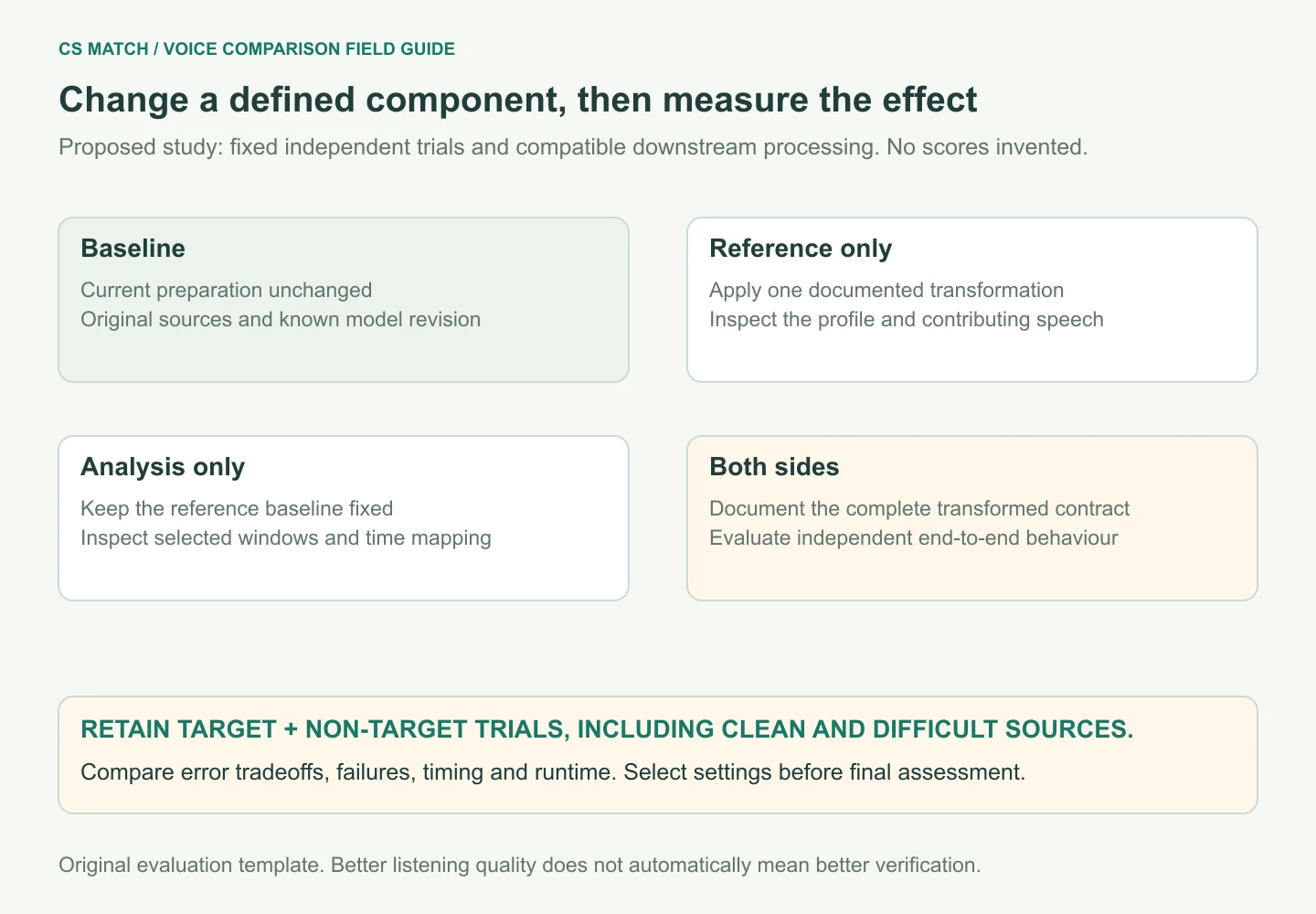
An ablation compares configurations while changing a defined component. Begin with a fixed trial set containing independent target and non-target comparisons, including clean and difficult sources. Run the current preparation unchanged, then apply one documented candidate transformation. Keep the encoder, reference construction and score policy fixed where the experiment requires isolation of that effect.
Specify which side is processed: reference only, analysis only or both. These conditions need not behave identically because our reference is aggregated while analysis is scored in windows. Record selected speech, window counts and timing as well as scores. A transformation can change the candidate population, so a different best score is not automatically evidence of improved representation for the same passages.
Choose settings using development data and reserve final trials for assessment. Measure error tradeoffs, failures, alignment and runtime before deciding whether a benefit justifies integration. The study diagram is a proposed protocol without fabricated accuracy numbers. If the unchanged baseline remains better or simpler for the relevant task, keeping it is a valid engineering result.
| Configuration | Keep visible | Compare |
|---|---|---|
| Baseline preparation | Original source and engine revision | Errors, timing and runtime |
| Reference-only transform | Profile and contributing speech | Target/non-target score movement |
| Analysis-only transform | Windows and source mapping | Selection changes and missed passages |
| Both sides transformed | Full processing contract | Independent end-to-end behaviour |
A practical policy for the current application
Use a clear original source and a suitable single-speaker reference first. Let the established path decode and prepare the waveform, then inspect the retained speech and report intervals. This addresses compatibility without adding an unmeasured enhancement chain. If the source remains inadequate, identify the concrete limitation instead of treating file acceptance as a guarantee of useful comparison.
When an external transformation is necessary, preserve the original, name the working version and document channel selection, timing and model settings. Review the actual engine used by the job: SpeechBrain fallback representations are different spaces, and a processing failure should not be diagnosed as an enhancement-quality result. Keep provenance with both successful and unsuccessful comparisons.
For future development, prioritize changes supported by representative independent trials and understandable operational behaviour. Denoising, dereverberation and separation are candidates to evaluate; they are not part of the current standard path. A transparent baseline, traceable source times and inspectable uncertainty make the report more useful than an elaborate chain whose effect on speaker evidence has never been established.
Questions about this workflow
Does the current normalize step automatically denoise the audio?
No. The current preparation produces mono 16 kHz, 16-bit PCM audio. Its name should not be read as a promise of loudness normalization, neural enhancement or target-speaker isolation.
Should every recording be filtered and denoised before matching?
No universal chain is justified. Preserve the baseline, identify a specific source problem and evaluate a documented transformation on independent target and non-target trials.
Do report timestamps still match the original after removing silence?
Not necessarily. Internal cuts require a piecewise time map; a single continuous crop only needs its offset when timing is otherwise preserved.
Does cleaner separated speech prove better voice verification?
No. Separation produces estimates that can contain leakage or artefacts. Evaluate the derived waveforms and the downstream comparison independently, retaining the original mixture and source mapping.
Continue with the next useful step
Speaker Diarization Methods: Clustering, Overlap and Speaker Changes
Understand speaker diarization from speech detection and window embeddings to cosine clustering, AHC, spectral methods, VBx and neural overlap handling. Explore evaluation and the current CS Match implementation.
Why the Same Voice Sounds Different Across Phones and Recordings
Explore how microphones, bandwidth, resampling, codecs, rooms, gain control and stereo handling affect speaker comparison. Learn to evaluate channel mismatch without confusing it with identity.
How to Choose a Reference Voice Sample
Choose a useful voice reference: one speaker, sufficient usable speech, independent recordings, appropriate channels and source context. Understand the current CS Match profile and its limitations.