
Speaker Diarization Methods: Clustering, Overlap and Speaker Changes
Understand speaker diarization from speech detection and window embeddings to cosine clustering, AHC, spectral methods, VBx and neural overlap handling. Explore evaluation and the current CS Match implementation.
Sources checked · Cyber Search MatchSpeaker diarization estimates which speaker-related label is active at each time in a recording. It combines speech selection, representations, grouping and timing decisions; some systems also model simultaneous speakers. Labels are local to the recording and do not establish personal identity. Evaluate boundaries, missed speech, confusion and overlap under a declared protocol, separately from transcription and reference-voice verification.
Define recording-relative speakers before naming people
A diarization output assigns labels such as Speaker 1 and Speaker 2 to speech intervals. The labels allow a conversation to be organized without knowing the participants' names. Their numbering is a presentation convention. Speaker 1 in one recording is not automatically the person called Speaker 1 in another, even when both reports use the same model.
Keep three questions separate: what words were spoken, which passages belong to the same voice, and whether a passage resembles a supplied reference. They can support one another, but each has its own failure modes. A readable transcript can have incorrect speaker assignments, and a well-grouped conversation can still be unsuitable for matching a contaminated reference.
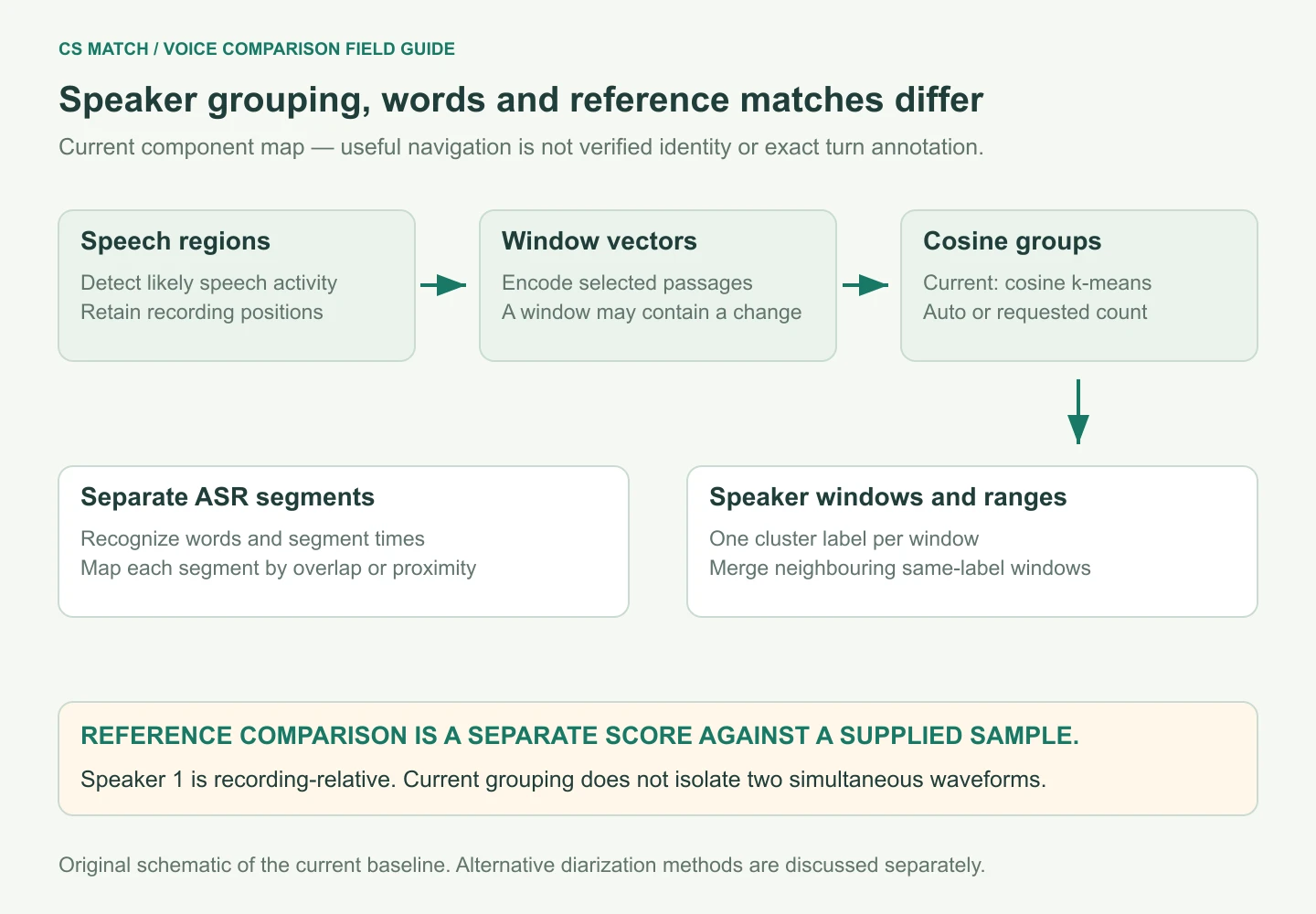
The current CS Match report presents dialogue turns, speaker windows and reference-comparison views together. That makes source review practical, but does not convert the combined display into verified identity. Decide whether the immediate goal is navigating a conversation, measuring turn accuracy or comparing a voice. Then choose evidence and metrics that belong to that goal.
Speech detection controls the evidence available to grouping
Speech activity detection selects regions likely to contain speech. If it misses a quiet participant, later grouping cannot recover that participant from windows that were never created. If it retains music or background television, the encoder receives unwanted material. Speech detection and speaker assignment therefore need separate inspection rather than a single good-or-bad judgment about the final speaker count.
Our preferred speech detector is Silero VAD, with an energy-based fallback in the worker. Neither path is a target-speaker verifier. Retained activity can include more than one voice, and a high detected-speech proportion is not a purity certificate. Inspect faint replies and noisy transitions alongside stronger speech to understand where the candidate windows came from.
During evaluation, distinguish a pipeline using detected speech from one supplied with manually annotated speech regions. The latter removes part of the practical problem and may produce a better score for that reason. Both experiments can be useful if labelled accurately. Do not attribute every change in diarization error to the clustering algorithm when the speech-selection inputs also changed.
Embedding windows and exact speaker turns are different objects
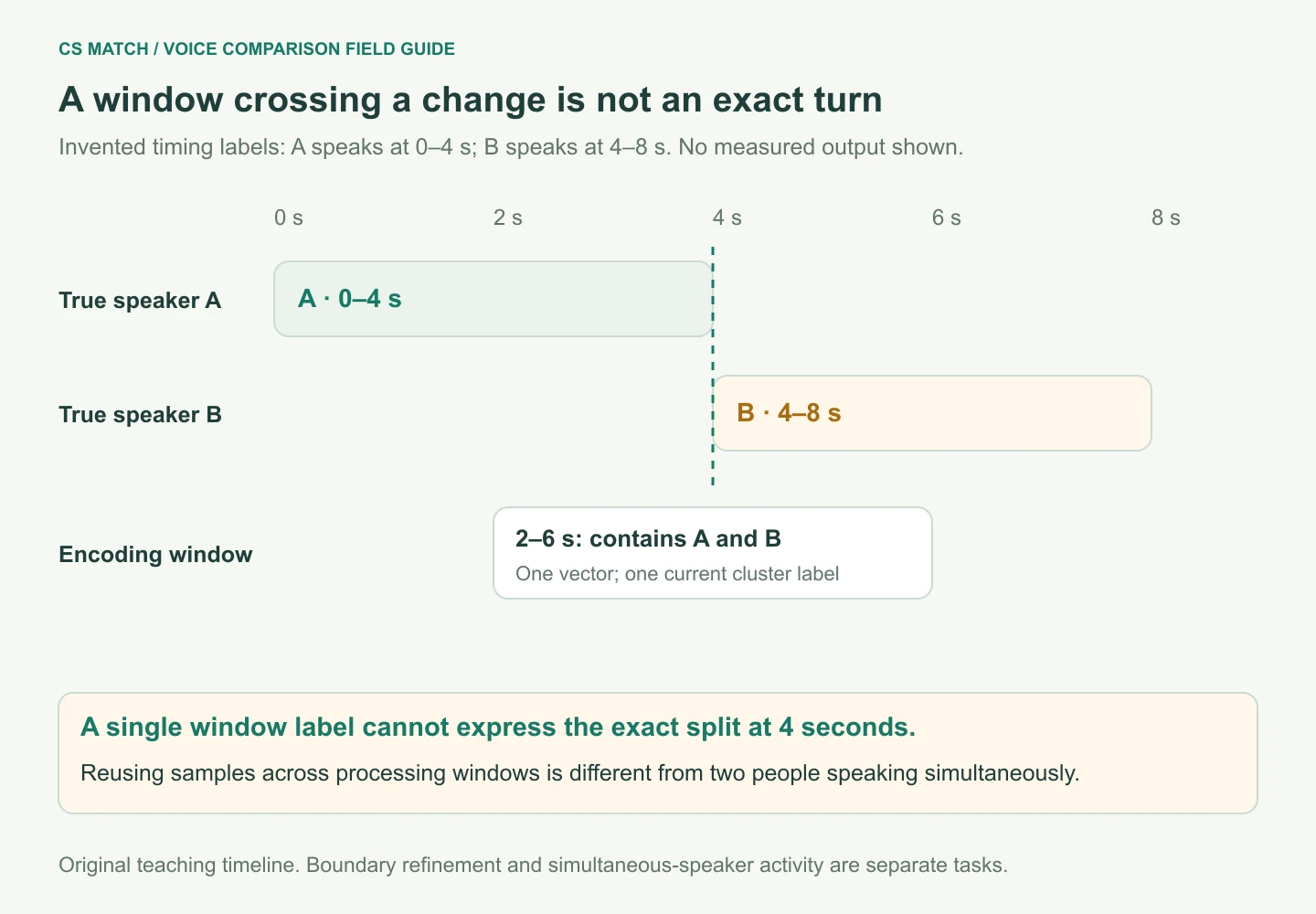
A window-based system summarizes a passage into a vector. Longer windows can provide more speaker evidence but may contain a change of speaker; shorter ones can localize events while supplying less information. Overlapping analysis windows soften sampling boundaries, yet their shared samples make neighbouring vectors dependent. The window length is a modelling choice, not an annotation of a person's exact turn.
Consider an invented eight-second conversation: A speaks from zero to four seconds and B from four to eight. A window from two to six crosses the transition. Assigning that entire window to one cluster cannot express the exact boundary at four seconds. Improving the encoder alone does not remove this representational limitation; segmentation or later boundary refinement must address it.
Our default window configuration uses a two-second minimum, five-second maximum and half-second overlap, with additional region handling. Those settings are configurable and do not guarantee pure single-speaker windows. When checking a short interjection, inspect the source and surrounding windows. A participant who speaks only briefly can be absorbed into a longer neighbouring passage before clustering begins.
Cosine k-means groups vectors around representative directions
A cosine grouping rule compares vector directions with candidate cluster centroids. In our worker, vectors are assigned to the centroid with highest cosine similarity, then centroids are recomputed by normalized averaging. These assignment and update steps repeat until labels stabilize or the iteration limit is reached. Initialization begins from one vector and adds directions distant from existing centroids.
The attraction is an inspectable baseline: a defined number of groups, explicit vectors and a direct relationship between assignment and similarity. Its limitation is equally concrete. A speaker whose channel changes may occupy several directions, while two voices with insufficiently discriminative windows can occupy nearby ones. A compact cluster is evidence about the representation, not a guarantee of one real person.
Keep encoder provenance and source windows when diagnosing those cases. Replacing a cluster count, changing input selection and updating the model simultaneously makes the cause of any improvement unclear. A cosine-distance objective is useful intuition, but the implemented finite iteration procedure should not be described as finding a guaranteed global optimum or a calibrated probability for each speaker label.
Cosine-distance intuition: sum over windows of [1 − cosine(window vector, assigned centroid)].The current finite assignment/update procedure does not guarantee a global optimum.AHC and spectral clustering organize similarity differently
Agglomerative hierarchical clustering starts with separate items and merges groups according to a linkage rule. Average and complete linkage summarize inter-group distances differently; the stopping threshold or requested group count controls the final cut. Scikit-learn's documentation makes these choices explicit. An AHC label alone therefore does not identify one fixed speaker-diarization system or a universally suitable similarity threshold.
Spectral clustering instead constructs a similarity graph and uses information from a graph Laplacian to obtain a representation for grouping. The affinity construction, graph connectivity and number of groups matter. Von Luxburg's tutorial explains this framework and its assumptions. A graph method does not eliminate dependence on the original embeddings or automatically distinguish channel variation from different speakers.
To compare these alternatives with our baseline, fix the input windows and encoder first, then evaluate each grouping configuration on the same annotated recordings. Include brief speakers and channel changes, not only long clean turns. Record memory and processing cost as window counts increase. A method that improves one recording needs broader evidence before becoming an application-wide replacement.
VBx and resegmentation add sequence structure
Clustering windows independently by similarity leaves temporal relationships implicit. A sequence model can express that neighbouring observations often belong to a continuing speaker while allowing changes. VBx is a documented approach using a Bayesian hidden Markov model over speaker embeddings; its recipe uses AHC initialization followed by variational Bayesian inference. It is a distinct backend, not another name for our cosine k-means.
Temporal persistence can reduce erratic switching, but excessive smoothing can erase a brief reply. Resegmentation more generally revisits assignments or boundaries using additional temporal evidence. It should be evaluated near real changes and overlap rather than judged only by a tidier-looking timeline. A continuous colour band is an interface property; accurate speaker activity is an empirical result.
Adopting such a backend requires a compatible extractor, its expected transforms and configured temporal assumptions. Preserve the input and output timing conventions. Evaluate whether improvements come from grouping, boundary refinement or changed preprocessing. CS Match does not currently run VBx or claim its published performance; the method is a concrete alternative for a controlled future study.
Auto speaker count is a model-selection problem
Requesting a known count constrains grouping; it does not prove that the recording contains exactly that many audible participants. Background voices, channel changes and brief contributions can make the representation support a different structure. Keep requested count, selected grouping and observed source content separate when explaining a report. Even a correct count can coexist with incorrect assignments.
Our Auto mode evaluates candidate cosine clusterings up to the configured maximum, using a silhouette-style separation score with a penalty for additional groups. Weak separation leads to a one-group result. The standard interface allows Auto or a requested count from one to five. This is a bounded heuristic based on available windows, not an independent participant census or a confidence-calibrated speaker-count model.
Test count estimation separately from turn accuracy. Include recordings with too little usable speech, similar voices, brief speakers and one person recorded through changing channels. Inspect which windows support an extra cluster. Raising the maximum can allow more groups, but cannot supply missing evidence or establish that every resulting group corresponds to a distinct person.
Model overlapping speakers explicitly when the task requires it
Overlap between processing windows means that two windows reuse some samples. Overlapping speech means that two people speak at the same time. These are different phenomena. A window with one assigned cluster label cannot fully represent two simultaneously active speakers, even if its neighbours overlap extensively. Confusing those meanings can hide a central limitation of an otherwise useful baseline.
End-to-end neural diarization research uses permutation-free objectives to learn speaker-activity outputs and explicitly handle simultaneous speakers. This addresses a different output structure from assigning one identity label to each window. The number of supported speakers, training conditions and long-recording strategy still need inspection for any concrete checkpoint. The research approach is not a guarantee of perfect overlap handling in arbitrary conversations.
Activity estimation also differs from source separation. Two active speaker labels do not create two clean waveforms. For the current product, inspect overlapping passages as mixed evidence and avoid describing a single window label as verified isolation. If overlap is common in the intended workload, evaluate an overlap-aware candidate and any separation stage as separate interventions with their own errors and resource requirements.
Attaching words to a speaker adds another timing decision
An ASR segment can span a speaker change, so mapping a whole segment to one label can misattribute some words even when nearby speaker windows are reasonable. Word recognition, time alignment and speaker activity are separate estimates. Inspect short replies and interruptions where a transcript sentence may not align with a clean single-speaker turn.
The current worker assigns each transcript segment to the speaker window with the greatest temporal overlap, using proximity when none overlaps. Adjacent same-label transcript segments can then be merged. This is a documented timing heuristic, not word-level speaker attribution or simultaneous-speaker transcription. When there are no speaker windows, a fallback label does not establish that the voice was actually identified.
Keep the original transcript segments available alongside the dialogue view when evaluating this layer. A merged row can span gaps and include more than one underlying segment. Listen around its boundaries instead of treating the entire displayed sentence as a precise annotation. Changing ASR segmentation can alter dialogue attribution even if the speaker encoder and cluster labels remain unchanged.
Declare the diarization scoring protocol before comparing numbers
Diarization error rate combines missed speech, false-alarm speech and speaker-confusion contributions relative to reference speaker time. Its interpretation depends on the scored region and annotation policy. In overlap-aware scoring, multiple reference speakers can contribute at the same instant. State the denominator and treatment of difficult regions rather than describe the metric loosely as the percentage of incorrect words.
The pyannote.metrics documentation exposes a boundary collar and an option to exclude overlapping speech, and describes optimal label mapping before computing error. These settings can materially affect reported results. Comparing two numbers without checking them can reward a more forgiving protocol instead of a better system. Recording-relative label permutations should not count as identity mistakes after appropriate mapping.
Report components and representative failure cases alongside the aggregate. A count error, missed quiet speaker and imprecise boundary call for different changes. Keep verification EER and transcription word error separate from DER. This article explains how to assess diarization; it does not publish a measured CS Match DER or borrow another pipeline's benchmark as evidence of our accuracy.
| Declare | Why it changes interpretation |
|---|---|
| Scored regions and speech annotations | Defines what the system is expected to explain |
| Boundary collar | Controls tolerance around annotated transitions |
| Overlap inclusion | Determines whether simultaneous activity is evaluated |
| Label mapping and error components | Separates naming conventions from activity errors |
Evaluate grouping separately from reference matching
Create annotations for a fixed set of representative recordings, with clear conventions for silence, overlap and uncertain boundaries. Keep separate recordings for tuning and final assessment. Evaluate speech selection, group count, turn assignment and transcript attribution as distinguishable layers. Where an upstream stage changes, report the complete-pipeline comparison as well as any isolated component study.
A reference score answers another question: whether a passage resembles the supplied sample under the chosen representation and policy. Do not select diarization parameters solely because they raise a desired reference match. A merged cluster can contain multiple people and still produce a favourable passage. Include evidence that contradicts the intended interpretation and preserve the source intervals that explain it.
Measure operating cost on realistic window counts and retain failed or fallback runs. A method that needs more memory than the deployment can supply has a practical boundary regardless of its clean-condition score. The right improvement is one that reduces relevant errors reproducibly while preserving source review and understandable failure behaviour, rather than merely increasing the apparent sophistication of the algorithm.
Use the current report as an inspectable baseline
Our implementation groups speech-window embeddings with cosine k-means, orders resulting labels by their earliest assigned window and merges compatible neighbouring windows under a configured gap rule. The output is useful for locating recurring voices and reviewing a conversation. These operations do not guarantee exact turn boundaries, isolate simultaneous speakers or establish consistent personal labels across recordings.
Start review with the source player and several turns from each group, including transitions and low-quality passages. Compare the requested or Auto count with what is audible. Read the dialogue together with the original segment times and inspect the reference separately. A single polished row or favourable score is too narrow a basis for accepting all of the assignments.
This modular baseline gives us specific upgrade questions: better speech selection, purer windows, temporal refinement, overlap activity or transcript attribution. Each can be evaluated without pretending that replacing one library solves the entire problem. Keep current capabilities and proposed alternatives distinct, and use independent annotations to decide which change materially improves the recording-review workflow.
Questions about this workflow
Does Speaker 1 identify the same person across recordings?
No. It is a recording-relative label, ordered by the current grouping output. Cross-recording reference comparison is a separate task and does not establish a verified personal identity.
Does overlap between analysis windows handle two simultaneous voices?
No. Reusing samples across windows differs from modelling multiple active speakers. The current window grouping assigns one label per window.
Will supplying the correct speaker count make every turn accurate?
No. It constrains grouping, but mixed windows, missing speech, channel changes and transcript boundaries can still cause errors. Inspect the source and evaluate assignments separately.
Can we compare DER values from any two papers directly?
Only after checking data, annotations, scored regions, collars, overlap handling and label mapping. Different protocols can produce different numbers without demonstrating a better deployment system.
Continue with the next useful step
Audio Preprocessing for Speaker Verification: What Helps and What Changes the Voice
Distinguish consistent audio preparation from filtering, denoising, dereverberation and separation. Preserve timing, inspect model contracts and evaluate whether transformations improve speaker comparison.
Speaker Recognition Libraries Compared: SpeechBrain, NeMo, WeSpeaker, Kaldi and pyannote
Compare five speaker-audio toolkits by task, checkpoints, training recipes, scoring, diarization, deployment contracts and evaluation, with the reasons behind the current CS Match baseline.
Find and Listen to Audio Speaker Segments
Use speaker labels, dialogue turns, matched windows and timestamps to locate and listen to passages in an Audio Analysis report.