
Training and Evaluating Voice Comparison on Real Recordings
Build a reproducible speaker-comparison study: source labels, speaker and session splits, trial conditions, baseline checkpoints, adaptation, calibration, full-recording evaluation and uncertainty.
Sources checked · Cyber Search MatchStart with a frozen comparison task and an identifiable pretrained baseline. Build source and trial manifests with known relationships, separate training and tuning from final assessment, and evaluate independent recordings across relevant conditions. Change one component at a time, retain failures and measure the full search workflow where it matters. Published model benchmarks are reference evidence, not substitutes for local deployment evaluation.
Write the study contract before collecting favourable results
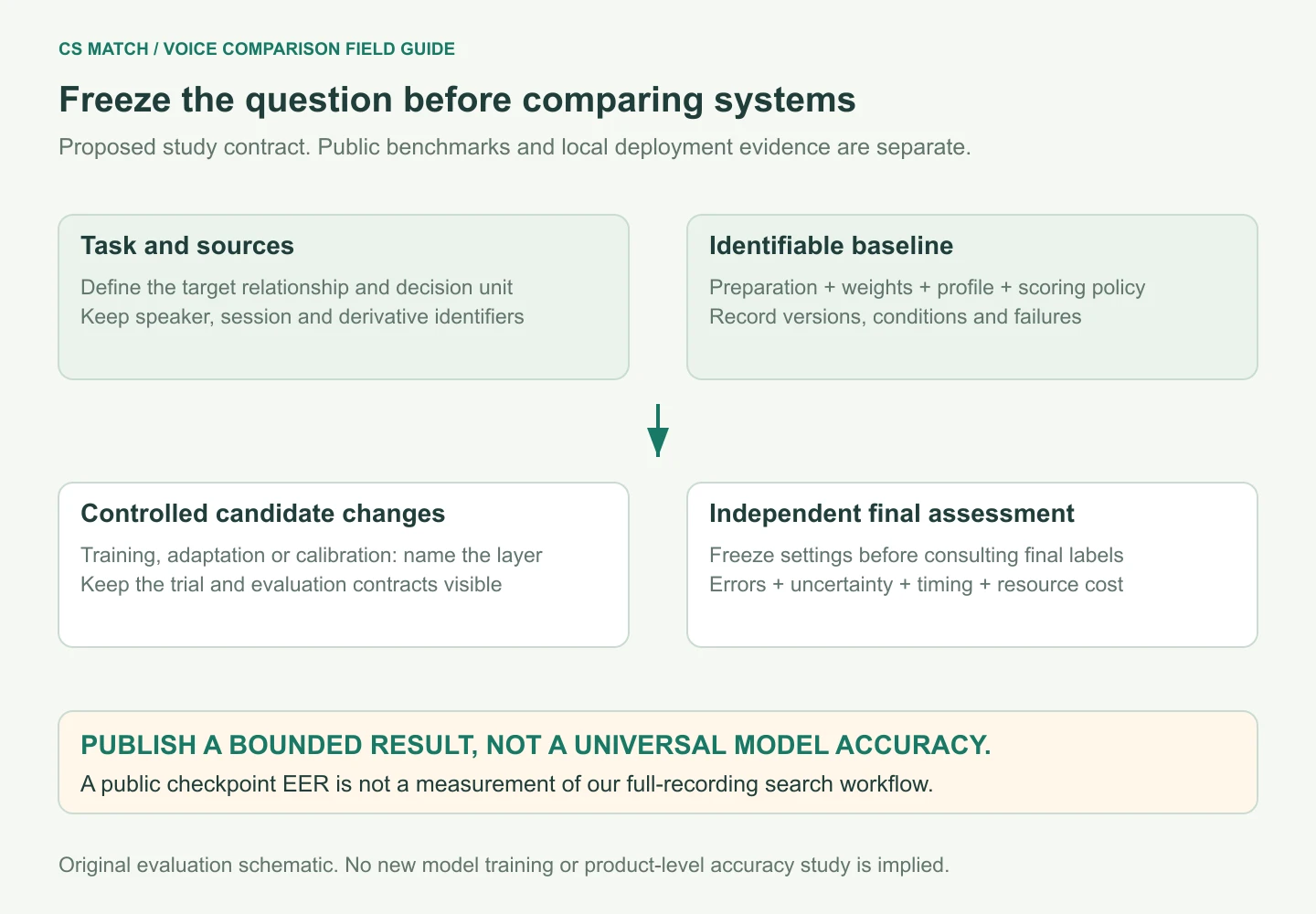
Define the output the application needs to support: comparison of two clean excerpts, presence of a supplied voice in a long recording or localization of relevant speech. Specify what counts as a target and which decision or ranking is evaluated. These tasks can share an encoder while requiring different trial construction, aggregation rules and error interpretation.
Freeze a baseline contract covering decoding, channel handling, speech selection, windowing, encoder revision, reference aggregation and score policy. Record the intended source conditions and usable-input limits. A statement such as test ECAPA is too broad to reproduce. The experiment needs an executable system and a defined question, not only an architecture name.
Choose acceptance criteria before viewing final results. Include the desired error tradeoff, processing coverage, timing and resource budget where relevant. This does not require inventing an accuracy target without evidence. It requires knowing which observations would justify a change and which would show that the unchanged baseline remains the more suitable engineering choice.
Build a source manifest with defensible relationships
List each recording with a stable identifier, speaker relationship, session, capture route, language where known and any editing history. Preserve the distinction between a single-speaker excerpt and a mixture. Labels should come from known source relationships or a documented annotation process, not from whether the model happened to give a high similarity score.
Inspect duplicates and derived copies. A re-encoded upload, cropped excerpt and original file can look like separate records while containing the same speech. Keep their common origin visible. Shared source material can leak across a split and make reference-to-test similarity artificially easy. File hashes help identify exact duplicates, but different hashes do not establish independent audio content.
Record uncertain labels separately instead of forcing them into the target or non-target class. Ambiguous provenance may still be useful for exploratory listening, but it cannot support the same accuracy claim as trusted ground truth. A smaller set of well-understood independent sources can reveal more than a larger catalogue whose identity and session relationships are poorly documented.
Separate training, development and final assessment at the right level
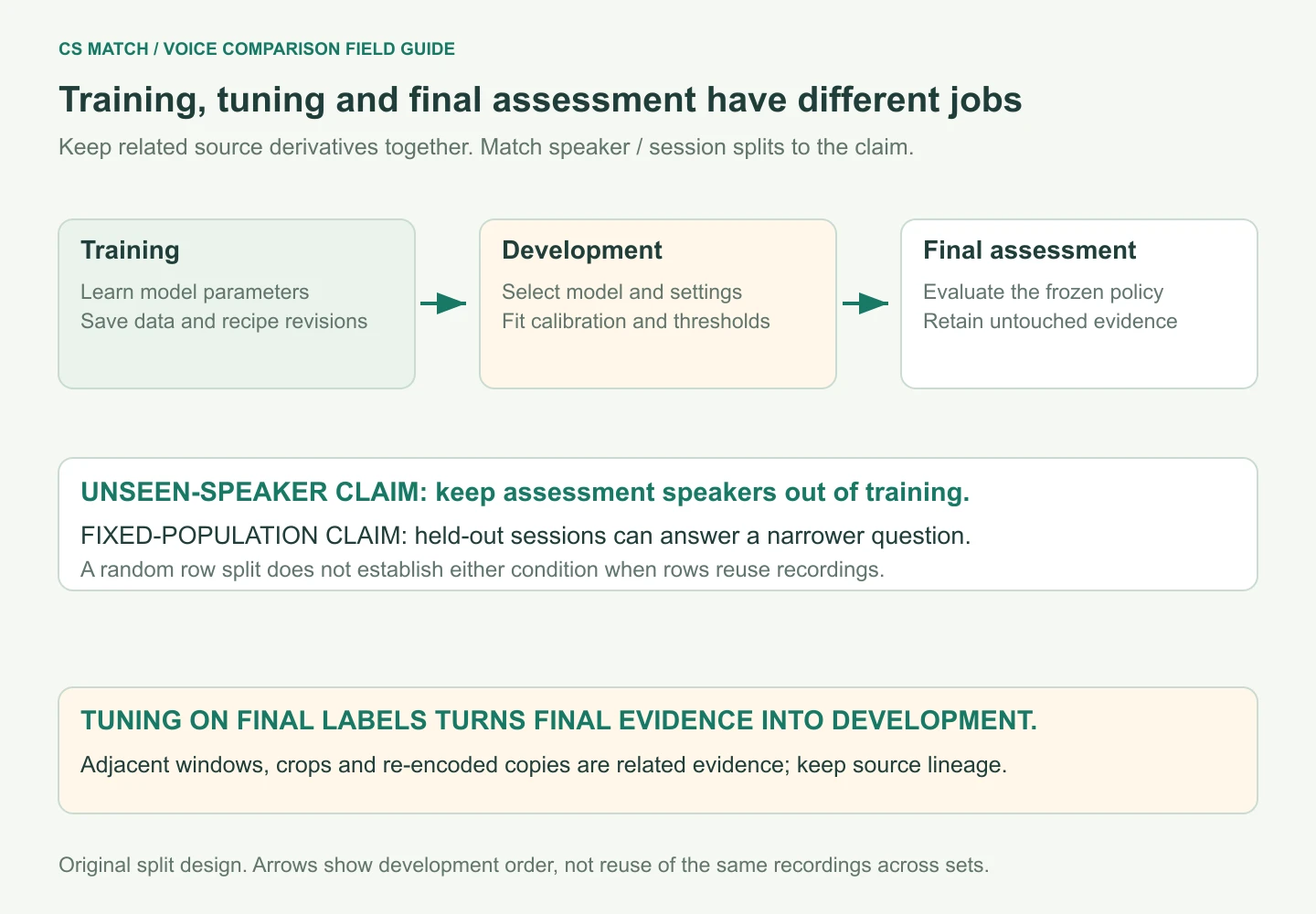
Training learns model parameters. Development selects configurations, calibration and operating policies. Final assessment estimates performance of the selected system on untouched evidence. Keep these roles distinct even when adapting a pretrained checkpoint rather than training from scratch. Trying many settings on the final set makes it part of development, whether or not gradient updates were involved.
For generalization to unseen speakers, keep evaluation speakers out of training and choose appropriate independent development speakers. For a fixed enrolled population, the evaluation question can instead involve known participants across held-out sessions. State that narrower scope. Speaker-disjoint and session-disjoint conditions answer different questions; one should not be advertised as the other.
Group all derivatives of a source together when splitting. Adjacent windows from one call should not become nominally independent training and final-test examples. Preserve session and source identifiers in the manifests so the separation can be audited. A random row split is insufficient when many rows are related crops, encodings or trials built from the same underlying recordings.
Construct trial conditions that expose the intended difficulty
Create target and non-target pairs across relevant reference durations, test durations, channels and session relationships. Include difficult but plausible non-targets without selecting them solely because one candidate model failed. Keep the construction rule fixed when comparing systems. An easy non-target pool can make a threshold appear strong while saying little about the comparisons users actually review.
NIST's SRE21 and SRE24 plans explicitly define enrollment and test conditions, including source and language variation. SRE24 also addresses multi-speaker segments under specified markings and task rules. These are useful examples of protocol design, not a claim that our local study follows every challenge condition or is directly comparable with its official scores.
Do not mistake pair count for independent population size. Reusing one reference in thousands of combinations leaves shared dependencies. Report speakers, sessions, source recordings and trial counts together. Break out meaningful condition cells rather than present only one aggregate over an arbitrary mixture. Where a cell has little evidence, preserve that limitation instead of smoothing it away in the headline.
Identify the checkpoint and benchmark before reproducing it
Use an immutable checkpoint revision or artefact hash, configuration and software environment for the baseline run. Keep preprocessing and scoring definitions with the model. A development branch can change after a checkpoint release, so today's recipe is not automatically the historical experiment. Successful inference is useful evidence of compatibility, not proof of exact training reproduction.
SpeechBrain's ECAPA VoxCeleb model card reports 0.80 percent EER on VoxCeleb1-test (Cleaned) for its dated release. That is a scoped checkpoint benchmark, not our deployment result. The current recipe also warns that VoxCeleb1-E and VoxCeleb1-H trials draw from VoxCeleb1 training material; training and evaluation exclusions must match the protocol being claimed.
Treat a public reproduction and a target-domain evaluation as separate deliverables. The first checks a specified published setup; the second asks whether the selected system serves our recording workflow. If data or components differ, document the adaptation. Do not rank alternative checkpoints by numbers from mismatched trial lists, score normalization, training populations or source conditions.
Train the whole experiment, not only the network diagram
A training run needs speaker labels, sampling rules, features, architecture, objective, optimizer, augmentation and checkpoint selection. Speaker-classification training can produce an embedding extractor used for previously unseen voices, but its classification labels are not an application identity database. Keep the exported representation and discarded training head distinct when describing what the final system does.
Choose augmentation from actual domain questions rather than collect a long list of impressive-sounding transformations. Noise, reverberation and channel variation can provide useful training conditions, but they do not guarantee robustness to every real capture. Keep a clean evaluation condition and inspect regressions. Training loss is a development diagnostic, not a substitute for independent verification trials.
Save the actual data manifest, recipe commit, random settings, logs and selected checkpoint. Record why that checkpoint was chosen before consulting final assessment labels. A reproducible experiment can explain an unsuccessful run as well as a successful one. Without this record, later improvements may reflect different source availability or selection rather than a better training method.
Fine-tune only after isolating a repeatable domain problem
First diagnose the baseline's failures. A mixed reference calls for source correction; unintended fallback embeddings call for processing investigation; inconsistent channel handling calls for preparation repair. None is automatically evidence that the encoder needs fine-tuning. Adaptation is justified when a repeatable model-related limitation remains under a stable, understood input and evaluation contract.
Separate adaptation data from final evidence and state which parameters are updated. Replacing an encoder, fitting a statistical backend and calibrating scores are different interventions. Keep them distinguishable where the study is intended to attribute gains. If several components are changed together, label the result as a complete-system comparison and use additional ablations before crediting one component.
Retain broader conditions while targeting a narrow one. Improvement on call recordings can coexist with a regression on close-microphone speech. Track both and include failed or insufficient-input cases. A customized model is not inherently more suitable than the pretrained baseline; its benefit must outweigh reproducibility, profile regeneration, resource and maintenance costs for the actual application.
Fit calibration and choose the operating rule on development data
After selecting a representation and backend, use development trials to fit any calibration and choose a decision policy. Keep the hypotheses, costs and target-prior convention explicit. Do not mix thresholds learned from one score space with another encoder's outputs. A model update can change score distributions even when the interface still displays the same numeric range.
Research on robust speaker backends shows why calibration conditions deserve attention. A mapping trained on one duration or capture population may transfer poorly elsewhere. Evaluate relevant condition cells independently and distinguish a better attainable minimum cost from a better actual policy. Both matter, but they answer different questions about discrimination and score interpretation.
Freeze the chosen mapping and thresholds before final assessment. If the final results reveal a problem and motivate another change, treat the revised system as new development and obtain fresh assessment evidence where necessary. Repeatedly revisiting one final set cannot support an endless sequence of independent claims simply because each iteration has a different checkpoint filename.
Evaluate full recordings when the application searches windows
Our workflow builds a reference centroid and scores multiple analysis windows, then selects and merges favourable passages. A benchmark of isolated clean pairs evaluates only part of that system. For a recording-level presence task, include complete positive and negative recordings and apply the actual aggregation and decision rule. Preserve each file's duration and detected speech as part of the condition.
Define temporal success separately where localization matters. A high maximum score somewhere in a target recording does not guarantee that the highlighted interval contains the intended voice. Compare proposed passages with suitable annotations and inspect overlap, boundaries and gaps. Diarization error, transcription accuracy and reference verification remain different outputs even when shown in one report.
Keep the distinction between score improvement and more search opportunities. Changed VAD or windowing can alter which passages are examined and how many maxima are available. Retain candidate windows and source times for both systems. A complete-pipeline gain can be valuable, but its cause should not be misreported as better embeddings if the evaluated population changed at the same time.
Assess uncertainty using the dependence structure
Report error counts and denominators, not only rounded percentages. Rare false alarms require enough relevant independent evidence to estimate them meaningfully. A zero count has uncertainty, and a broad confidence interval can be an honest result of a useful pilot. Do not replace that uncertainty with more digits or a larger number of dependent window pairs.
The VOiCES evaluation analysis explicitly studies speaker-aware bootstrap sampling and shows why sampling structure affects confidence assessment. Our own design should consider shared speakers, sessions and references rather than assume every score row is independent. Define the resampling unit to match the generalization claim, and use paired comparisons where systems are evaluated on the same source set.
Inspect failures by condition alongside statistical summaries. Several errors from one damaged source call for a different response from failures spread across many independent speakers. If evidence is too sparse to distinguish two candidates, preserve that conclusion. More representative recordings or a narrower supported scope can be more useful than choosing a winner from an unstable aggregate ranking.
Combine ablations with a realistic resource measurement
For each candidate, specify the component changed and retain the baseline outputs. Compare a new encoder with fixed preparation where compatible, a new reference rule with fixed vectors, or a preprocessing candidate with fixed scoring. Complete-system experiments are legitimate too, but their interpretation differs. The experiment record should make this distinction visible without relying on memory of development conversations.
Measure cold initialization, warm processing, peak memory and complete-job time on the intended host. Record hardware, concurrency and input workload. A short embedding call omits decoding, VAD, many-window search and report assembly. Include failed and degraded-mode jobs so runtime and usable coverage describe the actual configuration rather than only its convenient successful cases.
Settle on a candidate when its relevant gains justify its operating cost and maintenance burden. Keep final assessment stable rather than expanding or filtering it in response to favourable scores. When the task changes, declare the added condition as a separate study. The goal is a reproducible application decision, not an unbounded search for a numerical winner on familiar examples.
| Retain per run | Purpose |
|---|---|
| Source and trial manifests | Establish relationships, independence and conditions |
| Weights, code and preparation revisions | Identify the actual compared system |
| Scores, decisions and failures | Recompute metrics without hiding exclusions |
| Timing, memory and environment | Assess the complete operational workload |
Publish a bounded result and preserve a repeatable baseline
A useful result states the task, data relationships, conditions, system versions, operating rule, errors, uncertainty and processing coverage. Separate a public benchmark reproduction from local adaptation evidence. Describe exclusions and unsupported cases beside the outcome. Readers should be able to understand what the measurement predicts without assuming that a familiar model name covers every recording type.
Before adopting new weights or representations, define what happens to existing reference profiles. Equal vector length is not a compatibility guarantee. Regeneration or a separately validated mapping may be required, along with a recoverable baseline environment. Evaluate release behaviour as part of integration rather than discovering profile mismatch after interpreting plausible-looking but ungrounded scores.
CS Match currently provides an inspectable pretrained baseline, not the product-level accuracy study proposed here. This guide supplies a plan for obtaining that evidence without inventing results. The next justified improvement is the one supported by independent recordings and clear operating limits, while preserving the source review that makes technical resemblance useful in the first place.
Questions about this workflow
Must every evaluation use speakers absent from all development material?
It depends on the stated generalization task. Unseen-speaker claims need suitable speaker separation; fixed-population studies can assess held-out sessions but must state that narrower scope. Final assessment must remain independent of tuning.
Can we use model scores as ground-truth speaker labels?
Not for an independent accuracy claim about that model. Use known source relationships or a documented annotation process, and retain uncertain labels separately.
Does reproducing a VoxCeleb benchmark establish performance on our uploads?
No. Public protocol reproduction and target-domain evaluation answer different questions. The current window-search workflow and source conditions require their own assessment.
Does this guide report a newly measured CS Match accuracy?
No. It defines a reproducible study and cites scoped external evidence. Product-level error rates, calibration and a new trained model are not claimed as completed work.
Continue with the next useful step
Speaker Verification Metrics: FAR, FRR, EER, minDCF and Calibration
Read voice-verification metrics correctly: trial labels, false accepts and rejects, ROC and DET, EER, detection costs, calibration, uncertainty and the limits of current report scores.
ECAPA-TDNN and VoxCeleb: Training, Checkpoints and Real-World Limits
Understand ECAPA-TDNN training, VoxCeleb trial protocols, pretrained checkpoints, augmentation, reproducibility and the limits of applying benchmark results to real voice comparison.
How to Choose a Reference Voice Sample
Choose a useful voice reference: one speaker, sufficient usable speech, independent recordings, appropriate channels and source context. Understand the current CS Match profile and its limitations.