
Speaker Recognition Libraries Compared: SpeechBrain, NeMo, WeSpeaker, Kaldi and pyannote
Compare five speaker-audio toolkits by task, checkpoints, training recipes, scoring, diarization, deployment contracts and evaluation, with the reasons behind the current CS Match baseline.
Sources checked · Cyber Search MatchChoose a speaker-recognition toolkit by the component and workflow you need, then evaluate a specific checkpoint and configuration. SpeechBrain, NeMo, WeSpeaker, Kaldi and pyannote provide overlapping capabilities at different levels. Library names are not comparable accuracy scores. For our reference-comparison workflow, the practical baseline is a known encoder, compatible profiles and inspectable source intervals, with alternative components tested independently.
Compare complete systems while keeping component roles visible
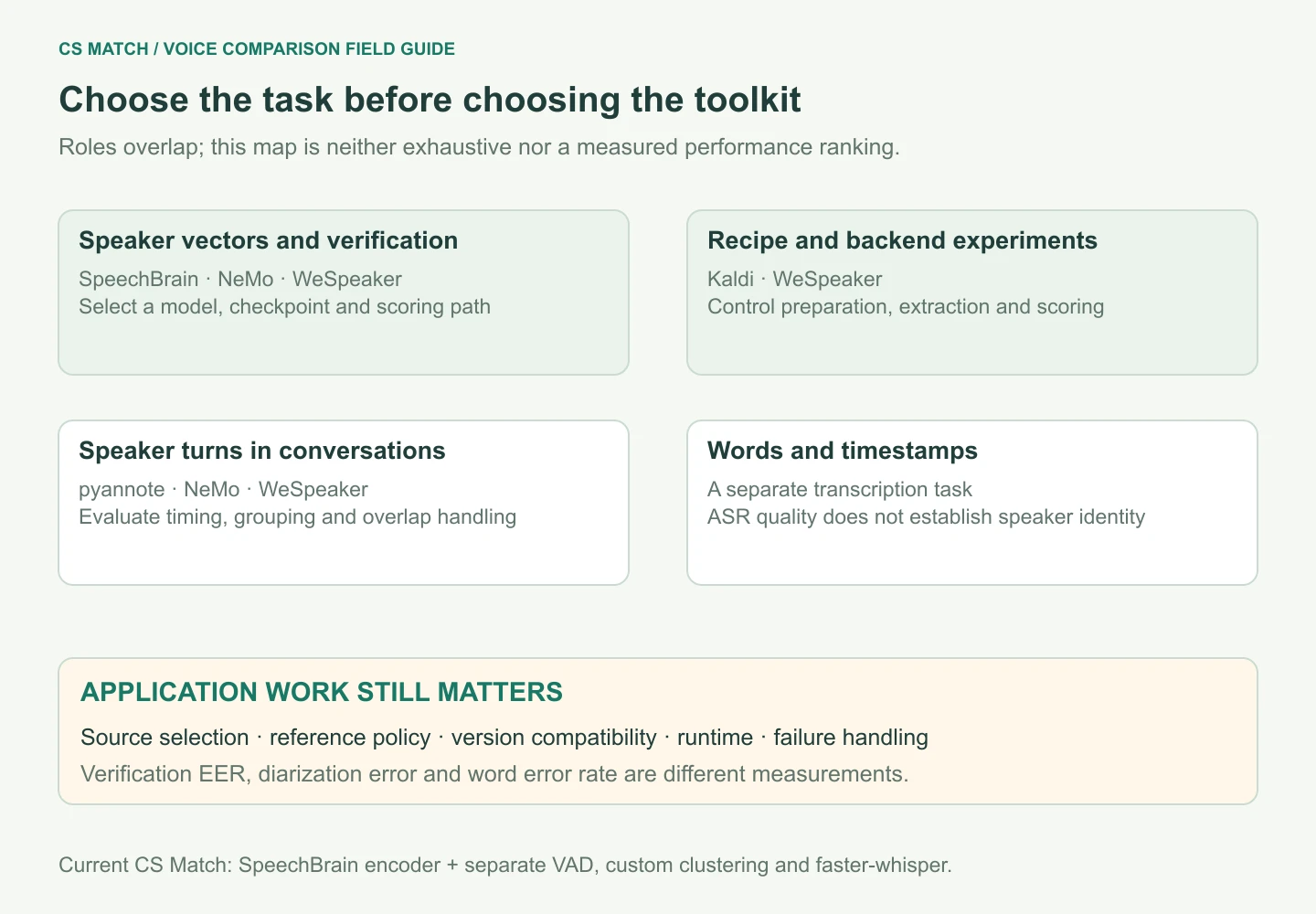
An application may need speech detection, embeddings, reference aggregation, scoring, speaker turns and transcription in the same report. Those tasks share audio but have different outputs. A library can supply one component, a training framework or a coordinated pipeline. Start by describing the missing capability instead of expecting every toolkit to replace the entire application with one installation.
For a fair comparison, identify a concrete configuration: library version, model revision, preprocessing, scoring backend and hardware. A vendor's package name or a research family's reputation is too broad. The question is whether a defined system handles your recordings with an acceptable combination of errors, latency, resource use and maintainability, including cases where it cannot provide useful evidence.
The map below summarizes roles, not measured winners. Its integration column describes work an application still needs to own. Even a complete pretrained pipeline needs a policy for input selection, interpretation and failure. Keep that application work visible when estimating effort; otherwise the apparently shortest inference example can hide the largest difference between a demonstration and an operational feature.
| Toolkit | Relevant role | Application responsibility |
|---|---|---|
| SpeechBrain | Speaker encoders and training recipes | Reference policy and result interpretation |
| NeMo | Speaker models and speech pipelines | Choose task configuration and runtime |
| WeSpeaker | Embedding learning and verification tooling | Validate checkpoint, scoring and export |
| Kaldi | Recipe-driven extraction and statistical backends | Maintain data and processing toolchain |
| pyannote.audio | Speaker diarization models and pipelines | Connect speaker turns to the reference task |
SpeechBrain: a direct baseline for pretrained speaker embeddings
SpeechBrain's ECAPA VoxCeleb model card supplies a pretrained speaker-recognition example, an input specification and links to training code. That combination helps connect inference to a documented experiment. It is a useful starting point when an application needs embeddings and wants the option to inspect the corresponding training recipe rather than depend only on a service response.
In CS Match, the worker uses EncoderClassifier to encode selected files and then performs its own normalization, reference averaging and window scoring. The application owns those later decisions. A model card's verification example does not automatically validate our aggregation rule, source selection or thresholds. This division lets us inspect components, but it also makes end-to-end evaluation our responsibility.
Keep the downloaded model revision and environment stable for a comparison run. A cache makes repeated initialization more practical, yet cached artefacts should be identifiable and recoverable. If loading fails, record the actual path taken. A successful job with an acoustic fallback should not be included silently in a claimed evaluation of the pretrained ECAPA configuration.
NeMo: choose the speaker task and its configuration explicitly
NVIDIA's NeMo documentation distinguishes speaker identification and verification and lists speaker models including TitaNet, SpeakerNet and ECAPA-TDNN. It documents embedding extraction and verification separately from speaker diarization. This is a framework with several relevant routes, not a single interchangeable voice model. Choose the task and checkpoint before comparing its output with another system.
For an integration study, start from the documented input manifest and model configuration, then isolate the output needed by the application. Replacing the encoder alone is a different experiment from adopting a diarization pipeline. Record how speech selection and pooling are configured so an improvement can be traced to a component instead of attributed vaguely to the framework.
Do not infer deployment cost from the NVIDIA name alone. Test the selected configuration on the available runtime and measure its actual resource requirements. Training throughput, embedding latency and complete-recording diarization are different workloads. A broader framework can be attractive when several speech tasks need coordinated development, but its additional integration surface should serve a concrete requirement.
WeSpeaker: investigate embedding recipes and the deployment path together
WeSpeaker focuses on speaker embedding learning and verification, with documented commands for extraction, similarity and diarization. Its repository links training recipes, pretrained models and a runtime directory. That makes it relevant when the main question concerns the encoder and scoring path, especially if the team wants to connect research experiments with a separately inspected deployment implementation.
Use a named recipe and checkpoint rather than combine attractive numbers from different examples. Training data, margin fine-tuning, score normalization and evaluation lists can all change reported results. A repository containing several successful systems does not imply that its default command selects the exact configuration behind a particular table. Trace the artefacts and evaluation procedure before choosing a candidate.
An exported model also needs a parity check. Compare prepared inputs, embeddings and downstream decisions between the reference implementation and intended runtime on representative files. Measure initialization and repeated processing separately. This work can reveal an export or preprocessing discrepancy before it becomes a confusing application-level regression attributed to the model's supposed quality.
Kaldi: explicit data preparation and scoring remain valuable
Kaldi's VoxCeleb recipe exposes a sequence of preparation, feature processing, x-vector extraction and backend evaluation steps. Its PLDA documentation describes a trained transformation and same-versus-different scoring model. These are useful references when the team needs control over a statistical backend and wants each stage represented as an inspectable experiment rather than hidden inside a single convenience call.
That explicitness comes with operational work. The data directories, manifests, scripts and generated intermediate artefacts must stay consistent. For a team already maintaining such a toolchain, extending it may be sensible. For a small application seeking one pretrained encoder, the same workflow can introduce more integration responsibilities than the immediate feature requires.
Avoid treating a statistical backend as a drop-in score upgrade. A fitted backend has its own training population, transformations and decision scale. Evaluate it with the encoder and domain for which it is configured. Cosine thresholds cannot simply be reused for likelihood-ratio scores, and a better ranking does not by itself establish calibrated decision probabilities or a suitable operating point.
pyannote: distinguish diarization from reference verification
pyannote.audio is oriented toward speaker diarization: estimating speaker-related turns in a recording. Its current README distinguishes a community-1 pipeline that runs locally after accepting model conditions from a precision-2 service path executed on pyannoteAI servers. These are different execution arrangements; inspect the selected model and route before describing where audio processing takes place.
Diarization answers who spoke when using recording-relative labels. Connecting a label to a supplied reference is an additional task. A tidy turn sequence does not prove that SPEAKER_00 is a named person or the intended reference speaker. An application must define how reference comparison interacts with those turns and how it handles overlapping or uncertain passages.
This makes pyannote a relevant candidate for improving conversation structure, not an automatic replacement for every reference score. CS Match currently uses custom cosine clustering, not this pipeline. A migration should measure turn errors, speaker-count behaviour and the effect on reference evidence separately. A vendor diarization benchmark does not establish better verification performance in our window-based workflow.
Make the embedding contract explicit before switching libraries
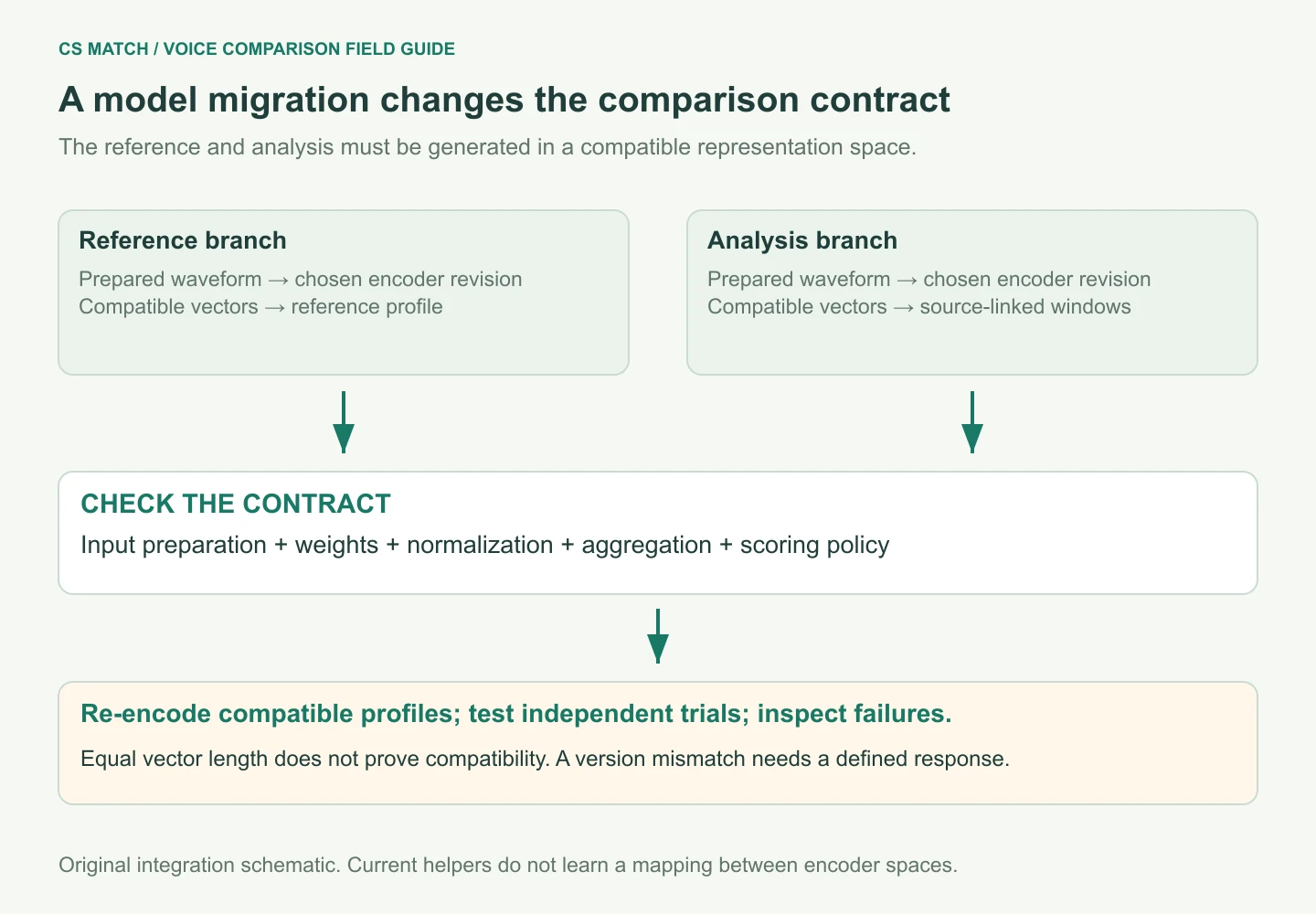
Define the waveform contract first: sample rate, channel handling, speech selection and time mapping. Then define the representation contract: model revision, feature preparation, output dimension and normalization. Finally define aggregation and scoring. An interface returning a list of numbers can conceal differences at all three levels, so matching a function signature is not enough for compatibility.
Equal output length is particularly misleading. Two independent encoders can produce vectors with the same dimension and unrelated coordinate systems. Comparing one system's reference with another system's analysis vector is not justified by their shared shape. Re-encode both sides consistently, or develop and independently validate a mapping. The current CS Match helpers do not perform that mapping.
Store an engine identifier beside profiles and diagnostic results, and define migration behaviour before changing weights. Existing references may need regeneration from retained, permitted source material or renewed enrollment. Test a version mismatch deliberately. An understandable incompatibility message is preferable to a plausible-looking score whose relationship to the previous profile has never been established.
Use metrics that belong to the task being changed
Verification evaluation uses labelled target and non-target trials to measure decisions or score distributions. Diarization evaluates the assignment of speech over time, while transcription evaluates recognized words. Their error rates use different denominators and protocols. Putting a verification EER beside a diarization error rate and sorting by the smaller number does not create a meaningful library ranking.
Build separate questions into an evaluation. Does the candidate encoder improve separation on independent reference trials? Does a turn pipeline reduce missed speech, confusion or overlap errors? Does transcription retain useful words and timestamps? A system can improve one output and regress on another, particularly when a preprocessing change feeds several tasks at once.
Keep shared conditions fixed where comparison requires it, and explicitly report pipeline differences where a complete-system comparison is intended. Include uncertainty from a limited sample and inspect error cases. A small evaluation can guide development without supporting a broad public accuracy claim. Name the population and operating policy so readers understand what the result can reasonably predict.
Measure runtime on the workflow, not only a single model call
A short warm inference example excludes model download, initialization, decoding, speech segmentation and report assembly. Measure those stages separately and also measure the complete job. Long recordings can produce many overlapping windows, so the relationship between file duration and embedding workload depends on the windowing policy and detected speech. Concurrency introduces another dimension beyond single-file timing.
Use the same host, input set and measurement boundaries when comparing candidates. Report cold and warm runs, peak memory and failures, together with hardware and thread settings. Include a recording with little speech and one with many speakers so convenient examples do not dominate the results. A faster encoder may still produce a slower workflow if its surrounding preparation is expensive.
Export and reduced precision should be treated as additional configurations to validate. Check output parity and the decisions affected near the operating threshold, then measure any resource benefit. Do not assume a supported runtime makes every model equally deployable. Select the configuration that meets the application's measured needs and can be maintained on the intended infrastructure.
Review artefacts, dependencies and execution boundaries separately
A practical adoption review inventories the library code, selected weights, data used for adaptation and any external service involved. Each artefact has its own provenance and published conditions. Record the versions and source references needed to reproduce installation. An open repository is useful evidence about code availability, but it is not a substitute for inspecting the exact artefacts a deployment consumes.
Dependency fit can determine whether a promising model is maintainable. Test it in an isolated environment before altering a working worker stack. Identify audio decoding requirements, framework versions and hardware assumptions. Keep a rollback path to a known environment and weights. This is ordinary release engineering, particularly when several speech components share a Python process.
Execution location also needs to be explicit. Local inference after a model download differs from sending a recording to a hosted API. A library may support both arrangements, as the pyannote examples demonstrate. The appropriate choice depends on the actual application requirements and selected route; avoid describing a whole ecosystem as uniformly local, cloud-only or operationally equivalent.
Run a controlled migration study before replacing the baseline
Keep an immutable set of permitted evaluation recordings with independent reference and test sessions. Include target pairs, non-target pairs, difficult channels and insufficient-speech cases. Run the existing configuration and candidate against the same declared protocol. Preserve source selections and outputs so a difference can be inspected at the passage level instead of reduced immediately to one aggregate number.
Change one layer first. For an encoder experiment, retain reference policy and scoring where technically appropriate. For a diarization experiment, keep the reference encoder stable and measure changed turns separately. Complete-pipeline comparisons are also legitimate, but label them as such. Their gains cannot be attributed to one model without a further controlled comparison.
Define acceptance criteria before examining final results: error behaviour at the intended threshold, runtime budget, compatibility handling and understandable failures. Include the operational cost of rebuilding profiles and supporting another environment. A candidate is ready when its demonstrated improvement justifies those costs and its behaviour can be reproduced, not merely when its sample command completes successfully.
Why the current combination fits our scope, and when to reconsider
Our current workflow combines SpeechBrain ECAPA embeddings with separate speech detection, custom speaker grouping and faster-whisper transcription. It compares an analysis recording with a supplied reference and keeps source intervals available for review. Using distinct components allows us to inspect and improve each output while preserving a clear boundary between words, speaker groups and reference resemblance.
That is a practical engineering rationale, not a measured claim that this combination beats every alternative. NeMo may suit a broader coordinated speech stack; WeSpeaker may support a focused encoder and runtime study; Kaldi may fit a backend research workflow; pyannote may address diarization requirements. Each possibility needs a specific candidate configuration and evidence on the relevant task.
Retain the baseline while building that evidence. The most valuable next step may be better reference selection, engine provenance or independent evaluation rather than replacing a library. When an alternative demonstrates a useful gain, the component boundaries make adoption easier to reason about. Our choice remains accountable to reproducible results and the recording-review experience the application actually provides.
Questions about this workflow
Which library has the best accuracy?
There is no library-wide accuracy number. Compare specific checkpoints and complete configurations on the same declared trials and source conditions, using metrics appropriate to the task.
Can pyannote speaker labels identify the reference person automatically?
Recording-relative turn labels do not establish a personal identity. Reference matching requires an additional defined comparison step and independent evaluation.
Can we reuse profiles after switching to another encoder?
Do not assume compatibility, even with equal dimensions. Re-encode compatible sources or evaluate a deliberately developed mapping, and preserve model-version information.
Why keep SpeechBrain if alternatives exist?
It provides a documented baseline that fits our current two-source workflow. Retain it until a concrete alternative demonstrates sufficient benefit under the same evaluation and operational requirements.
Continue with the next useful step
ECAPA-TDNN and VoxCeleb: Training, Checkpoints and Real-World Limits
Understand ECAPA-TDNN training, VoxCeleb trial protocols, pretrained checkpoints, augmentation, reproducibility and the limits of applying benchmark results to real voice comparison.
Speaker Embeddings Explained: From i-Vectors to ECAPA-TDNN and WavLM
Understand how speech becomes a speaker vector, how i-vectors, x-vectors, ECAPA, residual networks and WavLM differ, and why compatible checkpoints, aggregation and evaluation matter more than a vector label.
How Voice Comparison Works: From Recording to Reference Match
Follow the complete voice-comparison pipeline: source preparation, speech detection, windows, speaker embeddings, reference profiles, similarity scoring and source-linked review, with the current CS Match implementation explained.