
Prepare an Audio Recording for Transcription and Analysis
Inspect the original, improve a working copy only where needed, and prepare the analysis and reference sources.
Updated · Cyber Search MatchKeep an untouched original. Check speech clarity and clipping, prepare a conservative working copy if needed, then supply both the analysis recording and a deliberate reference sample to Audio Analysis.
Step 1 — inspect the original recording.
Listen through quiet speech, loud speech and any overlapping conversation. Note the language, likely speaker changes and intervals you need to review. If the source is video, the audio task extracts its sound; image content does not help this workflow transcribe speech.
Choose the correct audio track if the file contains several. Keep the original privately so that later cleaning decisions can be compared against it. Converting a heavily compressed source to WAV does not restore removed information.
Step 2 — improve a copy only where needed.
Use Audio Volume for a consistently quiet recording or Normalize Audio for a perceived-loudness target. Begin with modest changes and listen again. Neither operation reconstructs already clipped peaks or separates voices speaking over each other.
If steady background noise masks speech, compare a short denoised preview with the source. Strong reduction can remove useful consonants and change voice features. For a comparison task, keep the original and record any processing applied to either source.
Step 3 — prepare both sources for the current form.
Two source files are required: the recording to analyse and a reference voice sample. Choose a clear sample with one speaker when voice comparison is useful. Do not interpret a recording compared against itself as independent evidence of speaker identity.
Choose automatic speaker detection or the appropriate speaker count, then review the sources before submission. A transcript-focused task still uses this two-source workflow in the current interface; there is no separate single-file shortcut promised here.
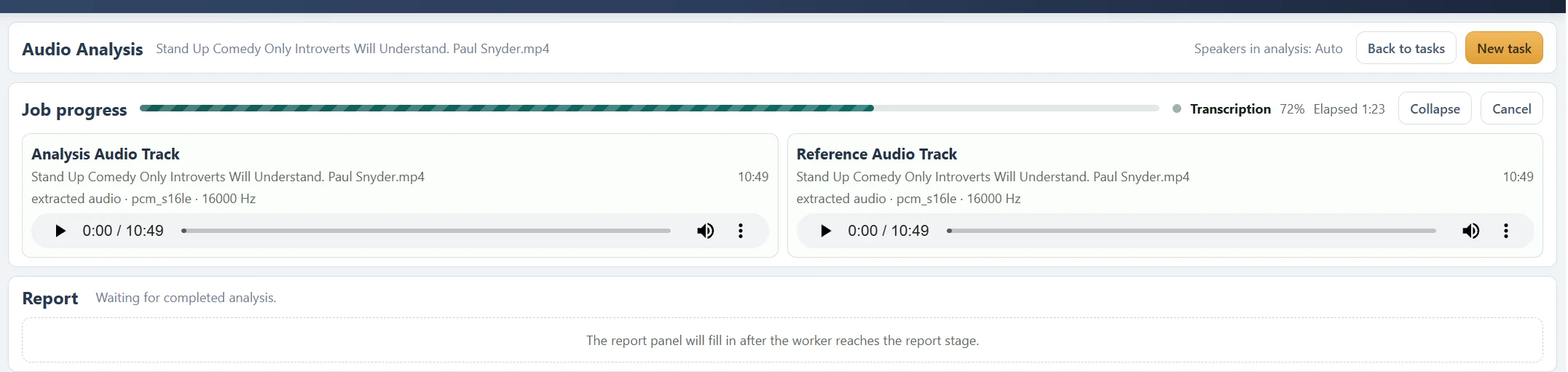
Step 4 — use the report as a navigation aid.
After completion, review Dialogue transcript, numbered speaker segments and the technical comparison separately. Listen at turn boundaries and verify names, numbers and other important words against the original.
Keep review notes with timestamps and distinguish model estimates from your listening checks. Speaker labels are not verified names, and voice similarity is not legal identification. Resolve uncertain passages before reusing their text.
Before you finish
- The original is retained alongside any processed copy.
- A clean reference was selected deliberately.
- Important transcript passages and speaker changes were checked by ear.
Questions about this workflow
Should I always denoise before analysis?
No. First listen to the source. Denoising can remove speech detail and alter voice features; use a conservative working copy only when it helps.