
Face comparison errors, accuracy and practical limits
Diagnose false matches, missed matches and unavailable comparisons. Learn what image quality changes, how to test results and why a score is not identity proof.
Implementation checked · Cyber Search MatchA face comparison can be wrong even when the detector finds a clear box and the interface shows a high percentage. Examine the source, selected reference, raw score and processing conditions. A technical-similarity label is evidence about model representations, not a verified identity or a liveness check.
Three failure modes need different responses
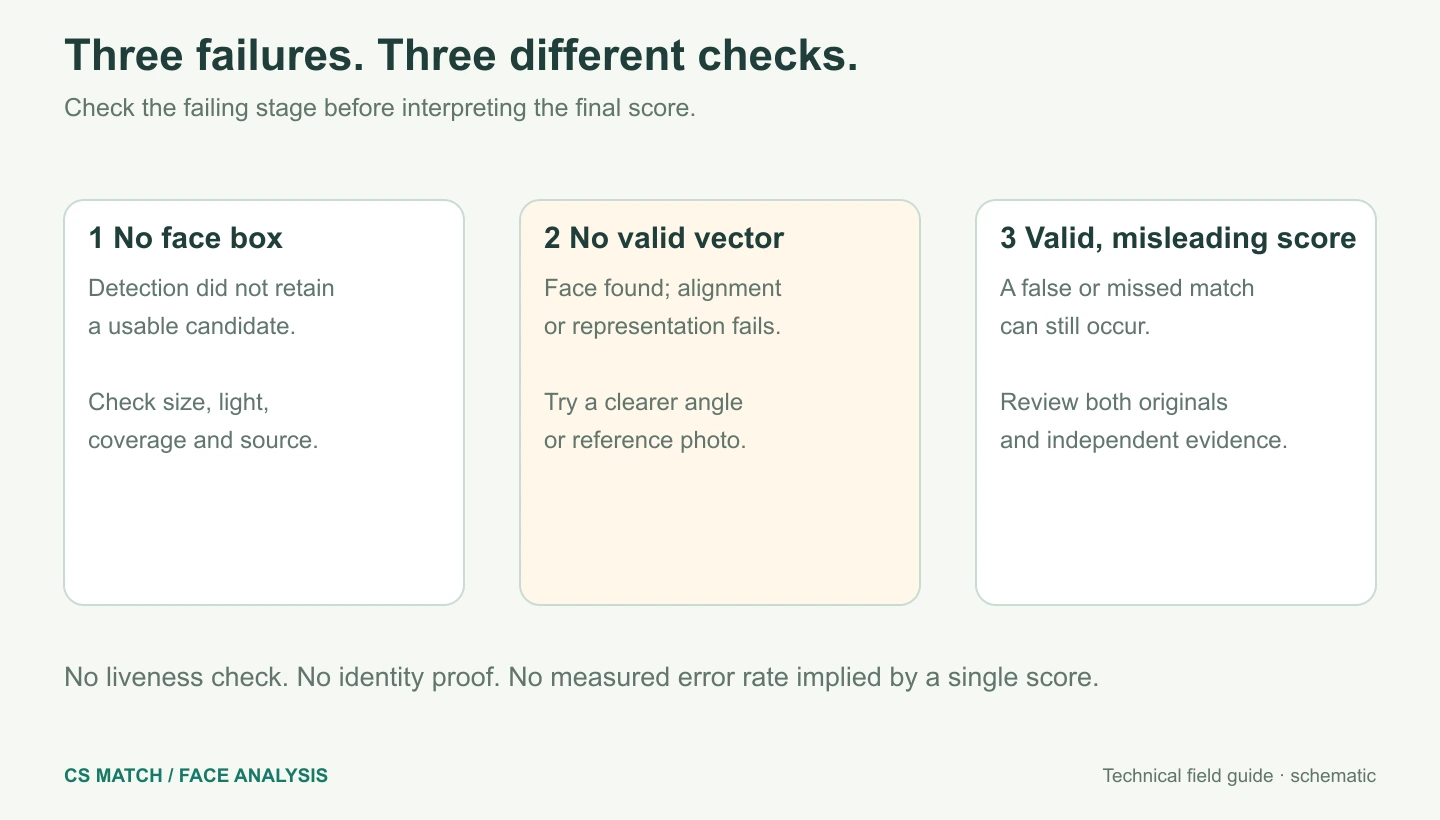
A false match occurs when different people receive similarity high enough for the application’s decision rule. A missed match occurs when photographs of the same person fall below that rule. An unavailable comparison occurs when a usable representation cannot be calculated. The third case is not a low-scoring match and should not be counted as one.
Detection has its own errors: a visible face may be missed, or a region may be detected incorrectly. The recognition stage only receives the detections that survive that stage. Improving a comparison threshold cannot recover a face that was never detected. Likewise, a high-confidence face detection cannot repair poor recognition input.
Start troubleshooting at the earliest failing stage. If there is no box, examine size, light and occlusion. If the wrong person is selected, correct the reference. If alignment is unavailable, try a clearer angle. If valid vectors disagree with known ground truth, document that as a comparison error rather than changing the story to fit the score.
| Observed result | What to check first |
|---|---|
| No face box | Visible face size, darkness, coverage and whether the image was reduced |
| Face found, comparison unavailable | Landmarks, pose and whether the face can be aligned |
| Unexpected low similarity | Reference selection, capture differences and source quality |
| Unexpected high similarity | Repeated portraits, resemblance, possible false match and the original context |
A bigger display does not add facial information
Blur, compression, small face size, strong exposure and partial coverage can remove details before the model sees them. The 112 × 112 aligned input standardizes the representation stage; it does not mean a tiny face in the original becomes informative when enlarged. Upscaling a few facial pixels creates more pixels, not new observations.
Extreme pose can hide landmarks and cause geometric alignment to be less useful. Shadows, glasses, masks, expression and changes over time can move a representation even for the same person. A restored or generated face may contain plausible invented detail. It should not be presented as a faithful recovery of evidence that the original did not record.
Use the clearest available original rather than a screenshot of a screenshot. Check both photos at a useful scale and compare reasonably similar angles where possible. A second independently captured, clear reference can help you assess whether the result is stable. Repeated near-identical crops of the same frame do not provide independent confirmation.
The reference choice can dominate the conclusion
A group photo used as a reference requires an explicit person selection. Check the numbered face, the reference crop and the original image together. A face number is local to that detection result, so the same number in another photo does not mean the same person. The Compared view makes the selected reference visible in every pair to reduce this ambiguity.
Repeated portraits, mirrors, collages and multiple photographs of one person can generate several detections. The report compares those detections independently. Neither the detection count nor the number of strong scores is a reliable count of unique people. Nearby or overlapping faces can also leave unwanted context in a crop.
When comparing a dense group, split the image if needed and keep track of overlapping regions. Record which reference was used for each run. Do not combine several trials by choosing only the highest score and then present it as though it were a single planned comparison.
Thresholds change the tradeoff, not the underlying evidence
Requiring a higher similarity for a positive decision can reduce some false matches while increasing missed matches. Requiring a lower value has the opposite tradeoff. A useful operating threshold depends on the intended data and the consequences of errors. The current display endpoints and strong/low bands do not provide a published false-match or missed-match rate for CS Match.
For a labelled evaluation, false-match rate measures how often different-person pairs cross a chosen threshold. False-non-match rate measures how often same-person pairs fail it. Those rates require genuine ground truth, defined sampling and enough relevant examples. They cannot be inferred from a single 100% comparison or from the detector’s confidence value.
In group comparisons or index searches, more candidates create more opportunities for an incidental high score. A small portrait-pair demonstration does not establish accuracy for a large candidate set, and a neural-network paper’s benchmark does not automatically transfer to this deployment. Keep the raw values and the number of tested candidates when documenting a result.
False-match rate: different-person pairs above the chosen threshold / all tested different-person pairsFalse-non-match rate: same-person pairs below the chosen threshold / all tested same-person pairsPerformance can differ across people and capture conditions
NIST’s face-recognition evaluation describes variation in false-positive and false-negative behaviour across demographic groups and capture conditions. Its reports also explain that image quality can contribute to measured differences. This is a reason to evaluate representative data, not a basis for assuming that one benchmark average describes every user.
Those NIST findings are background research, not a certification or independent test of CS Match. This project does not publish subgroup error rates for its current Face Analysis deployment. It also does not infer someone’s ethnicity, sex or age as part of the comparison report. A numerical face-similarity output should not be interpreted as such an attribute.
Include difficult but realistic conditions in any evaluation: different cameras, lighting, angles, face sizes and time gaps. Separate the effect of image quality from the effect of changing the person. Report failures and unavailable cases alongside successful examples instead of excluding them from the denominator without explanation.
A useful test is planned before the scores are read
Prepare a permitted, labelled set containing both same-person and different-person pairs. Keep near-duplicates and frames from the same capture from leaking into both development and test sets. Decide the reference-selection procedure and decision threshold in advance. If you tune a threshold, reserve separate data for the final check.
Record the model checkpoint, input-processing convention, thresholds, date, source dimensions, face sizes, reference selection and raw score for each pair. Preserve the original photos securely where you are entitled to do so. A changed model or preprocessing pipeline is a different experiment, even if the interface has the same name.
Count missed detections and unavailable comparisons separately, then report the error tradeoff for valid pairs. Inspect failures rather than reporting only an overall percentage. Our demo screenshots illustrate the interface with repeated sample portraits; they are not an accuracy dataset, and no production accuracy claim is derived from them.
- Define the question and ground truth before testing.
- Use representative photos and separate development from evaluation.
- Keep raw scores, thresholds and unsuccessful cases.
- Describe the capture conditions and sample size.
- Re-test after a model or preprocessing change.
What the tool does not establish
Face Analysis compares visible facial representations. It does not verify a legal identity, establish authorship, authenticate an account holder, detect whether a portrait is live or prove that an image is unedited. The current route has no liveness or spoof-detection stage, even though those are separate subjects in face-analysis research.
A face vector is not harmless merely because it is numerical. Use material you are entitled to process and keep the surrounding context. The tool does not add Face Analysis uploads to the public index, and the browser receives crops and scores rather than embedding arrays. Processing still happens on the server; do not assume an upload stayed only on your device.
When you need to investigate publication context, use Search this face to open the separate public-index search and inspect the recorded sources. Index coverage is incomplete, and resemblance is not provenance. Treat comparison, source research and independent verification as complementary steps, each with its own limits.
Questions about this workflow
Can a clear photo of a different person receive a high score?
Yes. Learned representations can be close for different people. A high score is not identity proof.
Does a low score prove two photos show different people?
No. Poor quality, strong angles and capture differences can produce missed matches.
Does the tool detect deepfakes or prove a person is live?
The current Face Analysis pipeline does not include a liveness, spoof-detection or image-authenticity stage.
Do the demo screenshots establish the system’s accuracy?
No. They demonstrate the interface with sample portraits. A reliable accuracy claim requires a labelled, representative evaluation.
Understand the pipeline, the vectors and the limits.
How face detection and alignment work
Follow a photo through CS Match: image preparation, SCRFD detection, five facial landmarks, person crops and 112 × 112 alignment for comparison.
Face vectors, ArcFace and the recognition model
Understand our 512-value face embeddings, RGB preprocessing, L2 normalization, angular similarity and the difference between model training and inference.
How a face is compared with a reference
Follow our exact comparison request: reference selection, two inference passes, cosine similarity, the 0.45–0.72 display scale and report decisions.