
License Plate OCR: PaddleOCR, CRNN, LPRNet and Transformers
Understand OCR frameworks, character segmentation, CRNN and CTC decoding, LPRNet and transformer recognizers, with a worked repeated-character example and guidance for evaluating CCTV plate reading.
Sources checked · Cyber Search MatchChoosing plate OCR means choosing an input representation, trained recognizer, alphabet and decoder, not just a library name. PaddleOCR is a framework; CRNN and LPRNet are model families; CTC is a sequence-learning and decoding approach. Transformer recognizers introduce further design choices. Compare complete registration readings on the same source data before drawing conclusions about accuracy or speed.
Compare components at the same level
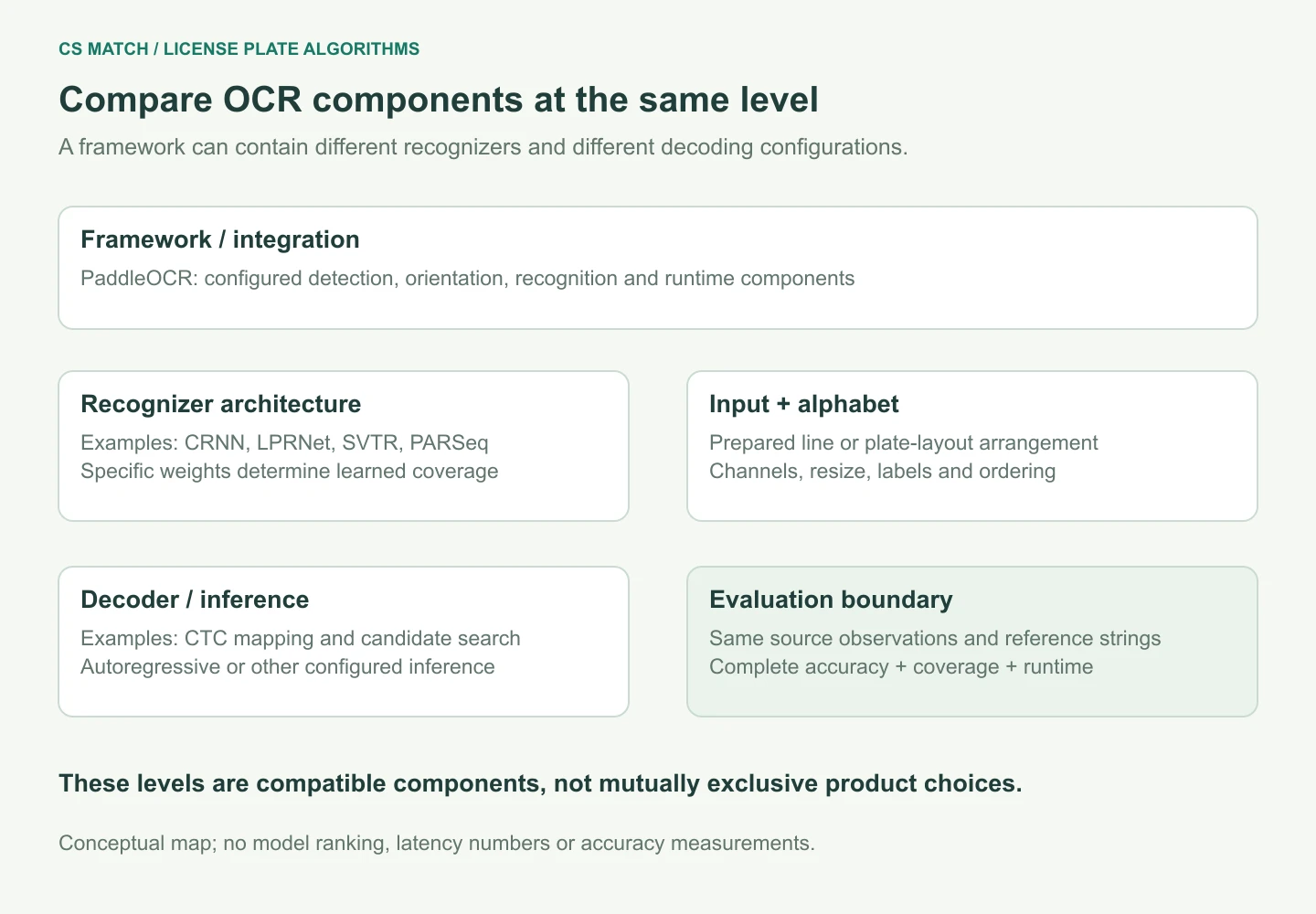
An OCR framework can supply text detection, orientation handling, recognition and deployment utilities. A recognition architecture defines how an image becomes character evidence. A decoder defines how that evidence becomes a string. Model weights determine what the system has actually learned. These layers interact, but their names are not interchangeable entries in a simple product ranking.
PaddleOCR's versioned documentation describes separately usable detection, classification and recognition components. The application chooses their configuration and interprets their outputs. A framework can contain several recognition families, and a transformer-based visual encoder can be paired with a CTC-style head. Consequently, comparing PaddleOCR with CTC as though only one could be selected is a category error.
For a reproducible comparison, record the package version, exact weights, alphabet, image preprocessing, decoding settings and hardware. A package upgrade may change defaults without addressing the actual failure in a specialty plate. Begin with the required output and the images the recognizer receives, then compare implementations that solve the same task under a controlled budget.
| Name | Level | Question it answers |
|---|---|---|
| PaddleOCR | Framework and pipeline components | Which configured detector and recognizer run? |
| CRNN / LPRNet | Recognition architectures | How is visual character evidence computed? |
| CTC | Training objective and sequence decoding | How are unsegmented positions transcribed? |
| Transformer recognizer | Architecture family with different heads | How are visual and optional token contexts modelled? |
Define the recognizer input before testing its output
A text-line recognizer expects a different input from a full-plate layout model. A prepared line can exclude the state name and slogan; a full crop can contain multiple registration rows and a stacked prefix. Feeding both to one recognizer without documenting the arrangement makes failures difficult to interpret. A good result on manually isolated text is not end-to-end ALPR accuracy.
Specify channel order, colour handling, scaling, aspect-ratio treatment and padding. Stretching a compact plate into a thin strip can alter character shapes, while clipping a wide patch can remove the final digit. The correct preprocessing depends on the trained model. An arbitrary larger tensor does not supply detail missing from the original image.
Keep registration-region selection distinct from character recognition. A model can correctly read a slogan that the application should exclude. Likewise, a perfectly selected main line can still omit required small letters. The layout guide explains those selection decisions; evaluate OCR on both controlled crops and the actual inputs generated by the preceding stages.
Character segmentation offers explicit boundaries and explicit failure modes
A segmentation-first recognizer separates character-shaped regions, orders them and classifies each patch. Traditional implementations may use thresholding, connected components or contour-based grouping, while learned approaches can detect individual characters. Their appeal is inspectability: a missing character region or merged pair can be seen before classification.
Their difficulty is deciding boundaries under realistic capture. A screw can create an extra component, a faint stroke can split one character, and blur can merge adjacent characters. Decorative edges and stacked letters complicate ordering. Counting detected patches is not equivalent to knowing how many registration characters the plate should contain.
Use segmentation as a controlled baseline when appropriate, with labels for character regions as well as the complete string. Compare its mistakes with a sequence recognizer on identical plate inputs. If both methods fail because the source crop omitted a prefix, changing classification architecture is unlikely to address the cause. Preserve that upstream failure in the evaluation.
CRNN combines visual features with sequence modelling
The CRNN paper by Shi, Bai and Yao describes an end-to-end architecture combining convolutional feature extraction, recurrent sequence modelling and transcription. An image line becomes an ordered feature sequence rather than a set of manually segmented characters. The architecture can handle variable-length strings through the transcription stage.
For plates, that removes the need to cut every character perfectly before recognition, but it does not remove the need for suitable training data or correct layout preparation. A network trained on ordinary horizontal text can still struggle with small registration stacks or unfamiliar plate fonts. The learned input distribution matters as much as the architecture label.
Inspect substitution, deletion and insertion errors separately. A recognizer that drops a narrow character differs from one that reads every character but confuses O and 0. Keep the reference string faithful to the registration rather than a dictionary word. Compare full-string results and partial character diagnostics; neither alone describes all the operational behaviour.
CTC handles alignment; repeated characters need care
CTC provides a way to train sequence transcription without assigning each target character to a fixed input position. Its paths include a blank label, and multiple paths can correspond to the same target string. The original Graves and colleagues paper defines the mapping and sequence probability. Input positions are not inherently separate physical character boxes.
Consider the fictional path A, A, blank, A, B, B, blank, 1, 1. First merge consecutive repetitions within the path, producing A, blank, A, B, blank, 1. Then remove blanks, giving AAB1. The blank between the two A runs preserves a genuine repeated character. Removing blanks before merging repetitions would incorrectly collapse that pair.
This is a deterministic teaching example, not an actual model output or an accuracy measurement. It explains why an OCR parser must respect its recognizer's decoding semantics. A postprocessing rule that deletes all repeated letters can corrupt valid registrations. Repetition across model positions and repetition within the intended identifier are different concepts.
Illustrative path: A A blank A B B blank 1 1Merge adjacent repeats: A blank A B blank 1Remove blanks: A A B 1 → AAB1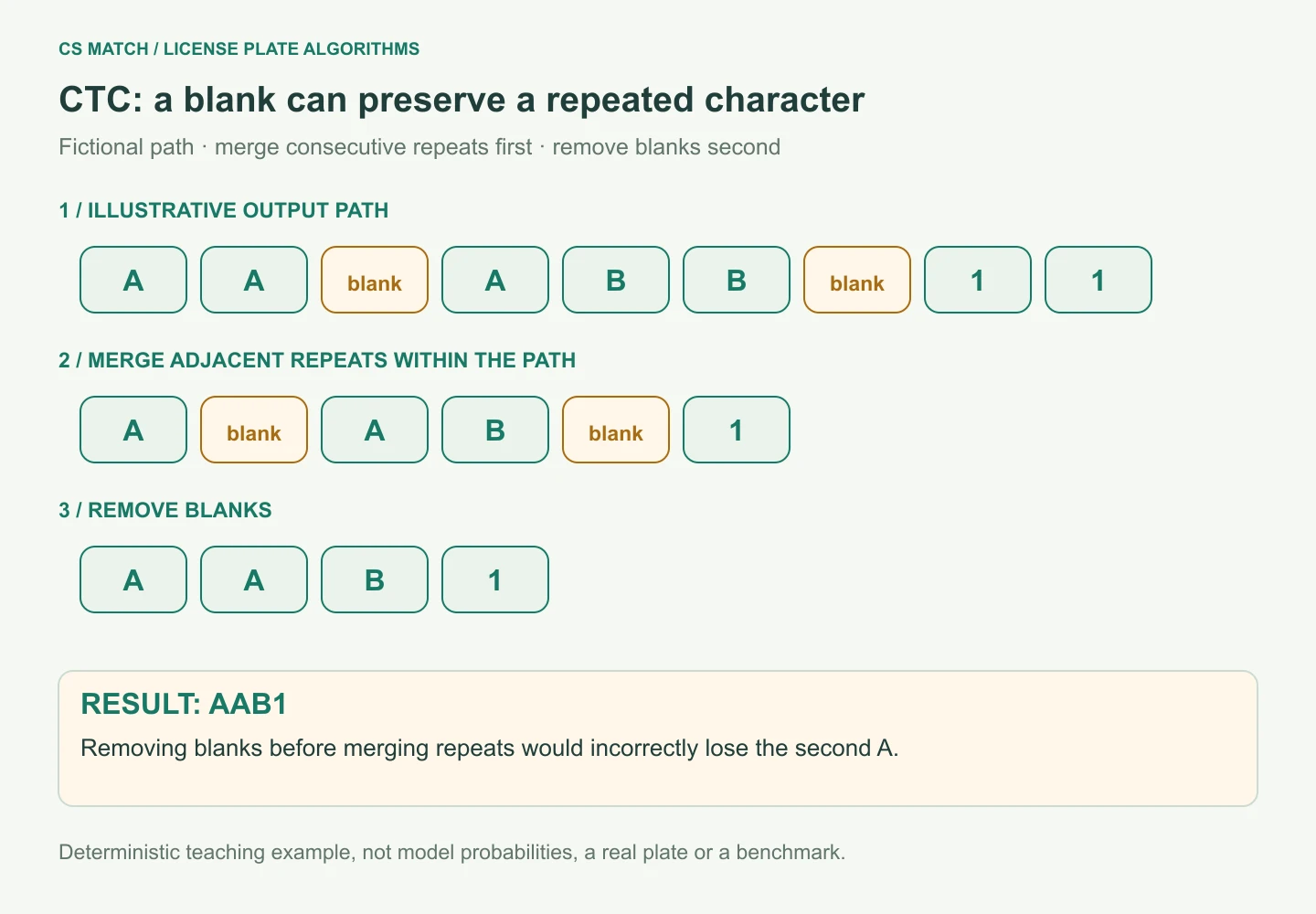
Best-path and beam decoding answer different search questions
Best-path decoding selects a highest-scoring label at each output position, then applies the transcription mapping. Beam-style search can consider multiple partial sequences rather than committing at every position. Candidate search is distinct from the visual network: changing the decoder can change the selected string without changing the captured pixels or extracted features.
Keep search constraints explicit. An alphabet can exclude symbols that the model cannot produce; a format prior can favour certain arrangements; a lexicon can prefer known strings. Those choices can improve a defined task while also rejecting genuine unfamiliar registrations. Ordinary-language spelling correction is especially questionable for arbitrary identifiers and personalized combinations.
Evaluate extra candidates with complete strings and a fixed computational budget. Increasing the beam does not guarantee improved deployed accuracy, and a list of alternatives needs a review or selection policy. Preserve the unconstrained candidate when a regional rule changes the answer. Decoder scores should not automatically be displayed as calibrated probabilities of plate correctness.
LPRNet specializes the recognition stage
LPRNet proposes a lightweight convolutional recognizer for license plates without preliminary character segmentation or recurrent layers. Its published experiments concern particular data and hardware. The architecture offers an example of a specialized recognition stage, not proof that every pretrained LPRNet weight file handles every country's layouts.
A specialized model still has an expected input size, alphabet and training distribution. Confirm those before interpreting its output. A detector, rectifier and layout selector may still be required around the recognition network. If a model expects one prepared registration patch, giving it a whole vehicle crop changes the task rather than providing a fair comparison with scene-text OCR.
Compare available implementations on the same retained plate observations, including unfamiliar designs and failed reads. Measure exact strings, missed characters, abstentions and inference cost under the intended runtime. Do not transplant the paper's numerical accuracy into a claim about our CPU deployment or US specialty plates. Architecture evidence and local measurements should remain identifiable as different sources.
Transformer recognizers are not one decoding method
Transformer-style recognition covers different ways of modelling visual patches and token context. SVTR uses a visual model with local and global component mixing; it should not be described as a conventional recurrent recognizer merely because its output is a string. PaddleOCR also documents an SVTR configuration with a CTC-related recognition setup.
PARSeq provides a different example, using permutation language modelling and supporting different inference modes and refinement. This illustrates why attention, autoregressive prediction and parallel transcription should not be treated as synonyms. Compare a specific trained configuration, not the broad claim that transformers must always be slower or more accurate.
Context can help ambiguous characters, but identifiers make incorrect repair costly. A model's preference for a likely sequence can conflict with the actual registration. Include unusual combinations and held-out designs in testing. When a candidate changes during refinement, retain the source evidence and distinguish a supported reading from a context-driven hypothesis that remains unresolved.
PaddleOCR is configured software, not one fixed recognizer
The current project pins PaddleOCR 2.7.3 and PaddlePaddle 2.6.2 in the video worker requirements. Its resident LPR role initializes the legacy OCR interface with angle classification enabled and an English language configuration by default. These facts describe our integration; they do not establish the exact architecture of every downloaded weight file without inspecting the deployed model artifacts.
The worker submits candidate plate images to that interface and joins returned text fragments. It averages fragment scores, normalizes text and applies configured regional validation. It does not currently expose character-level probabilities, semantic text roles or an alternative beam decoder in the report. A framework supporting additional models does not activate those features automatically.
Check the character dictionary against the trained output head as well as the language setting. Adding a symbol to a dictionary is not equivalent to teaching compatible weights to recognize it. A mismatch in label ordering can produce systematically incorrect strings even when inference completes. Include alphabet and decoder compatibility in a replacement's integration checks.
A fair replacement experiment should preserve the current observations, record exact new weights and compare both raw and final strings. Test parser compatibility as well as model inference. An improved recognizer can lose its benefit if an adapter changes line order, drops small regions or interprets the returned score differently. Integration behaviour belongs in the evaluation.
Training coverage determines which visual evidence generalizes
Training for plate OCR needs accurate strings and representative inputs. Vary fonts, spacing, viewpoints, character sizes and relevant capture defects, while keeping the labels consistent with the intended registration. For multiline or stacked layouts, specify whether selection and ordering occur before recognition or inside the model. Those are different learning problems.
Synthetic examples can expand coverage but can also teach shortcuts from uniform rendering. Hold out real cameras and design families when evaluating generalization. Cross-dataset recognition research motivates checking beyond familiar test distributions. Compression-informed transformer research offers a specific investigation of heavily compressed plates; it is not evidence that every transformer automatically repairs compression artifacts.
Keep unreadable captures and uncertain references identifiable. A guessed target string can reward a model for reproducing a prior rather than observing detail. Separate training, tuning and evaluation at vehicle or recording level so neighbouring frames do not leak across them. Improvement on a synthetic crop should be confirmed on the actual source conditions the application is intended to handle.
Evaluate the full identifier and the runtime budget
Define the comparison before running it: common input crops, a reference set, output normalization and hardware settings. Report exact-string accuracy and character error rate separately, then include detection and passage coverage for the complete pipeline. A model evaluated only on successful readable crops answers a narrower question than a system expected to find plates in arbitrary CCTV recordings.
Measure latency with warm-up behaviour, batch size and CPU or GPU configuration stated. Record memory and any extra text detector or rectifier required by the candidate. One recognizer can appear faster simply because its evaluation omits preprocessing that another includes. No architecture ranking is meaningful without a consistent boundary around the work being timed.
Break down errors by layout, lighting and source quality. Test regression on ordinary horizontal plates when improving a difficult specialty design. Report no-read outcomes and the number of examples behind each category. A useful choice balances supported complete readings, processing cost and understandable failure behaviour rather than maximizing one isolated confidence score.
Choose the next experiment from the observed failure
If the source plate is clipped or severely oblique, address localization or geometry first. If the correct crop contains a slogan joined to the registration, investigate layout selection. If the intended registration region is correct but characters are systematically confused, compare recognition training or decoder alternatives. These diagnoses lead to different experiments and should not be collapsed into replacing the entire library.
For our current workflow, retain the source plate, compare the original and enhanced variants and inspect nearby vehicle observations. Note whether the raw reading is wrong or only the normalized result is rejected. The application already supplies an inspectable path through crops and source times, which is a useful baseline for measuring a new stage.
Start with one bounded change and a fixed reference set. Keep successful and failed cases, document the model artifacts and compare complete strings under the same conditions. This can justify adopting a specialized recognizer or improved parser when evidence supports it. It does not require claiming that one model family is universally best or that a plausible-looking reconstruction is a verified plate reading.
Questions about this workflow
Is PaddleOCR an alternative to CRNN or CTC?
They are different levels of a system. PaddleOCR is a framework that can contain recognition architectures and decoders; CRNN is an architecture and CTC is a sequence-learning and transcription approach.
Why can CTC preserve two identical adjacent letters?
A blank can separate their runs in the model path. Merge consecutive repetitions before removing blanks; deleting all repeated characters would corrupt some valid strings.
Are transformers always autoregressive?
No. Visual encoders, prediction heads and inference modes differ. Compare a specific trained configuration, including its decoder and preprocessing.
Does this article install a new OCR model in CS Match?
No. It explains the current integration and candidate architectures. New recognizers, weights and decoding behaviour require a separately evaluated implementation change.
Continue with the next useful step
License Plate Detection and Perspective Correction
Compare axis-aligned boxes, rotated rectangles and four-corner plate geometry. Learn homography, corner checks, resampling, coordinate mapping and how to evaluate rectification on CCTV.
Why US License Plates Are Difficult for ALPR
Explore American plate designs, personalized strings, stacked characters, jurisdiction recognition and CCTV domain shift, with documented state examples and a practical evaluation strategy.
US Specialty Plates: Graphics, Stacked Letters and Multiple Lines
Learn to separate registration characters from slogans, graphics and labels, order stacked and multiline text, and evaluate layout-aware OCR using documented US examples and annotated schematics.