
Why US License Plates Are Difficult for ALPR
Explore American plate designs, personalized strings, stacked characters, jurisdiction recognition and CCTV domain shift, with documented state examples and a practical evaluation strategy.
Sources checked · Cyber Search MatchUS plate recognition must handle more than a national alphabet. The issuing jurisdiction, plate class, design generation and personalized configuration can change which marks belong to the registration and how they are arranged. A robust pipeline separates those questions, preserves uncertain readings and tests unusual designs independently from ordinary passenger plates.
A state, a plate design and a registration are different attributes
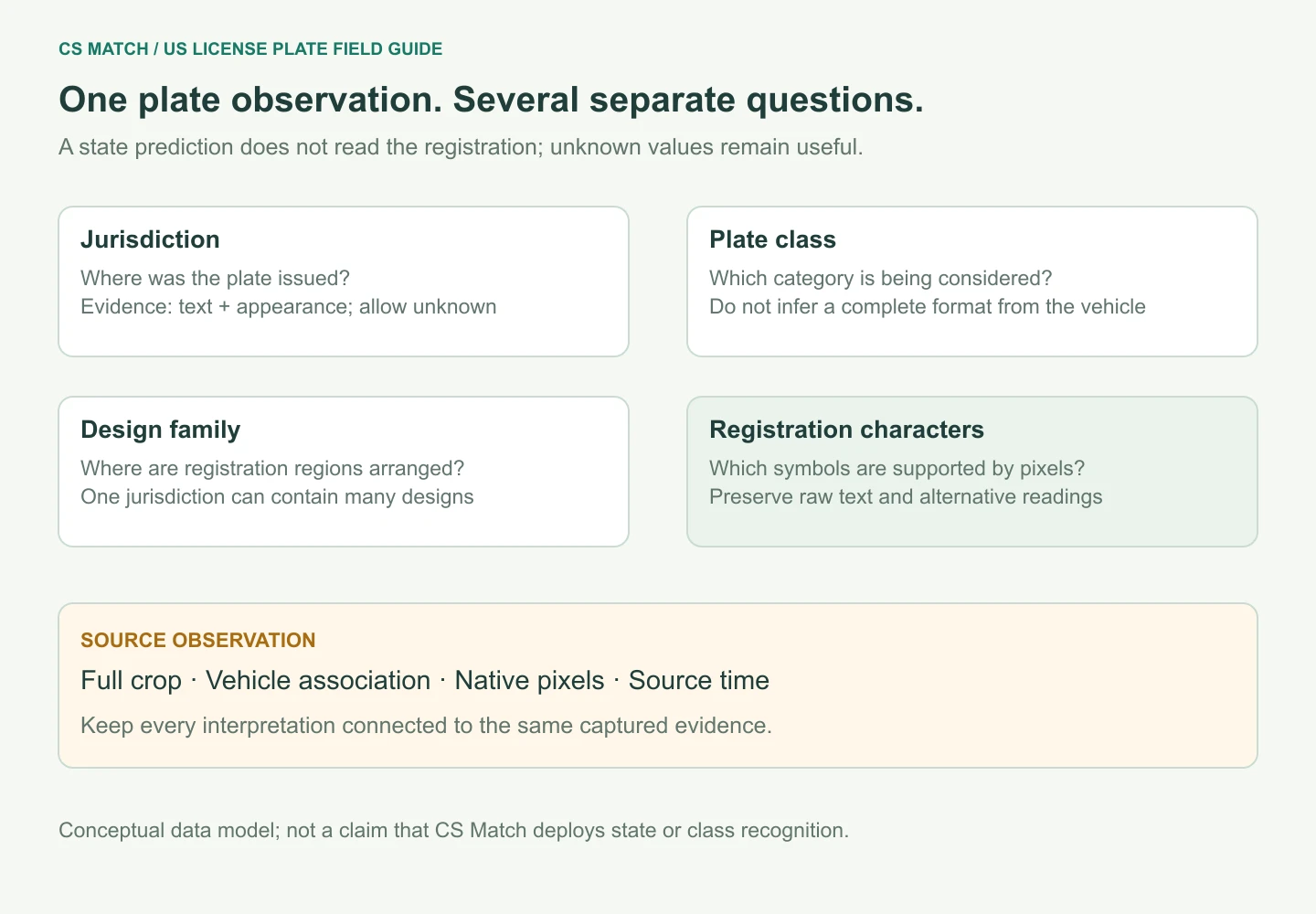
Treat a plate observation as a structured record. It can contain the issuing jurisdiction, a plate class, a design family, visible registration characters and the source time. These attributes are related but not interchangeable. Recognizing a familiar background does not read the identifier, and reading an identifier does not necessarily establish where it was issued.
A single jurisdiction may offer a standard design, special-interest designs and personalized combinations. California DMV explicitly describes both graphic special-interest plates and sequential or personalized configurations. That distinction explains why learning one California-looking template cannot cover every California plate. The relevant model coverage is the range of issued appearances, not merely a state label in a settings menu.
Keep unknown values available. If the state name is cropped away, the system may still produce useful character candidates. Conversely, a visible jurisdiction name can coexist with an unreadable registration. Conflating these outcomes encourages a classifier's confident background prediction to overwrite ambiguous text. The report should allow a reviewer to inspect each attribute and its supporting image region separately.
Official examples reveal several kinds of variation
Use primary issuing-agency documents to establish a design's supported configuration, then use captured footage to evaluate recognition. An application form is evidence about available plate options, not a benchmark of OCR accuracy. A recognizer can fail on a design that is perfectly described in a catalogue, especially when CCTV removes the smaller distinguishing details.
New York's personalized-plate guidance permits different character capacities for standard, motorcycle and picture plates. Maryland's integration guide lists tag formats that include stacked letters. California's REG 17 form offers several design families and separate symbol choices for Kids Plates. Together, these examples show variation in capacity, geometry and symbol handling without requiring speculative claims about all fifty states.
The engineering response differs for each case. Capacity differences affect validation; stacked characters affect ordering; graphics and symbols affect region selection. Do not label all three as bad image quality. Annotate which stage failed and keep the original issuing-agency reference with the test definition, so future catalogue changes can be distinguished from changes in the recognition model.
| Documented example | Design issue to test | Separate from |
|---|---|---|
| New York plate-type capacities | Length and layout assumptions | OCR character correctness |
| Maryland stacked-letter formats | Small-character retention and ordering | Decorative text removal |
| California graphic and Kids options | Registration regions and symbol policy | Background or logo recognition |
Personalized strings weaken fixed-template assumptions
A recognizer trained on one familiar letter-and-digit pattern can learn that pattern so strongly that it repairs a genuine personalized string into something more conventional. The output may become easier to validate and less faithful to the image. Distinguish a prior learned from common registrations from a hard rule that truly applies to the observed plate class.
In an illustrative example, a candidate containing alternating letters and digits should not be forced into three letters followed by four digits simply because that pattern dominates a training set. Keep image-supported alternatives and evaluate the exact string, including rare combinations. The example describes decoder behaviour; it is not a claim that the invented candidate is an issued registration.
Length also interacts with layout. Fewer large characters can be easier to read than many small characters, but variable spacing can confuse text grouping. A personal message that resembles an ordinary word should not receive automatic correction from a general-language dictionary. Registration identifiers are not prose, and spelling plausibility is a weak substitute for visible character evidence.
Plate class changes the relevant hypothesis
Passenger, motorcycle, trailer and other plate categories can differ in available space and registration structure. Decide whether the system actually needs a class prediction to read the identifier, or only needs to avoid applying the wrong class-specific rule. A generic unknown class is preferable to a confident restriction chosen from an inappropriate visual shortcut.
Vehicle appearance can contribute context, but should not silently determine every plate attribute. A partially visible vehicle may be misclassified, and the plate itself may provide better layout evidence. A proposed classifier can combine separate observations while keeping their individual outputs available. Record whether an error started with the vehicle, plate class, text layout or character recognition.
A practical annotation scheme stores the plate rectangle, its registration regions, the reference string and any known class independently. This permits class-blind OCR to be compared with class-aware decoding on the same inputs. Otherwise, an apparent OCR improvement can hide the fact that difficult classes were filtered out before the recognizer was evaluated.
Graphics can be mistaken for text, or erase useful contrast
Decorative marks affect recognition in at least two ways. Their edges can produce extra text detections, and their texture can compete with registration strokes. A scene-text system may faithfully read a slogan that the application should exclude. A character recognizer may instead mistake a background edge for a stroke inside the intended registration region.
Separate localization from semantics. First ask which pixels contain readable text; then ask which text belongs to the registration. A fixed central crop can work on one family while cutting off an offset identifier on another. A blanket instruction to discard everything small can remove a meaningful stacked prefix along with a harmless slogan.
A useful test retains two labels: all visible text regions and the registration regions selected for decoding. Compare whether errors come from missed characters, added words or incorrect region selection. This turns an apparently mysterious failure on a colourful plate into a concrete stage that can be improved. The companion layout guide illustrates how to make that separation.
Stacked characters have a different pixel budget
A small letter above another can occupy much less image height than the main registration characters. The large digits may survive downsampling while the smaller pair disappears into a few uncertain strokes. Measuring only the total plate width conceals this failure. Evaluate the smallest required element rather than assuming that a readable main line means the full identifier is readable.
The AAMVA standard treats stacked registration characters as part of the number and describes their ordering. It is design guidance, not proof that every historical plate follows one layout. The application still needs the relevant jurisdiction and class context to interpret a particular observed stack. Do not apply a universal delete-small-text heuristic.
For CCTV evaluation, include cases where the main line is correct but the stack is missing or reversed. Count the whole registration as incorrect when a required character is absent, while recording the partial success diagnostically. A system that reports only large-character accuracy can appear strong while systematically collapsing distinct registrations into the same shortened string.
Jurisdiction recognition should allow uncertainty
A state classifier can use text, layout and visual appearance, but each cue can disappear or become misleading. Night imagery may remove colour distinctions, a holder may cover the state name, and a specialty design may differ sharply from the standard plate. Returning a state label for every crop is not equivalent to reliable jurisdiction recognition.
A proposed pipeline can retain several jurisdiction candidates or leave the field unknown. Run text recognition independently where possible, then compare whether a region-specific interpretation improves the supported reading. Avoid a circular decision in which the guessed state selects a format and the resulting formatted string is then used as confirmation of that same state.
Evaluate jurisdiction accuracy separately from registration accuracy and their joint correctness. A correct string with the wrong state can be an important failure if records are grouped by jurisdiction. Conversely, an unknown state with an honest text candidate can be useful for review. Keep these outcomes distinct rather than hiding them behind a single overall confidence percentage.
Use format knowledge as a measured constraint
Region-aware decoding combines image evidence with an applicable set of character and layout constraints. One option is to score several text candidates using the recognizer output, a layout hypothesis and a format-consistency term. These terms need evaluation and calibration; multiplying convenient confidence values does not automatically produce a probability of complete correctness.
Research by Laroca and colleagues explicitly combines plate detection, layout classification and postprocessing rules. That provides a concrete architectural alternative to a single universal OCR pass. Its reported experiments concern the paper's datasets and configurations, not the accuracy of our application on every American design. Compare architecture ideas without transferring benchmark percentages to untested footage.
Keep the unconstrained reading available beside any corrected candidate. If a constraint changes O to 0, record the original, the selected interpretation and the rule responsible. When the layout or state remains uncertain, soften or withhold the rule. The goal is to reject unsupported interpretations, not to manufacture a plausible identifier from an unreadable patch.
CCTV adds a capture domain shift to the design problem
A clean catalogue image is useful for understanding where elements belong. It is a poor substitute for distant, oblique, compressed or infrared footage when evaluating deployed recognition. The same registration can be clear in a reference photograph and unresolved in the recording. Training on the former does not automatically teach the system how to handle the latter.
Cross-dataset generalization research examines the gap between performance within familiar data and performance on other collections. Dataset-bias research further motivates checking which visual regularities a model has learned. For this task, test combinations of unfamiliar designs and unfamiliar cameras, not only another random sample of nearly identical frames from known recordings.
Keep capture and interpretation failures separate. If the small prefix never resolves in any frame, a better layout parser cannot verify its characters. If the pixels are clear but the parser reads a slogan, camera changes may not help. A useful evaluation matrix crosses design family with day or night, viewpoint, native character size and source camera.
Build coverage around failure mechanisms
Collect representative labelled examples of ordinary and difficult layouts, with permission to use the material. Annotate complete registration text, text-region roles, geometry and known jurisdiction independently. Record unreadable elements rather than inventing a reference label from a likely format. A training set with attractive but inaccurate labels can teach systematic repairs that evaluation then accidentally rewards.
Synthetic plates can vary spacing, graphics, angle, illumination and character size, but their rendering assumptions need scrutiny. A generator that always places the state name in one perfect band can create another shortcut. Test synthetic-trained behaviour against real captured footage, especially on layouts and capture conditions absent from the generator.
Separate training and testing by meaningful units such as vehicle, recording, camera or design family. Repeated frames of one plate should not make recognition appear independent across splits. Include a held-out-design evaluation when the product must handle unseen special-interest releases. Maintain an explicit unknown-layout outcome so that new designs do not force confident guesses from an obsolete catalogue.
Report the complete result and its failure distribution
Measure exact registration accuracy, character error rate, jurisdiction accuracy and the proportion of relevant passages that receive a usable reading. These answer different questions. Reading six of seven characters correctly can be diagnostically encouraging while still failing an exact-match lookup. Reading only easy plates can improve conditional accuracy while reducing useful passage coverage.
Break the results down by layout and capture condition, and retain the number of examples behind each figure. Compare ordinary horizontal plates, stacked identifiers, picture designs and compact formats separately. Tiny categories need uncertainty rather than sweeping conclusions. If a system abstains, report that abstention instead of counting it as either an invisible failure or a correct identification.
Inspect confusion patterns, not only averages. Are suffixes dropped, stacks reversed, state names appended or zeros substituted? Each pattern suggests a different intervention. Keep a fixed reference set and change one stage at a time, then check whether gains on a rare layout came at the cost of mistakes on common plates.
What the current CS Match US setting does
The current worker searches selected vehicle crops with a plate detector and reads candidate plate regions using PaddleOCR. Its parser joins returned text fragments, then normalization keeps Latin letters and digits. The US validation rule accepts a broad two-to-eight-character alphanumeric string. That can filter some outputs, but it does not classify states or understand their complete plate programmes.
Dedicated state recognition, semantic registration-region selection and class-specific decoding are not deployed features of this path. Existing repeated observations provide evidence and bounded retries, rather than a full character-level temporal consensus model. Keep those boundaries clear when comparing the algorithms discussed here with the actual report produced by a task.
To investigate a difficult American plate, start with a short recorded passage, retain its crop and inspect the source frame. Compare the raw reading with the intended registration region and nearby vehicle observations. Establish whether the issue is capture, detection, ordering or validation before choosing the next improvement. This makes a modular, inspectable pipeline a useful basis for development without asserting accuracy that has not been measured.
Questions about this workflow
Does selecting US identify the state?
No. The current setting applies a broad alphanumeric validation rule. State classification and design-specific decoding are separate capabilities.
Are all small letters decoration?
No. Some small stacked characters belong to the registration. Their role must be established from the relevant plate format rather than from font size alone.
Can one regular expression cover every American plate?
A permissive rule can accept many strings, but it cannot determine text roles, read a missing character or fully describe every jurisdiction, class and personalized layout.
Does good accuracy on standard plates establish specialty-plate accuracy?
No. Evaluate unfamiliar layouts and CCTV conditions separately, with complete-string accuracy, passage coverage and enough examples to support the comparison.
Continue with the next useful step
US Specialty Plates: Graphics, Stacked Letters and Multiple Lines
Learn to separate registration characters from slogans, graphics and labels, order stacked and multiline text, and evaluate layout-aware OCR using documented US examples and annotated schematics.
How License Plate Recognition Works: From CCTV to Text
Follow the complete ALPR pipeline: video sampling, plate detection, geometry, OCR, format rules, repeated readings and reviewed results, with the current CS Match implementation explained.
Why CCTV License Plates Are Hard to Read
Understand plate pixel size, exposure, frame coverage, perspective, focus, night capture, WDR and compression, with worked examples and a practical diagnostic workflow for CCTV recordings.