
How License Plate Recognition Works: From CCTV to Text
Follow the complete ALPR pipeline: video sampling, plate detection, geometry, OCR, format rules, repeated readings and reviewed results, with the current CS Match implementation explained.
Sources checked · Cyber Search MatchLicense plate recognition is a sequence of decisions, not one text-reading model. The system must capture a usable view, locate the plate, read its registration characters and connect the reading to the correct vehicle and source time. Each stage needs its own checks; a plausible final string does not prove that every earlier step was correct.
Start by defining what a correct result means
ALPR and ANPR usually describe automatic reading of vehicle registration plates. The intended result might be a text candidate from one photograph, a reviewed vehicle passage from a recording, or an input to a controlled entrance system. These tasks share image processing but have different acceptance requirements. A candidate for manual inspection can remain uncertain; an automated action needs an explicit decision policy around it.
Specify whether the required output is the complete registration string, its issuing jurisdiction, a source timestamp, or a grouped passage. Reading the characters does not automatically identify the owner, prove that the plate is genuine, or establish that two separate recordings show the same vehicle. Those conclusions need additional information and checks beyond OCR.
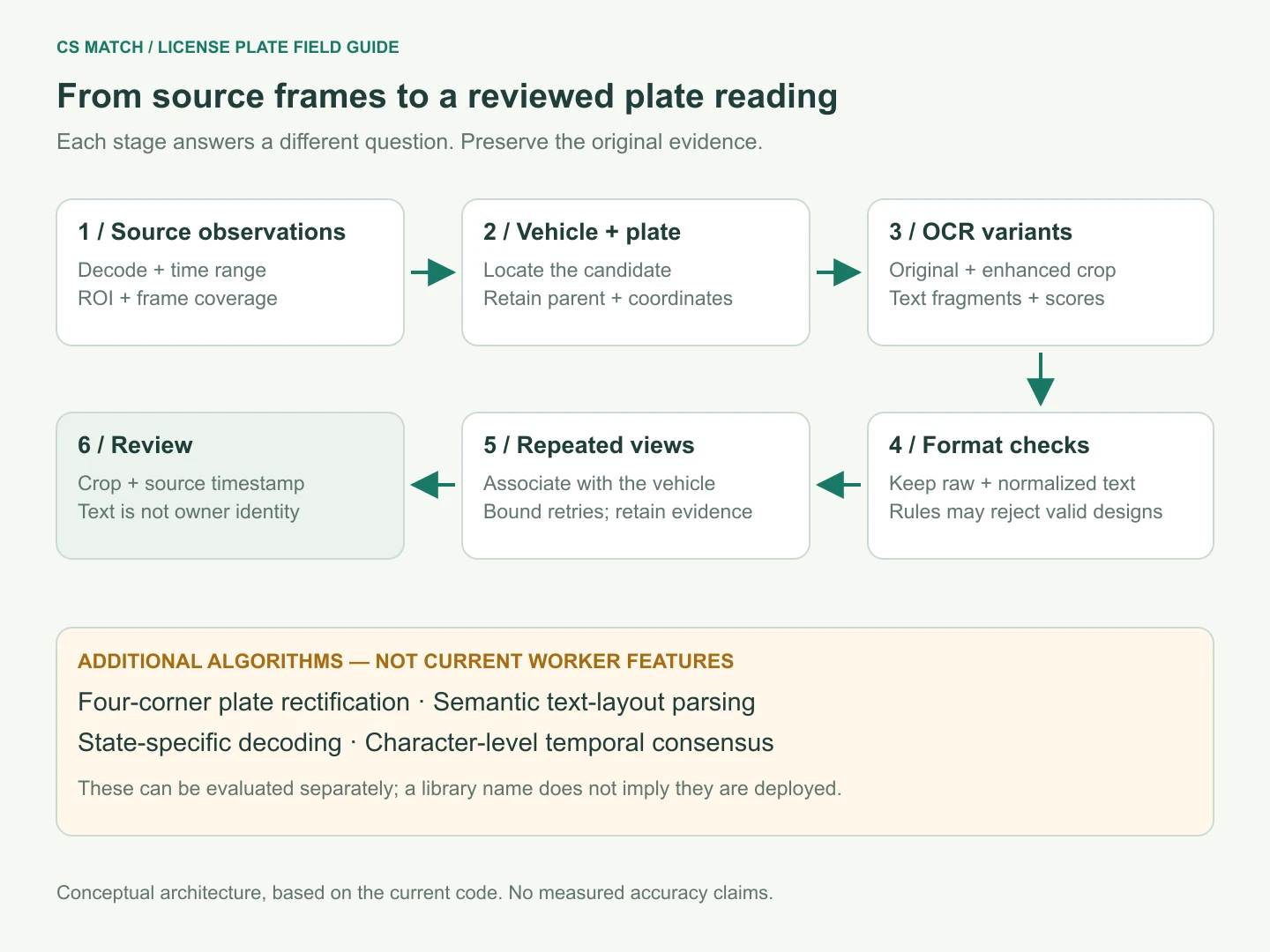
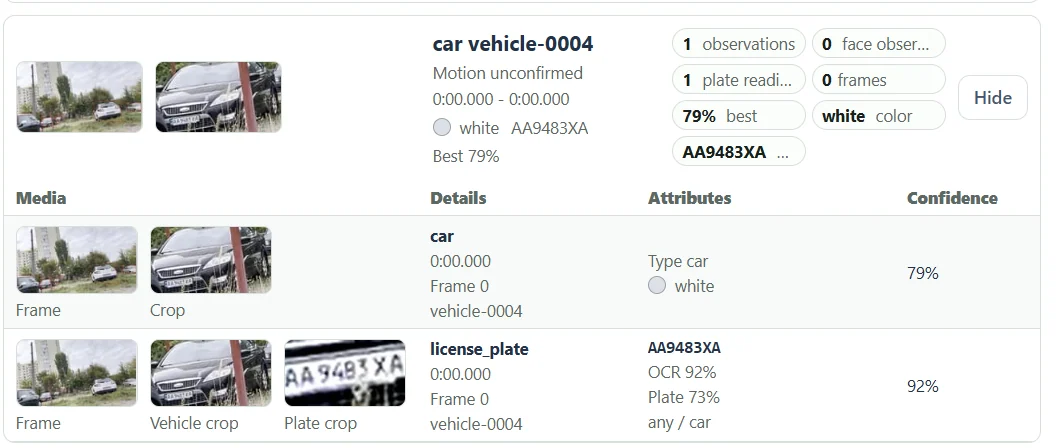
For recorded-footage review, a useful result includes the reading, the plate crop, the surrounding vehicle and a route back to the original frame. An unreadable outcome is also meaningful. Keeping it separate from an empty search result prevents a failed reading from being mistaken for evidence that a vehicle never appeared.
Decode the source and choose observations
The first algorithmic choice happens before a plate detector runs: which source frames enter analysis? A short appearance can fall between widely spaced samples. Conversely, processing every frame can spend substantial time repeating nearly identical views. The appropriate schedule depends on how long the plate is usable, not simply how long the recording lasts.
Suppose a hypothetical source runs at 30 frames per second and the plate is readable for half a second. Sampling every 60th source frame leaves two-second gaps, so that readable interval can be missed completely. This is an illustration of coverage, not a measurement of CS Match detection accuracy. Sampling more densely cannot repair blur already present in each captured frame.
Decode the actual source stream and retain its time references. A browser preview may be shorter or converted for playback, while analysis uses the original recording. Trimming, variable frame timing and export offsets make frame positions different from a verified camera clock. Before reading text, confirm that the chosen interval and saved analysis area include the vehicle's useful approach.
Vehicle detection provides context, with a dependency
A vehicle-first architecture locates cars or other supported vehicle classes, tracks their observations and searches their crops for plates. This reduces irrelevant scene content and makes it easier to associate a reading with a vehicle. Its limitation is dependency: when the parent vehicle is missed or its crop excludes the plate, the OCR stage may never receive the relevant pixels.
A plate-first architecture searches a wider frame directly, then associates plate detections with vehicles. It can avoid some parent-detector misses but must handle more small objects and unrelated text. Neither arrangement is universally superior. Compare complete pipelines on the target footage, including vehicles for which no plate candidate was produced.
Our current resident LPR worker receives vehicle candidates and searches their saved crops. The public workflow also exposes vehicle-related reading settings. Preserve enough context when choosing an analysis area, and inspect the parent observation if a known plate is missing. Lowering an OCR threshold cannot recover a candidate that an earlier stage never passed onward.
Locate the plate before interpreting its characters
A plate detector predicts where a plate-like region lies and assigns a detection score. Typical outputs include rectangular coordinates and a class. Ultralytics exposes bounding boxes and confidence values through its prediction interface; the application still determines how those outputs are cropped, filtered and associated. The score does not certify that every character is legible.
Our worker runs a plate-specific YOLO model on each selected vehicle crop. It clamps the predicted rectangle to the available image, extracts the region and maps its coordinates back to the source frame. This coordinate mapping matters: an attractive crop is less useful if its reported location or parent vehicle is wrong.
Detection errors include missing a small plate, choosing an advertisement, retaining only part of the registration, or including excessive surroundings. Before comparing OCR models, inspect these rectangles. If the rightmost character is outside the crop, a recognizer cannot directly observe it. A broader rectangle may restore context, but too much background introduces competing text and reduces the plate's effective scale.
Separate cropping from perspective correction
A rectangular crop preserves the source view, including its angle. A plate seen from the side can remain a narrow trapezoid inside that rectangle. Geometric rectification is a separate operation: estimate the plate corners, map them to a target rectangle and resample the image. OpenCV provides perspective-transform functions for this mapping; finding trustworthy corners is the preceding problem.
Corner detection, rotated boxes and segmentation offer different ways to estimate geometry. Compare their errors on frames where a bumper, frame holder or shadow hides an edge. A wrong transformation can stretch a digit, truncate a corner or make a neighbouring label look like part of the plate. Rejecting an unstable correction may be preferable to displaying a confidently distorted patch.
The current CS Match plate path uses axis-aligned crops and image enhancement; it does not implement a dedicated four-corner plate rectifier. The diagram describes the wider algorithm family, not an additional feature silently running in our worker. Rectification can reorganize visible detail, but cannot reveal a character hidden behind another object or restore detail absent from the capture.
Prepare controlled image variants
OCR preprocessing tries to make existing strokes easier for a recognizer to use. Common candidates include resizing, grayscale conversion, contrast adjustment and filtering. Their value depends on the actual defect. A treatment that helps a dim plate may amplify compression edges on another, so keep the original available rather than replacing it with one supposedly improved image.
Our enhancement helper enlarges narrow plate crops to a configured minimum width, adjusts contrast and applies sharpening. Grayscale conversion is optional. The resident worker tries the enhanced crop and, when needed, the original; it can stop early after a sufficiently confident valid reading. Resizing here satisfies a processing choice, not a claim that the camera captured that many plate pixels.
Evaluate variants with the full string and saved evidence. If sharpening changes a plausible B into an 8, compare the source rather than choosing whichever result looks cleaner. Running many correlated filters and selecting the largest score can favour an artifact. A bounded, documented set of alternatives is easier to debug and reproduce than unlimited trial-and-error enhancement.
OCR converts image features into a character sequence
OCR may first locate text lines, then recognize each line as a sequence. PaddleOCR's versioned documentation distinguishes detection, angle classification and recognition. Our integration uses its legacy OCR interface with an English configuration. A framework's newest advertised models should not be confused with the particular runtime and weights installed in an application.
Specialized recognizers can instead accept a prepared plate and predict its registration sequence directly. CRNN-style approaches combine convolutional features with sequence modelling and often CTC decoding, which handles alignment between image positions and characters. LPRNet is a published example that recognizes plates without preliminary character segmentation. Attention-based approaches provide another decoding family; each still needs evaluation on the intended layouts.
A model trained on ordinary horizontal registration strings may struggle with small stacked prefixes or unfamiliar alphabets. The relevant question is not whether the library supports OCR in general, but whether its trained representation and decoding cover the target data. Compare unfamiliar designs separately rather than hiding their failures inside an average dominated by easy plates.
Find the registration text within the plate layout
A plate can contain more text than the registration itself: a jurisdiction name, slogan, website, small prefix or another label. A general text reader may correctly recognize those words and still produce the wrong registration string. Layout interpretation therefore asks which text regions belong to the identifier and in what order they should be read.
A richer system retains text boxes, groups lines using their positions and estimates their semantic roles. A two-line registration should not be flattened blindly according to incidental detector order. Likewise, a small vertical prefix may be part of the identifier rather than decoration. Region and plate-class knowledge can help, but uncertain jurisdiction predictions should remain visible.
Our current parser joins returned text fragments and averages their fragment scores. It does not perform a dedicated semantic separation of slogans and registration characters. California's documented special-interest plates illustrate why one jurisdiction can contain multiple graphic designs and personalized configurations. The US setting is consequently not a promise that every American layout is understood.
Validate formats without turning guesses into observations
Normalization standardizes representation; validation tests a rule. Converting letters to uppercase or removing spaces can make two equivalent readings easier to compare, but neither operation establishes the missing characters. Keep raw text alongside normalized text so that a reviewer can understand what changed and distinguish formatting from recognition.
The present normalizer keeps Latin A–Z and digits after its formatting steps. With regional validation enabled, the US rule accepts two to eight alphanumeric characters; EU uses a broad five-to-ten range, while UA has a more specific two-letter, four-digit, two-letter pattern. These are application filters, not complete legal catalogues of issued plates. Some legitimate designs can fall outside them.
Treat an ambiguous O/0 or I/1 as competing interpretations unless the pixels and an applicable format resolve it. A future region-aware decoder could rank alternatives using soft constraints. Unconditional replacement risks creating a plausible number that the image never supported. A rejected reading should be explainable as a format rejection rather than disappearing into an unexplained no-result state.
| Operation | What it can establish | What it cannot establish |
|---|---|---|
| Normalization | A consistent representation | That a character was read correctly |
| Format validation | Whether a candidate satisfies a configured rule | That the plate exists or belongs to a vehicle |
| Source inspection | What is visibly supported by the captured pixels | An obscured character absent from every view |
Use repeated views without confusing repetition with proof
A video offers multiple opportunities to see the same plate. Select observations with useful size, exposure and geometry, then compare their readings within the correctly associated vehicle track. An early frame may reveal the first characters while a later frame resolves the end. The association must be checked before any text combination becomes meaningful.
Our streaming pipeline bounds recognition attempts per crop segment and records matching text across distinct parent observations. Two matching readings, with the later qualifying score at least 0.85, can mark a segment recognized for scheduling. Both scores need not meet that threshold. This is a retry heuristic, not a character-level consensus decoder, calibrated probability or correctness guarantee.
A more elaborate temporal recognizer could align candidate strings, compare edit distances and weight character hypotheses by observation quality. It must account for correlation: successive frames may repeat the same reflection or compression artifact. Keep disagreements available and inspect the vehicle context. Combining text from two neighbouring vehicles would produce a stronger-looking result with weaker factual support.
Read detection and OCR confidence separately
Plate confidence concerns the detected region; OCR confidence concerns the recognizer's reading. A strong detector can locate a blurred plate, and a recognizer can confidently read the wrong text inside a poor crop. Averaging scores from fragments also does not produce a calibrated probability that an entire registration string is correct.
Consider a hypothetical seven-character plate where six characters are clear and one remains ambiguous. The operational result is not fully correct simply because most characters were easy. Compare exact-string accuracy with character-level errors, and inspect whether the system can retain an uncertain outcome. Threshold changes trade coverage against mistakes rather than creating additional information.
In a useful report, text, crop, source time and parent observation remain connected. Check the original and enhanced crops, compare nearby views and record unresolved disagreement. A plate reading supplies visible registration evidence. It does not independently establish owner identity, authenticity of the physical plate, or permission to take an automated action.
Evaluate complete passages, then inspect a short task
Measure the whole chain on representative recordings: how many relevant passages occurred, how many produced a candidate, and how many produced the complete correct string? OCR accuracy measured only on already-cropped readable plates omits missed detections and unusable capture. Report those conditions separately, including day, night, angle and unusual designs.
Dataset geography matters. UFPR-ALPR documents Brazilian vehicle recordings and annotations; success on that collection does not establish accuracy for US specialty plates. Keep related views of the same vehicle or recording together when separating training and test data, and retain difficult or unreadable passages in the operational evaluation rather than quietly excluding them.
In CS Match, begin with a short uploaded interval that includes approach and departure. Confirm the analysis area, enable the relevant modes, choose sufficient frame coverage and save plate evidence. Review the vehicle track before relying on the reading. This workflow is recorded-video analysis, not a live camera connection, owner lookup or automatic gate controller. Its practical value is that each candidate can be checked against its source.
Questions about this workflow
Does a high OCR score prove the complete plate is correct?
No. The score is a recognizer output, and our parser combines fragment scores. Check the complete string against the saved crop and source observations.
Does the US region option identify the issuing state?
No. It currently applies a broad alphanumeric format rule. It is not a state classifier or a complete catalogue of specialty layouts.
Does CS Match currently correct plate perspective using four corners?
No. The current plate worker crops axis-aligned rectangles and creates enhanced image variants. Dedicated four-corner rectification is described here as an additional algorithmic approach.
Can repeated frames resolve an unreadable plate?
Different usable views can help, but repeated blur or glare can repeat the same error. There must be supporting captured detail; matching strings alone do not guarantee correctness.
Continue with the next useful step
Why CCTV License Plates Are Hard to Read
Understand plate pixel size, exposure, frame coverage, perspective, focus, night capture, WDR and compression, with worked examples and a practical diagnostic workflow for CCTV recordings.
Choose a Video Frame Sampling Interval
Balance coverage and processing with source-frame intervals and optional adaptive sampling. See why short events need closer sampling.
Video Tracks vs Observations: Read the Results
Understand track groups, individual detections, plate readings and face observations without treating track totals as unique people or vehicle counts.