
Video Tracks vs Observations: Read the Results
Understand track groups, individual detections, plate readings and face observations without treating track totals as unique people or vehicle counts.
Updated · Cyber Search MatchAn observation is a record from an analyzed frame. A track groups observations associated within a job. One vehicle can have several observations and plate readings; one real person can also produce several tracks after cuts or occlusion.
Know what each count refers to.
Frames analyzed counts source frames that reached analysis. Vehicle tracks and person tracks count associated groups. Plate readings and face observations describe records found in the sampled views, not distinct plates or unique faces across the recording.
A group card summarizes its available observations, source-frame range, timestamps and representative confidence. Expand Show to inspect the underlying rows. A face or plate row can be attached to the same group as a person or vehicle observation.
Do not add these counters together as a total number of objects. They describe different layers of the report and can overlap.
| Report item | Meaning | Avoid assuming |
|---|---|---|
| Track | Associated observations inside one job | A persistent identity across cameras or videos. |
| Observation | A detection or derived record at a sampled frame | A distinct real-world object. |
| Plate reading | Text recognized from a plate candidate | A separately counted vehicle or verified registration. |
| Face observation | Face detection inside a person crop | A named or verified identity. |
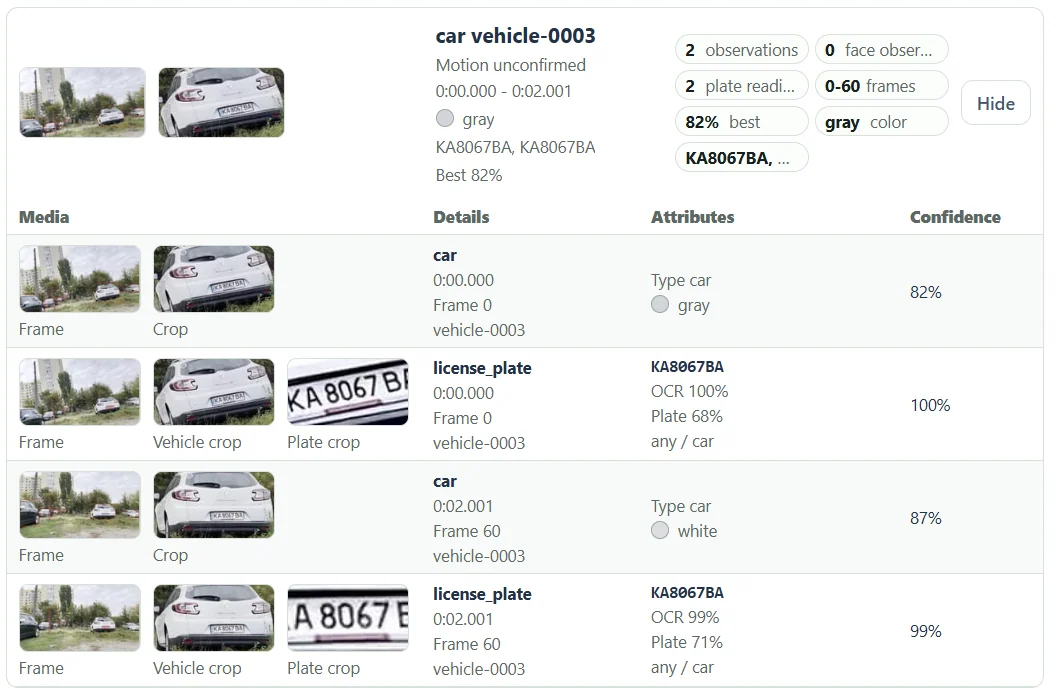
One track, two observations, two readings.
The close-range vehicle example shows vehicle-0003 at 0:00.000 and 0:02.001, frames 0 and 60. Each moment has a vehicle record and a plate reading. The group combines those records so you can compare the vehicle and text evidence together.
The repeated KA8067BA reading is useful context, but two matching text observations do not remove the need to inspect the crop. Tracking can associate the wrong object in a crowded scene, and text recognition can repeat the same mistake.
Motion unconfirmed means the available evidence has not established a motion classification. A one-frame record is still useful for locating a frame; it does not establish movement.
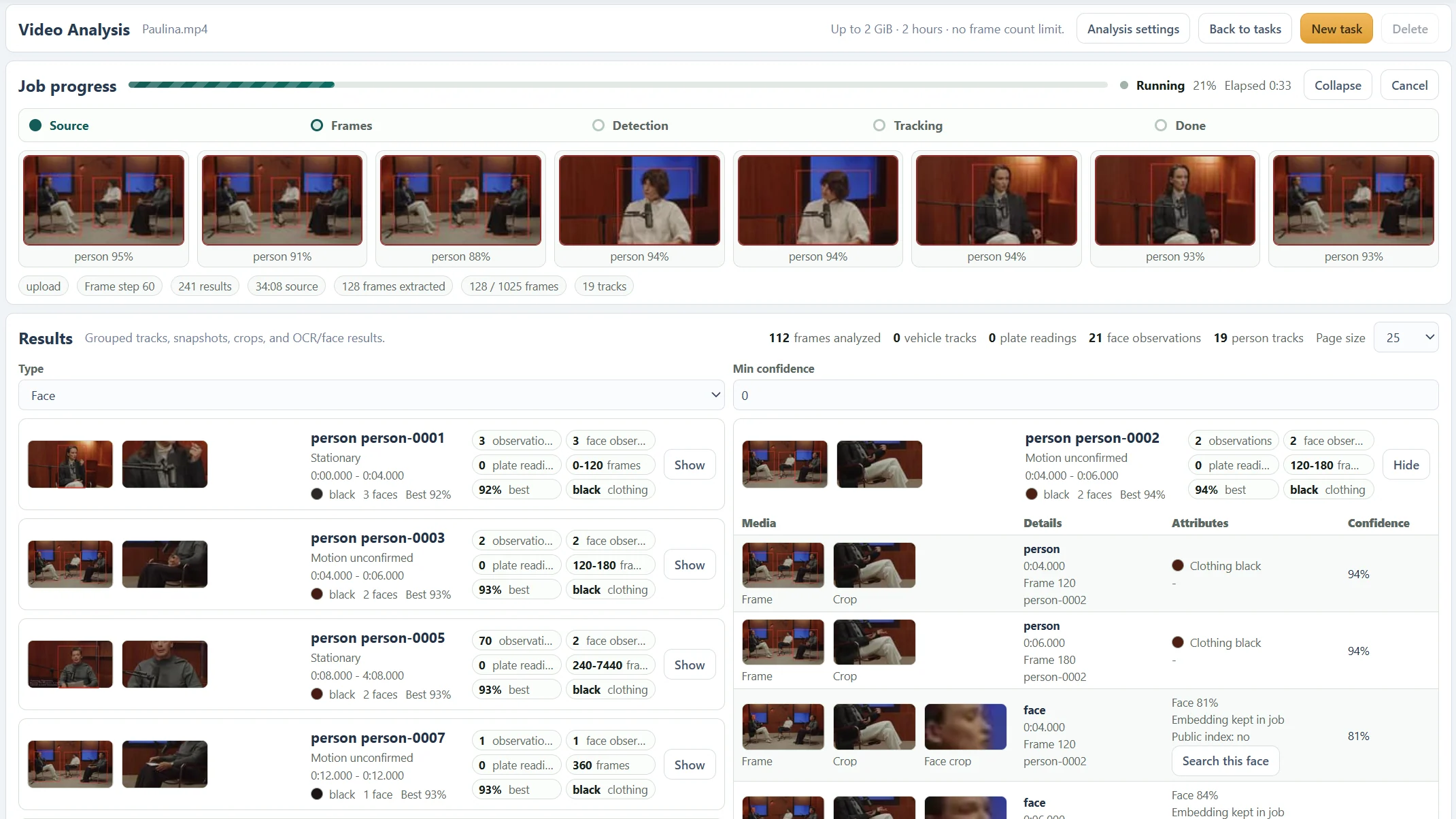
Edited footage can create many tracks for few people.
The interview example contains 19 person tracks while the task is still processing. That count is provisional and does not mean 19 participants. A speaker can receive new track groups after shot changes, occlusion or a long gap between observations.
Track IDs such as person-0023 are local references for the task. Comparing that identifier with an identifier in another task does not establish that the same person appears in both.
For a reliable report, describe the observed moments and the limits of the association. Use the original video to check continuity beyond the sampled frames.
Questions about this workflow
Can I use the person track count as a visitor count?
The report does not establish a deduplicated count of unique visitors. Multiple groups may belong to the same person, and some people may be missed.
Can totals change while processing runs?
Yes. Results and associations shown during a running task are partial. Check the completed task before treating the report as final.
Continue with the next useful step
Understand Video Analysis Timestamps and Frame Numbers
Read source times, frame indices and track ranges. Learn how trimming, sampling and variable frame rates affect the times shown in a video report.
Object Tracking vs Detection in Video
Learn the difference between locating objects in a frame and linking observations across frames, with practical examples from the Video Analysis report.