
Object Tracking vs Detection in Video
Learn the difference between locating objects in a frame and linking observations across frames, with practical examples from the Video Analysis report.
Updated · Cyber Search MatchDetection asks what is visible and where in one analyzed frame. Tracking asks which observations belong together across analyzed frames. Detection can locate a useful moment; tracking adds an association that you should verify against the underlying crops.
Detection locates; tracking associates.
A detector returns a supported class, bounding region and confidence for a frame. Seeing a vehicle box at one moment does not by itself establish that a box in the next frame belongs to the same vehicle.
Tracking associates observations over time and assigns a task-local track reference. In CS Match you can inspect grouped vehicle and person cards and expand their records. The association is a useful navigation aid, not a permanent identity.
License plate OCR and face detection add observations to this workflow. A text reading or face crop can supply useful evidence, but it is a separate signal from associating objects over time.
| Question | Useful layer | What to check |
|---|---|---|
| Is a person visible in this frame? | Detection | The complete frame and person crop. |
| Which sampled views are associated? | Tracking | The expanded group and gaps between observations. |
| What characters are on a plate? | OCR | The saved plate crop and repeated readings. |
| Does this crop resemble an indexed face? | Separate Face Search | Similarity scores and the original publication context. |
Read both layers in a real result.
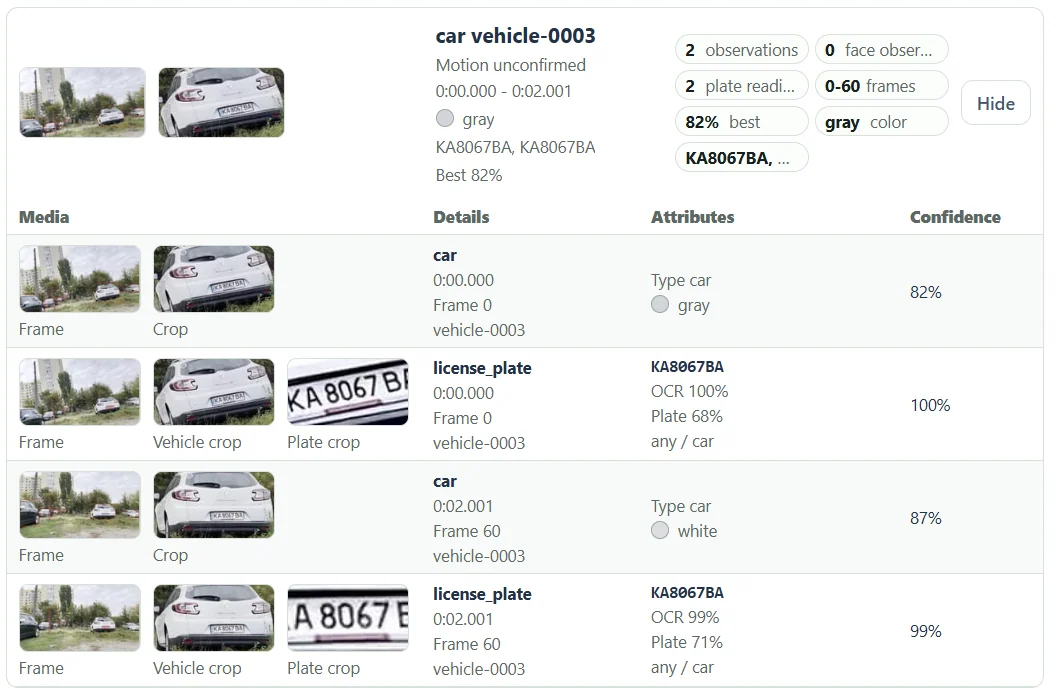
The vehicle example groups observations at frames 0 and 60 under vehicle-0003. Each row records its own source time, crop and confidence. The group says the observations were associated; the rows let you inspect that claim.
If the same vehicle appears once, detection can still locate a useful source frame. Tracking cannot establish a continuous path from a single observation. If it disappears and returns, it may be represented by more than one group.
For interviews, shot changes can create new person tracks for the same speaker. That is why track totals should not be read as the number of participants.
Choose the layer that answers your task.
Use the detection evidence when you need a representative frame, crop or visible plate. Use grouped tracks when you need to compare appearances over time. In either case, retain the original recording to check the surrounding sequence.
Choose a shorter frame interval for fast motion and enough image area for the full useful path. Tracking cannot associate observations that were excluded by a boundary or missed between sparse samples.
You do not need to write a model pipeline for this workflow. Choose the supported modes in the wizard, submit the task and inspect the report. Custom object classes and persistent cross-camera identities are outside the current interface.
Questions about this workflow
Is tracking always more accurate than detection?
They solve different problems. Tracking depends on detections and adds associations that can also be wrong. Inspect both the individual frames and the grouped result.
Can tracking reveal what happened between skipped frames?
The report contains sampled evidence. It does not reconstruct every unobserved moment between samples.
Continue with the next useful step
Video Tracks vs Observations: Read the Results
Understand track groups, individual detections, plate readings and face observations without treating track totals as unique people or vehicle counts.
Choose a Video Frame Sampling Interval
Balance coverage and processing with source-frame intervals and optional adaptive sampling. See why short events need closer sampling.