
Find the appearance. Review the movement.
Locate people in an uploaded video and inspect person tracks, clothing colors, source frames and optional face observations in one report.
Free account · No card required · Uploaded recordings, processed in the background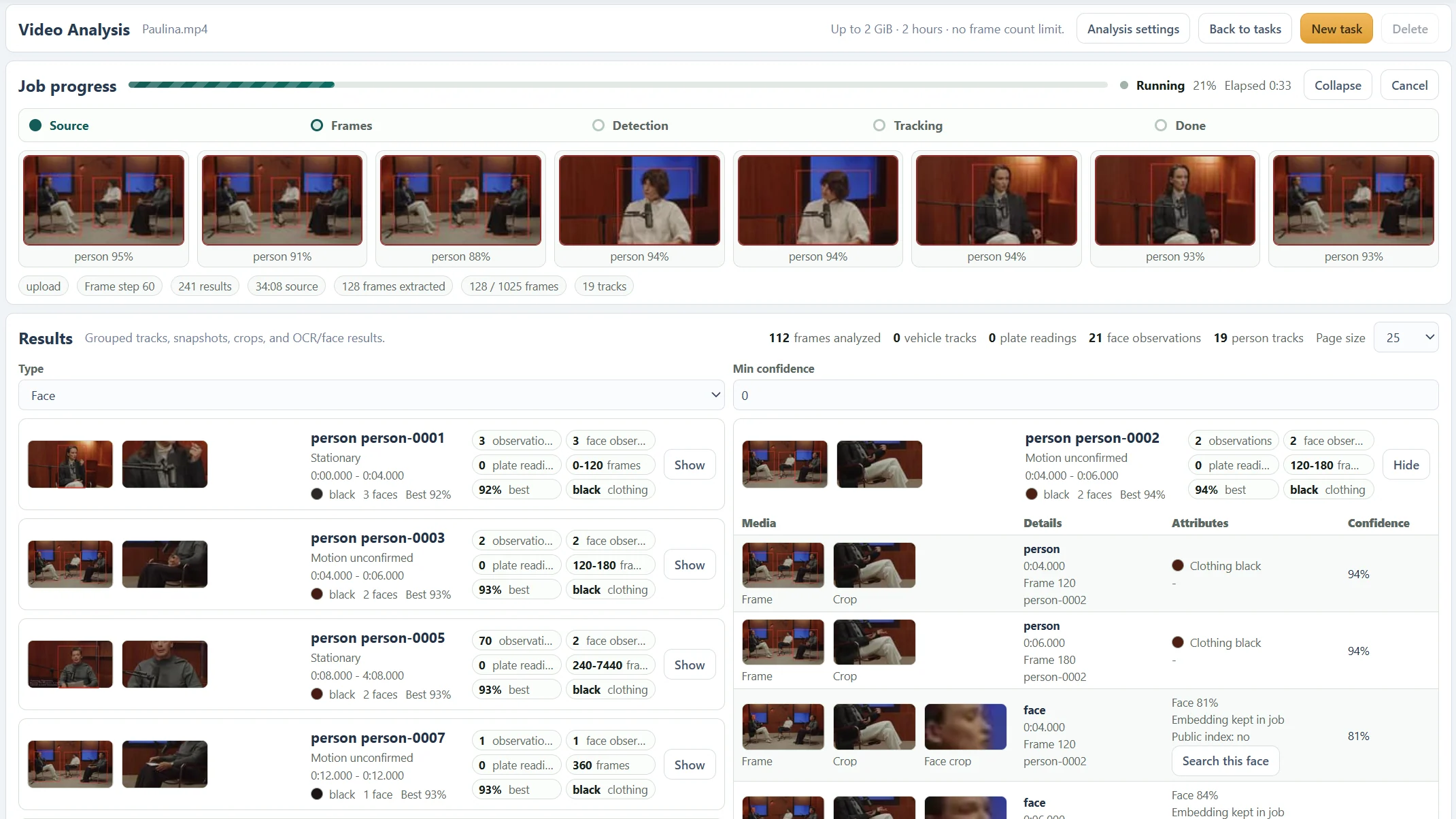
From the source to the useful frame.
- 01
Choose the useful range
Include the person’s arrival or visible activity.
- 02
Set the analysis area
Keep the full useful path inside the boundary.
- 03
Enable Person
Choose confidence and optional clothing color.
- 04
Add face crops if needed
Enable face detection inside person crops.
- 05
Inspect each observation
Compare times, crops and surrounding frames.
Separate person detection from face detail.
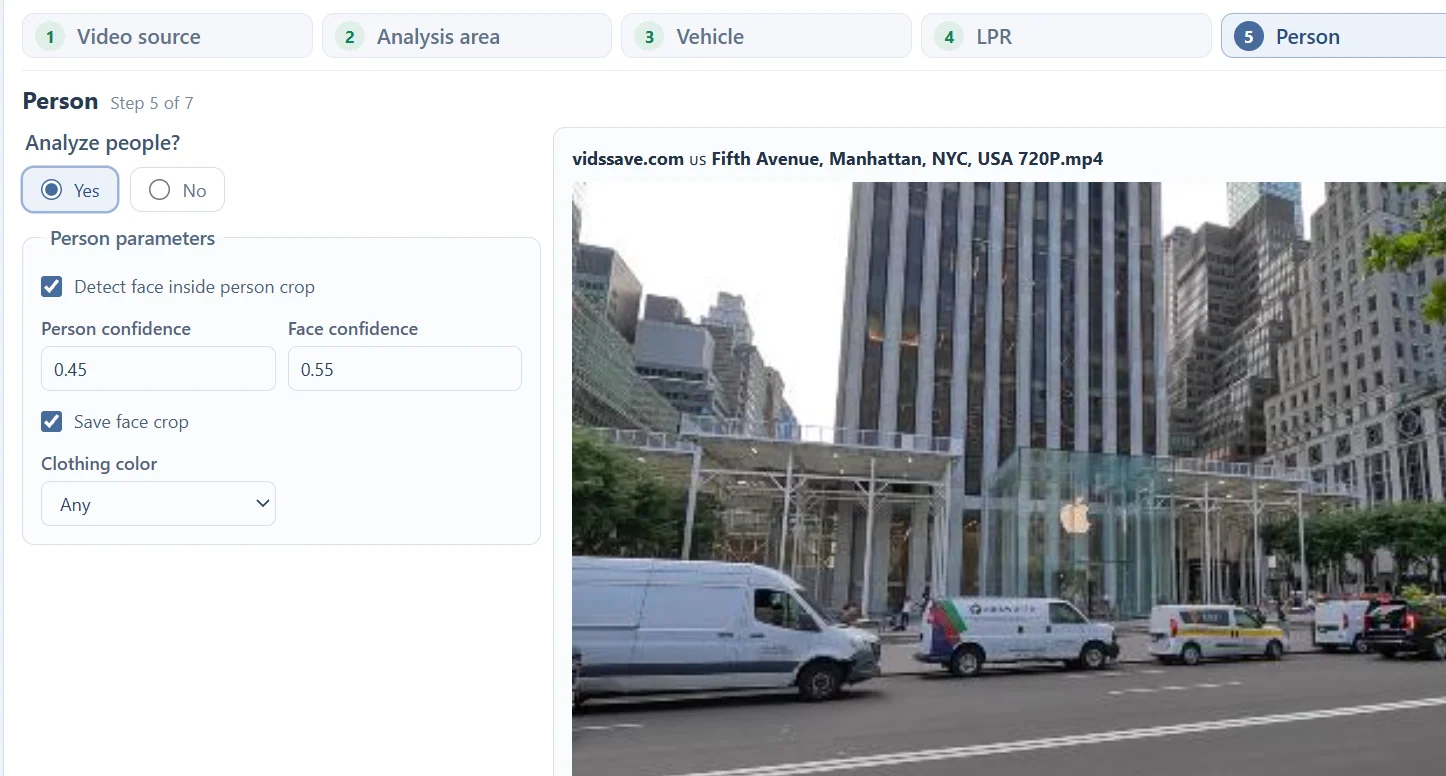
A person can be detected even when their face is turned away or too small to use. Person confidence controls person detections; Face confidence applies to optional face detection inside a person crop. They measure different steps.
Save face crop controls whether a face image is kept for inspection. Clothing color is an estimated attribute, not an identifier. In the interview example, a light shirt can be assigned different colors under different lighting or framing.
Several tracks can belong to the same speaker.
The interview screenshot shows 19 person tracks while processing is still at 21%. It does not show 19 unique interview participants. Shot changes and changes in visibility can create new track groups for the same person.
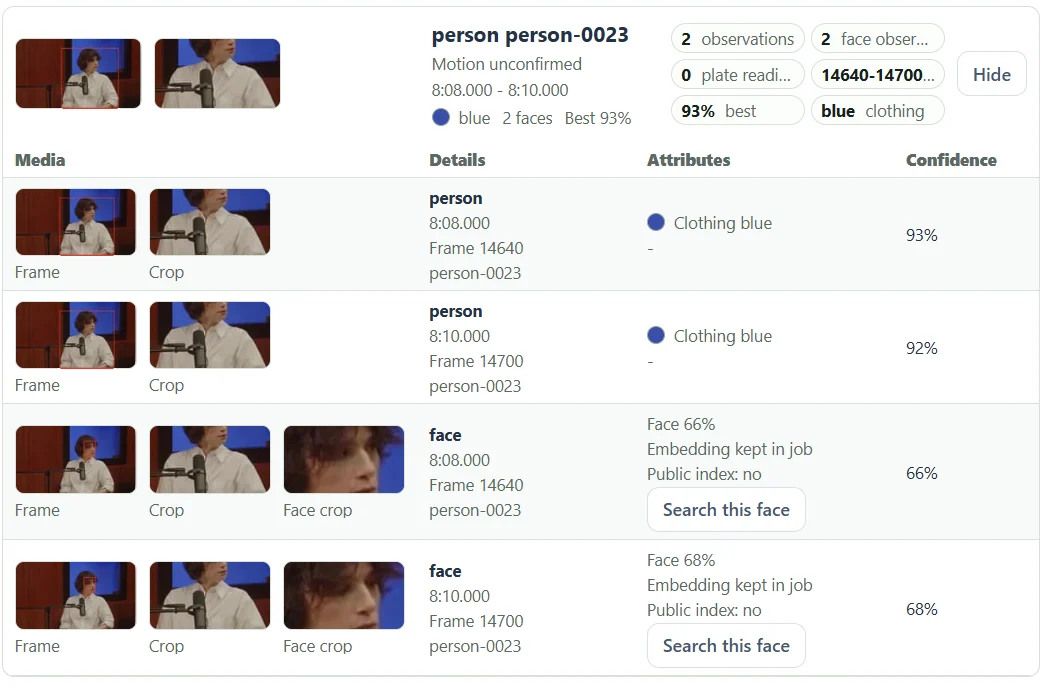
Expand person-0023 in the separate detail view to see observations at 8:08 and 8:10 and their face crops. These are records attached to one group, with the full frame available to preserve context.
For a walking person, compare multiple observations before interpreting motion. One static crop does not establish a direction, route or identity.
Choose footage that can answer the question.
Occlusion, small subjects, low light and motion blur reduce usable detail. Use an interval that captures several views during the person’s appearance, and keep the whole relevant area inside the saved boundary.
If your only question is when someone is present, person observations may be enough. If you need a face crop for a separate search, inspect its sharpness and angle first. More observations do not automatically mean a more useful face image.
Questions about this workflow
Can I close the tab while analysis runs?
After the upload and submission have finished, processing runs in the background. Return to the Video task list to check the job and available results. Keep the tab open while the file is still being uploaded.
What are the current source limits?
The current Video Analysis interface accepts files up to 2 GiB and two hours. Processing and storage limits also apply. Analyze a short representative range first when choosing settings.
A useful frame starts with a focused task.
Video Analysis
Analyze an uploaded video without coding. Review vehicle and person tracks, license plate readings, face crops and the timestamps behind each observation.
Object Tracking
Track supported people and vehicles in a submitted video. Compare grouped observations, crops and timestamps without writing detection or tracking code.
Vehicle Tracking
Find vehicle appearances in your video, filter supported types and colors, and review grouped crops and timestamps for the passage you need.
License Plate Reading
Extract visible license plate text from video frames. Compare OCR readings, detection scores, vehicle crops and timestamps before relying on a result.
Faces in Video
Find face observations inside detected person crops, review their source times and open a selected crop in a separate Face Search.
YouTube Video Downloader
Prepare an available public YouTube video, choose a returned resolution and download the file or use it for Video Analysis. Source restrictions can affect availability.
Read the recording. Understand the report.
Choose a Video Analysis Area of Interest
Use the entire frame, a rectangle or a polygon to focus a video task. Learn how fixed boundaries affect moving subjects and camera movement.
Choose a Video Frame Sampling Interval
Balance coverage and processing with source-frame intervals and optional adaptive sampling. See why short events need closer sampling.
Video Tracks vs Observations: Read the Results
Understand track groups, individual detections, plate readings and face observations without treating track totals as unique people or vehicle counts.
Understand Video Analysis Timestamps and Frame Numbers
Read source times, frame indices and track ranges. Learn how trimming, sampling and variable frame rates affect the times shown in a video report.
Video Analysis File Formats and Upload Requirements
Check size, duration, containers, codecs and browser previews before submitting a video. Keep the original when preparing a compatible copy.
Troubleshoot Video Analysis: Uploads, Missing Results and Tracks
Work through source errors, empty reports, missing plates, fragmented tracks and processing delays with focused checks before rerunning a video.
Object Tracking vs Detection in Video
Learn the difference between locating objects in a frame and linking observations across frames, with practical examples from the Video Analysis report.
See what your media
can do for you.
Create your free accountNo card required. Start with a Free account.