
Make your voice the starting point.
Record or upload your own speech or singing, submit training and use the ready model for song covers and short voice messages.
Free account · Your own voice · Background processingSame phrase. A different sound.
Synthetic speech followed by a simple pitch effect. These illustrative samples are not outputs from a trained CS Match model.
Illustrative audio · No real person’s voice model used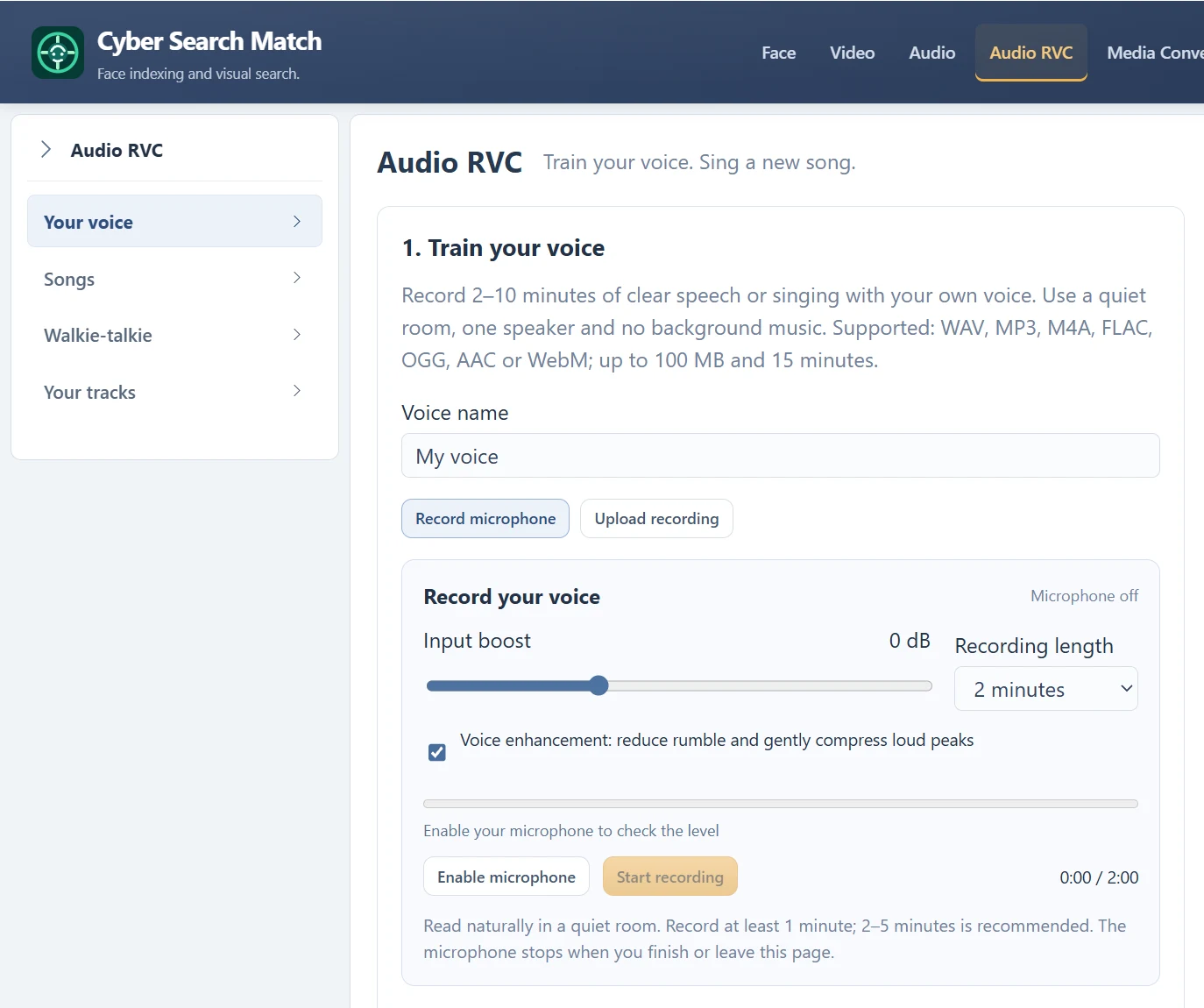
Four steps. One voice workspace.
- 01
Record or upload
Use a clean recording of your own voice and give the model a name.
- 02
Listen before training
Check the selected sample and confirm the own-voice consent.
- 03
Wait for Ready
Submit training and follow the task in Your tracks & training.
- 04
Choose your next output
Use the ready model for a song or a short walkie-talkie message.
One voice. Clear sound. Useful variety.
Use natural speech or singing without a music bed, another speaker or strong room echo. The setup recommends 2–10 minutes. Training requires 1–15 minutes; a short greeting will not meet the minimum. WAV, MP3, M4A, FLAC, OGG, AAC and WebM are listed sample formats, with decoding dependent on the actual audio stream.
The microphone recorder offers 1, 2 and 5 minute sessions and a level meter. For a longer sample, upload a prepared recording within the duration and 100 MB limit. Keep microphone position consistent and include natural variations rather than shouting to make the signal louder.
Listen, consent, then train.
Give the model a recognizable name. If you used the recorder, compare Original with Boosted / enhanced and select the cleaner version. The selected sample is sent when you submit training, not merely because you enabled the microphone.
Confirm This is my own voice and choose Train my voice. Your tracks & training shows the queued job, current stage and progress. Your voices shows the model status. A queued or training model cannot yet be selected as a conversion voice.
Ready opens the next two paths.
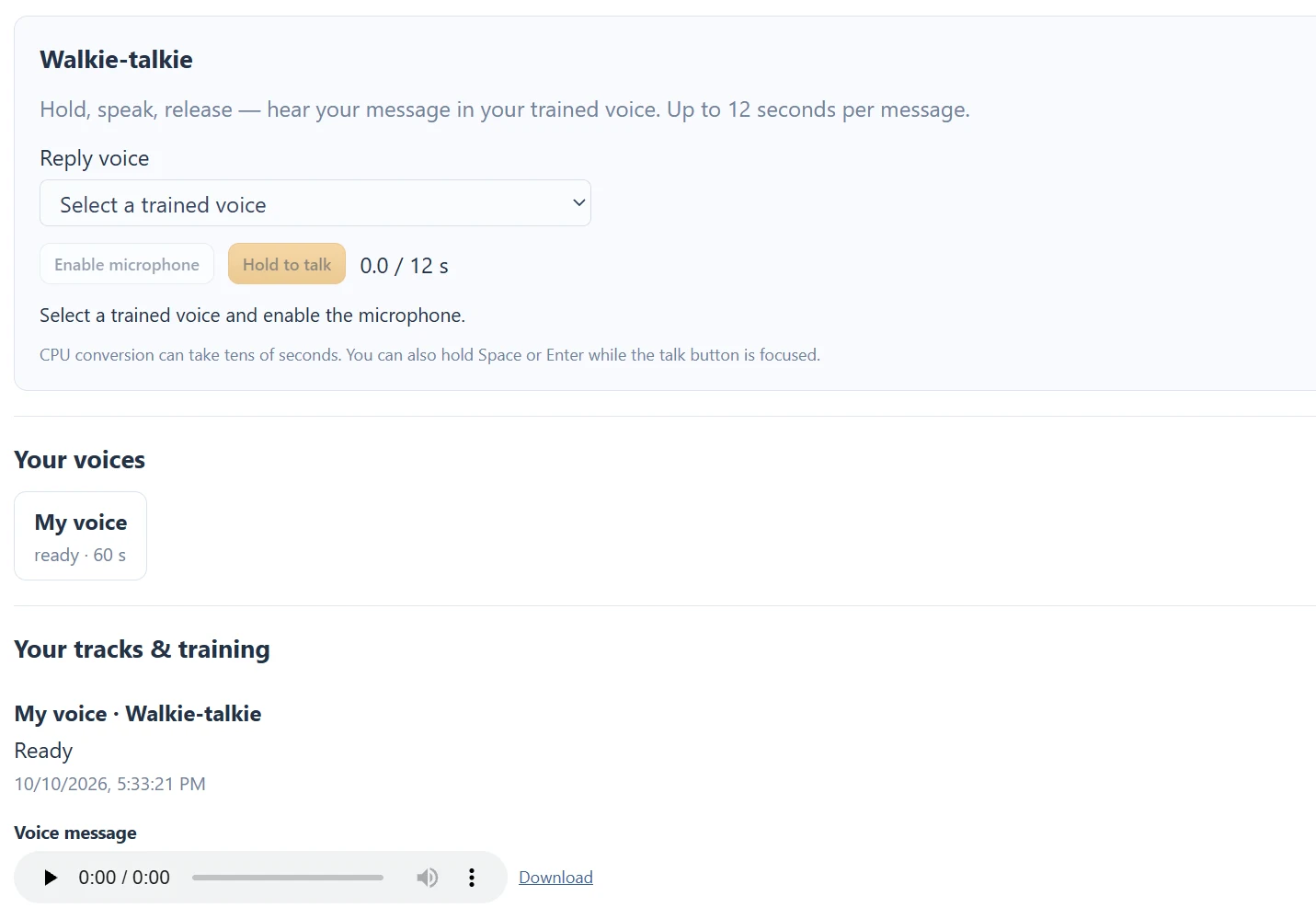
Once ready, choose the model for a song conversion or a walkie-talkie message. The current account limit is five stored voice models. A name is only an account label; it does not prove identity or certify the model’s quality.
Models and task files are accessed through your account. Keep copies of recordings and outputs you need, and contact support through the data-deletion page for a deletion request. The current voice screen does not expose a model download or a model-delete button.
Questions about this workflow
Do I need a voice model first?
Song conversion and walkie-talkie messages require one of your ready voice models. You can record and preview a sample before training. The current training form asks you to confirm that it is your own voice.
Can I leave while a task runs?
Keep the page open until recording, upload and submission finish. Submitted training and conversion jobs continue in the background; return to Your tracks & training to check progress.
Is this a continuous live voice filter?
No. Walkie-talkie records a short message and converts it after release. CPU processing can take tens of seconds. It does not provide a virtual microphone or a continuous Discord voice feed.
Choose your next voice task.
Voice Changer
Train your own voice model, convert a song’s vocals or send a short recorded message through it. Record, review and create in one browser workspace.
AI Song Covers
Convert a song’s singing with your own trained voice model. Review the final mix alongside separated vocals and instrumental audio.
Microphone Voice Recorder
Record your own voice in the browser, check microphone level and compare original with boosted or enhanced audio before downloading WAV or training.
Push-to-Talk Voice Changer
Record a short message and hear a converted reply in your trained voice. Each message is processed after release, with playback and MP3 download.
Better input. A more useful result.
How to Record a Useful Voice Model Sample
Prepare a clean own-voice recording: duration, room, microphone distance, speech and singing before training.
Microphone Gain: Boost Your Voice Without Clipping
Use the input meter, −12 to +24 dB boost and original/processed playback to prepare a clean voice recording.
Separated Vocals and Instrumental: Read the Song Outputs
Understand the final mix, original vocal stem and instrumental stem produced by a completed song conversion.
Song Conversion Levels: Recording, Playback and Mix
Distinguish microphone gain, player volume and the fixed vocal/instrumental mix used for song conversion.
Voice Training Queued: Progress, Waiting and Failures
Understand queued training, background processing, ready models and what to do when a voice task fails.
Voice Conversion vs Text-to-Speech
Choose between changing recorded sound, generating speech from text and transcribing a recording.
Voice Tools Permissions: Microphone, Samples and Songs
Understand microphone access, the own-voice training confirmation, song permissions and account-only outputs.
See what your media
can do for you.
Create your free accountNo card required. Start with a Free account.