
ALPR Architecture Choices: Open Models, Edge and Cloud
Compare classical pipelines, modular detectors and OCR, integrated plate networks, edge devices, self-hosted workers and managed ALPR. Evaluate task fit, retained evidence, runtime and operating effort without borrowed accuracy claims.
Sources checked · Cyber Search MatchChoose ALPR architecture around the required input, outcome and evidence trail. Algorithm design and processing location are separate choices: an open model can run on an edge device or a server, and a managed engine can be hosted locally or remotely. Compare complete-reading outcomes on the same footage, then weigh latency, maintenance and source access. For recorded review, inspectable stages and bounded processing are practical priorities.
Separate recognition design from deployment location
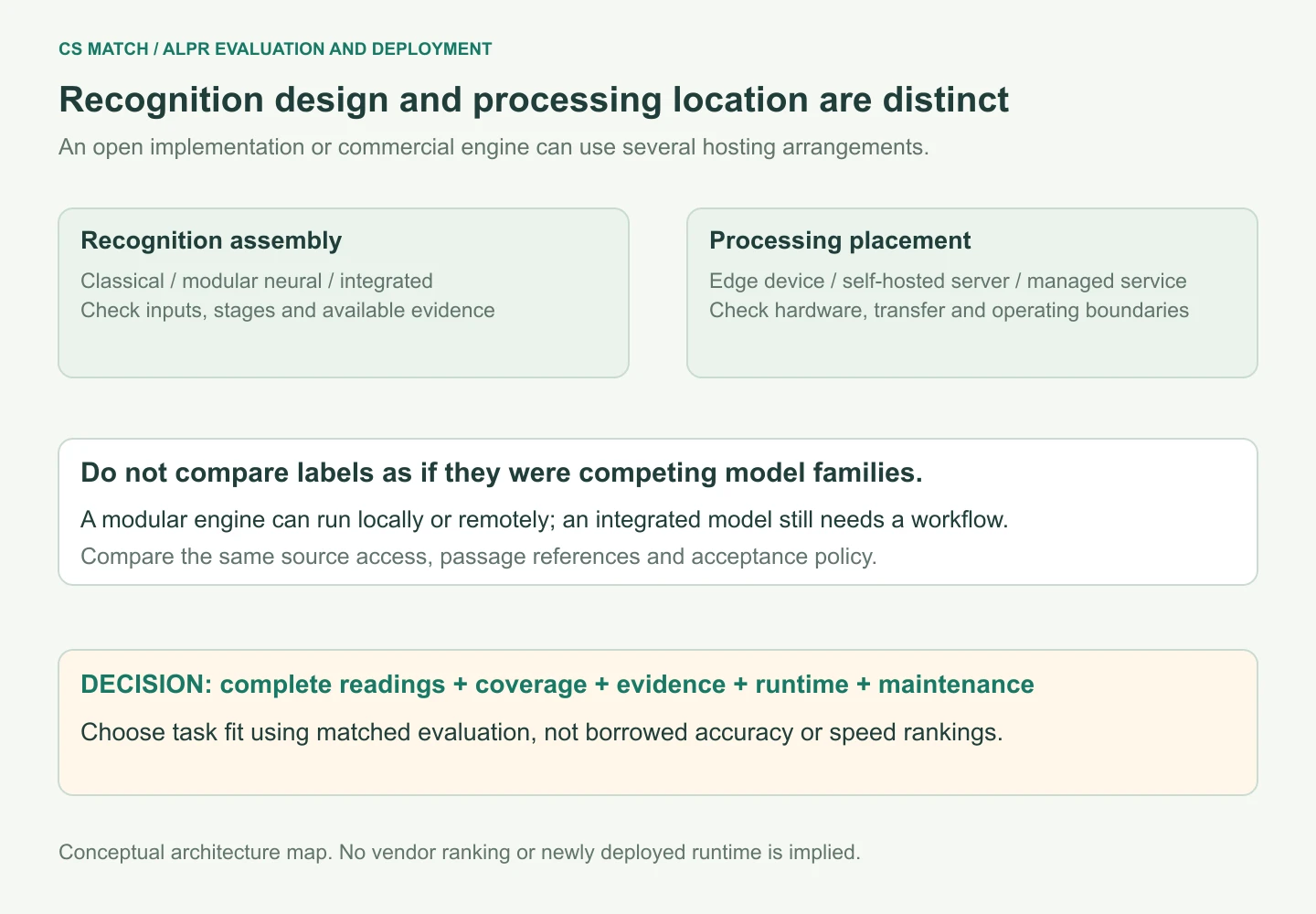
A discussion framed as open source versus edge versus cloud mixes different dimensions. Open source describes aspects of the implementation's availability; edge and cloud describe where computation happens. A classical recognizer can run remotely, a neural pipeline can run on a camera-side device, and a commercial SDK can operate on a local server.
Start with the input contract: supplied plate crops, complete images, recorded video or a continuous camera stream. Then define the output: text candidates, source-linked observations, passage events or an input to another application. A model that transcribes a crop is not automatically a video service with decoding, tracking, storage and a review interface.
List the constraints before comparing implementations. These include expected traffic density, supported designs, response timing, available hardware, source-data handling and the team's ability to maintain models. A useful shortlist satisfies the same task definition. Comparing a warm single-image benchmark against the completion time of a full uploaded recording cannot establish which architecture serves that task better.
Classical image processing remains a useful baseline
A classical pipeline can use contrast segmentation, edges, connected regions and geometric constraints to propose a plate, then isolate character-like components for classification. OpenCV documents thresholding and morphological operations used in such processing. These are building blocks, not a complete pretrained registration reader or a guarantee that every character can be segmented cleanly.
The approach is easiest to reason about when capture and layout are constrained. A stable reading zone with consistent registration design offers more predictable component shapes than distant CCTV with emblems, shadows and overlapping strokes. Its weakness is often the accumulation of hand-tuned assumptions: one threshold or aspect-ratio rule can exclude a valid design outside the commissioning examples.
Keep a classical baseline when it provides an understandable comparison for a controlled task. Measure its misses and exact strings on the same passages as neural alternatives. Do not retain it solely because it avoids a large model, or reject it solely because its algorithms are older. The relevant question is whether its operating envelope matches the actual requirement and maintenance budget.
Modular detection and OCR expose useful boundaries
A modular neural pipeline separates vehicle or plate detection, crop preparation, text recognition and postprocessing. This makes stage outputs available for diagnosis and allows targeted replacement. If a detector misses a plate, changing the OCR dictionary will not fix that miss; if the crop is correct but stacked letters disappear, the recognizer or layout stage is the more relevant experiment.
YOLO-based detectors and transformer detectors such as RT-DETR are model families for localization. The official RT-DETR repository describes object-detection implementations; that does not mean a generic checkpoint already contains an appropriate plate class. Dedicated training or suitable plate weights remain separate requirements. Likewise, a general OCR toolkit still needs compatible input, vocabulary and registration-region selection.
The engineering cost is coordination. Coordinate mappings, image colour conventions, resize policies and scores must agree across components. Version the complete assembly rather than only the recognizer weights. Modularity is valuable when these boundaries are explicit; otherwise, several individually working libraries can produce a pipeline whose partial crops or altered strings are difficult to trace.
Integrated networks reduce some boundaries, not the whole application
Integrated ALPR can mean several things: jointly locating and reading plates from an image, or recognizing an already supplied crop without explicit character segmentation. State the input precisely. LPRNet's paper describes a lightweight convolutional plate recognizer without preliminary character segmentation; that is different from a complete multi-vehicle surveillance workflow with passage grouping and source playback.
An integrated design can share features or reduce intermediate transformations, but its actual benefit depends on the implementation and target data. It can also make a failure harder to isolate if separate localization and text evidence are unavailable. Compare observable outputs, training needs and error analysis, not the end-to-end label by itself.
Surrounding work remains necessary: source decoding, interval selection, association, acceptance decisions and result persistence. A candidate integrated model should be tested with the same complete-string policy and missed-passage denominator as the modular baseline. Keep the retained source detail so a simpler model graph does not produce a less reviewable result.
Generic OCR is a component, not a registration policy
General image-text services can return words, lines, bounding regions and scores. Amazon Rekognition's DetectText documentation describes that type of text-detection response. Reading visible words is useful, but selecting the registration rather than a state name, slogan or neighbouring sign remains an application decision. Text output alone does not establish vehicle association or plate authenticity.
This distinction matters on specialty layouts. A system may transcribe every large word correctly while omitting a small stacked prefix that belongs to the registration. Evaluate the selected final identifier, not merely whether some text was recognized. Preserve text regions and reading order when comparing a generic OCR component with a dedicated plate recognizer.
A generic service can be a reasonable candidate for a small controlled experiment if its input and output fit the task. Establish normalization, layout selection and unsupported outcomes explicitly. Avoid converting fluent or plausible text into accepted evidence without inspecting the source. A dedicated plate component should earn its place through fewer relevant errors, not through its product category alone.
Edge processing changes the operating boundary
An edge deployment performs inference near the camera, potentially sending compact events rather than a continuous full-resolution stream elsewhere. That can suit a site with limited connectivity or a tight local response budget. It also creates hardware and maintenance constraints: device memory, thermal behaviour, supported operators and remote update procedures become part of the recognition system.
Define what evidence survives the local decision. An event containing only a string can be difficult to review when the candidate is wrong. A source crop, surrounding vehicle and time reference may improve inspection, but they require storage and transfer policy. Processing near capture does not automatically retain the evidence needed by a later recorded-footage investigation.
Test device behaviour over the expected operating duration and traffic load, including connection loss and restarts. Distinguish inference latency from event-delivery latency. An edge model with good isolated throughput can still drop opportunities if decoding or local queues are overloaded. Choose a deployment only after checking its full capture-to-output path and the recovery behaviour required by the site.
Self-hosted workers offer control with operating responsibilities
A server-hosted pipeline can centralize model packages, batch recorded jobs and expose intermediate crops for review. It also places decoding, CPU or accelerator capacity, storage and job admission under the operator's control. This can be useful for uploaded footage with deliberate intervals, where immediate camera-side actuation is not the target outcome.
Resident model workers can avoid reloading weights for each small unit of work, while bounded concurrency limits resource contention. These choices need measurement with the actual workload. Increasing worker count can duplicate memory and oversubscribe CPU threads; a larger pool is not automatically a faster service when each process also launches its own compute threads.
Operational design must cover interrupted jobs, partial results, disk growth, cleanup and model rollback. Record the deployed package and retain enough source context for a reviewer to inspect candidates. Self-hosting moves responsibility rather than eliminating it. Compare its controllability with the engineering effort the team can sustain, especially when the same host also serves unrelated workloads.
Managed ALPR can be local or remote
Dedicated commercial engines are another option, and their hosting models differ. Plate Recognizer's Snapshot documentation describes image recognition through hosted and on-premise interfaces. Its Stream documentation separately supports processing video files. These are examples of different integration contracts, not evidence that any one service is more accurate than our current pipeline on a particular recording.
Check the exact interface needed by the application: synchronous image response, asynchronous video output, event delivery or local SDK call. Identify which crops, alternative readings, scores and timestamps are available. A managed engine can reduce model-maintenance work while leaving integration, failure handling and source-to-result association as responsibilities of the surrounding product.
Evaluate service behaviour on the same representative footage with a frozen acceptance policy. Record provider version information where exposed and document request settings. Treat timeouts, unavailable responses and unsupported inputs as distinct from successfully processed images with no reading. Compare observed outcomes and operating effort rather than repeating a vendor's broad accuracy slogan as an independent benchmark.
Runtime optimization needs output-equivalence checks
The runtime executes a model; it does not define which characters the model knows. ONNX Runtime exposes execution providers for different hardware targets. A compatible provider can be useful for deployment, but an exported graph still needs the expected preprocessing, output interpretation and supported operations. Measure the complete implementation on the hardware actually available.
Quantization changes numerical representation to reduce some compute or memory costs. ONNX Runtime's documentation explicitly notes possible accuracy loss and hardware-dependent performance. Validate complete readings after conversion and use representative calibration inputs where the chosen technique requires them. A smaller weight file is not by itself proof of lower latency or equivalent treatment of difficult character strokes.
Profile before optimizing. Decoding, image encoding, data copies or persistence may dominate a small recognizer's runtime. Keep timing boundaries consistent and compare cold and steady operation. An optimization that accelerates one isolated network but increases transfer or batching delay can worsen job completion, so retain both component timings and the user-visible processing outcome.
Count workload, failures and maintenance together
Operating cost includes more than a published per-request price or the purchase of a device. Account for acquisition, decoding, repeated OCR opportunities, storage, network transfer, model updates and the review effort created by wrong or unresolved strings. Traffic density and selected source coverage can change the workload even for recordings with identical duration and resolution.
Use a measured workload model before estimating capacity. For a service, count actual requests, retries and completion delays under its contract. For local processing, measure memory and CPU or accelerator occupancy with representative concurrent jobs. Keep this separate from recognition quality: a cheap candidate that misses the required passages may not meet the task at any acceptable operating point.
Track component provenance separately as well: implementation source, trained weights, training-data permissions and runtime dependencies can have different terms and maintenance histories. Review the exact artefacts and intended use instead of assuming that an accessible download settles every deployment question. This guide does not certify the current stack's licensing or replace a project-specific dependency review.
Use one comparison contract for every candidate
Prepare one reference set with passage boundaries, complete identifiers, unreadable references and relevant camera conditions. Run candidates with equivalent source access and report any preprocessing advantage, such as manually supplied crops for only one engine. Record exact-string outcomes, missed passages and acceptance coverage before interpreting an aggregate score.
A practical decision table should separate recognition, evidence, latency, resource use and operational integration. Avoid a single ranking assembled from incomparable vendor metrics. If the target is uploaded-recording review, source links and inspectable crops may matter more than live-event delivery; if the target is a camera-side controller, a different integration boundary may dominate.
Keep the baseline and candidate results paired. Inspect improvements and regressions by condition, then choose the smallest intervention that meets the declared goal. A replacement that improves one capture condition but loses source traceability can change the product's usefulness even if its OCR percentage rises. Document that trade-off so architecture selection remains reviewable.
| Comparison axis | Measure or inspect | Avoid substituting |
|---|---|---|
| Recognition | Correct complete passages and coverage | Detector mAP or isolated character accuracy |
| Evidence | Crop, vehicle context and source time | A bare plausible string |
| Runtime | Full workload, concurrency and completion | One warm inference timing |
| Operations | Recovery, versioning and ongoing effort | Hosting location alone |
Why the current CS Match approach fits recorded review
Our current implementation uses separate vehicle-related plate detection and PaddleOCR reading, with controlled crop variants, normalization and bounded repeated-reading attempts. The report connects retained observations to crops and source times. This assembly matches a practical recorded-review goal: select useful intervals, inspect the evidence and understand where a candidate came from.
The value of this design is stage visibility and targeted iteration. It allows investigation of a missed crop separately from an unfamiliar text layout or a filtered reading. It does not establish universal accuracy superiority over an integrated model, an edge appliance or a managed engine. Dedicated rectification, richer layout parsing and temporal consensus remain possible extensions requiring their own evaluation.
For the current task, an evidence-preserving modular workflow is a reasonable starting architecture. Improve it where paired tests show a meaningful gain, and compare a replacement when a demonstrated limitation justifies the added integration work. The strongest quality claim is a reproducible result on representative footage with failures visible, not the number of libraries or a borrowed leaderboard position.
Questions about this workflow
Is edge recognition necessarily more accurate than cloud recognition?
No. Processing location does not determine the learned model, source quality or acceptance policy. Compare the same task and footage, then evaluate latency, evidence retention and operating constraints separately.
Does an open detector checkpoint include a plate recognizer?
Not necessarily. Localization classes, trained weights, OCR vocabulary and decoding are separate requirements. Inspect the checkpoint and complete pipeline rather than assuming one detector supplies every ALPR stage.
Can a managed ALPR engine process recorded video?
Some provide a specific video-file interface; the linked Stream documentation is one example. Verify the current contract and outputs. An image endpoint and a video workflow are different integration surfaces.
Does this article prove CS Match is the most accurate option?
No. It explains why inspectable modular processing fits recorded review. Superiority would require a matched independent benchmark on representative footage, with complete-string outcomes and missed passages included.
Continue with the next useful step
Training and Evaluating ALPR Models for Real CCTV
Build a reproducible ALPR experiment with representative footage, trustworthy labels, grouped splits, targeted fine-tuning, controlled augmentation, paired comparisons and complete-pipeline performance checks.
License Plate Confidence: Detection, OCR and Whole-Plate Accuracy
Interpret plate detector scores, OCR scores, exact-string accuracy, coverage, calibration and abstention. Use worked examples to distinguish a high-confidence candidate from measured end-to-end performance.
How License Plate Recognition Works: From CCTV to Text
Follow the complete ALPR pipeline: video sampling, plate detection, geometry, OCR, format rules, repeated readings and reviewed results, with the current CS Match implementation explained.