
Training and Evaluating ALPR Models for Real CCTV
Build a reproducible ALPR experiment with representative footage, trustworthy labels, grouped splits, targeted fine-tuning, controlled augmentation, paired comparisons and complete-pipeline performance checks.
Sources checked · Cyber Search MatchTraining a useful ALPR model starts with a defined task and an independent evaluation set, not a larger pile of crops. Label the required registration and its source context, keep related observations in one split, and measure complete correct readings alongside missed and rejected passages. Fine-tune the failing stage, then verify the exported pipeline on the intended hardware and camera conditions.
Define the experiment before collecting more images
Specify what the system must produce: a registration from a supplied crop, a plate reading from a full frame, or one reviewed candidate per vehicle passage. These experiments have different inputs and denominators. A recognizer tested on manually selected clear crops cannot establish how many relevant passages a vehicle-first video pipeline will miss before OCR starts.
Write the reference policy first. Define registration characters, separator normalization, multiple lines, partial visibility and unknown outcomes. Include the relevant jurisdictions and plate classes without assuming that every source contains a familiar passenger design. Record whether the intended task tolerates unresolved alternatives or requires one complete supported string before an outcome can be accepted.
Keep a reproducible baseline with its actual detector, recognizer, preprocessing, parser and acceptance settings. Run it on a short representative set and classify its failures by stage. This establishes whether new training addresses localization, text selection, transcription or a later filter. More training is unlikely to fix a source interval that omitted the useful vehicle appearance.
Read dataset scope before comparing headline results
UFPR-ALPR documents Brazilian vehicle imagery with moving vehicles and a moving acquisition camera. CCPD documents Chinese plates, annotations and defined challenge subsets. Both are valuable research resources, but neither description establishes coverage of the state emblems, stacked prefixes and personalized layouts encountered in a particular American CCTV installation.
Check acquisition conditions, plate families, available labels and the evaluation protocol for each release. CCPD's documented recognition criterion requires the complete plate string, and its detection protocol assumes one plate per image. A multi-vehicle surveillance scene requires additional handling, so preserve the original benchmark definition when reporting a reproduction instead of silently changing its task.
Separate a public benchmark reproduction from a target-domain acceptance test. The first supports comparison under a shared protocol; the second measures suitability for the intended recordings. A model can improve on one and regress on the other. Report both with their conditions, and avoid converting published foreign-dataset accuracy into a claim about our service's current US night-time performance.
| Reference collection | Documented context | What still needs local evaluation |
|---|---|---|
| UFPR-ALPR | Brazilian vehicle imagery and annotations | Target camera geometry and plate designs |
| CCPD | Chinese plates and challenge subsets | Multi-vehicle CCTV and unfamiliar layouts |
| Target review set | Declared local passages and conditions | Independent labels, split quality and coverage |
Collect failures and ordinary passages together
A target set should represent the footage the application actually receives, including ordinary successful passages. If collection consists only of rejected crops, it cannot measure whether a proposed improvement breaks common cases. Retain short source intervals with vehicle context, not just the final plate image, so localization and association remain inspectable.
Group examples by camera, session, passage and known repeated vehicle where possible. Record relevant capture attributes such as day/night mode, apparent plate size, motion, weather and layout. These labels help investigate failures without pretending that every condition can be inferred automatically. Preserve unknown attributes rather than inventing a precise category from a poor image.
Use hard examples deliberately, but keep their sampling role explicit. A balanced diagnostic collection can help compare failure mechanisms, while an operationally weighted set estimates performance under a declared traffic mix. They answer different questions. Store enough provenance to reconstruct which passages were selected and why, especially when several neighbouring observations come from the same original recording.
Annotate what is visible and what is required
A plate detector needs localization labels; a corner rectifier needs ordered geometric points; a recognizer needs the intended sequence. A layout component may need registration-versus-slogan regions and reading order. Do not assume one rectangle and a guessed string are sufficient supervision for every stage. Specify which labels support the component being trained.
Keep the source image, registration transcription and comparison key separately. If a reference comes from another verified view, record that provenance rather than claiming the difficult crop itself is fully legible. Mark unreadable or partially visible source evidence according to the protocol. A label should not be inferred merely because one of the models under evaluation predicted it.
Use a second review for ambiguous characters, stacked letters and borderline crops. Disagreements should trigger inspection of the source and the annotation policy, not automatic acceptance of the model with the higher score. Version corrected labels so earlier results remain explainable. A supposed model regression can otherwise be nothing more than a reference string that changed between experiments.
Split related evidence together before augmentation
Randomly splitting video frames can put nearly identical views of the same registration in both training and test. ALPR near-duplicate research directly examines the effect of such contamination. A high score under that setup may reflect recognition of repeated appearance rather than generalization to independent passages, designs or camera conditions.
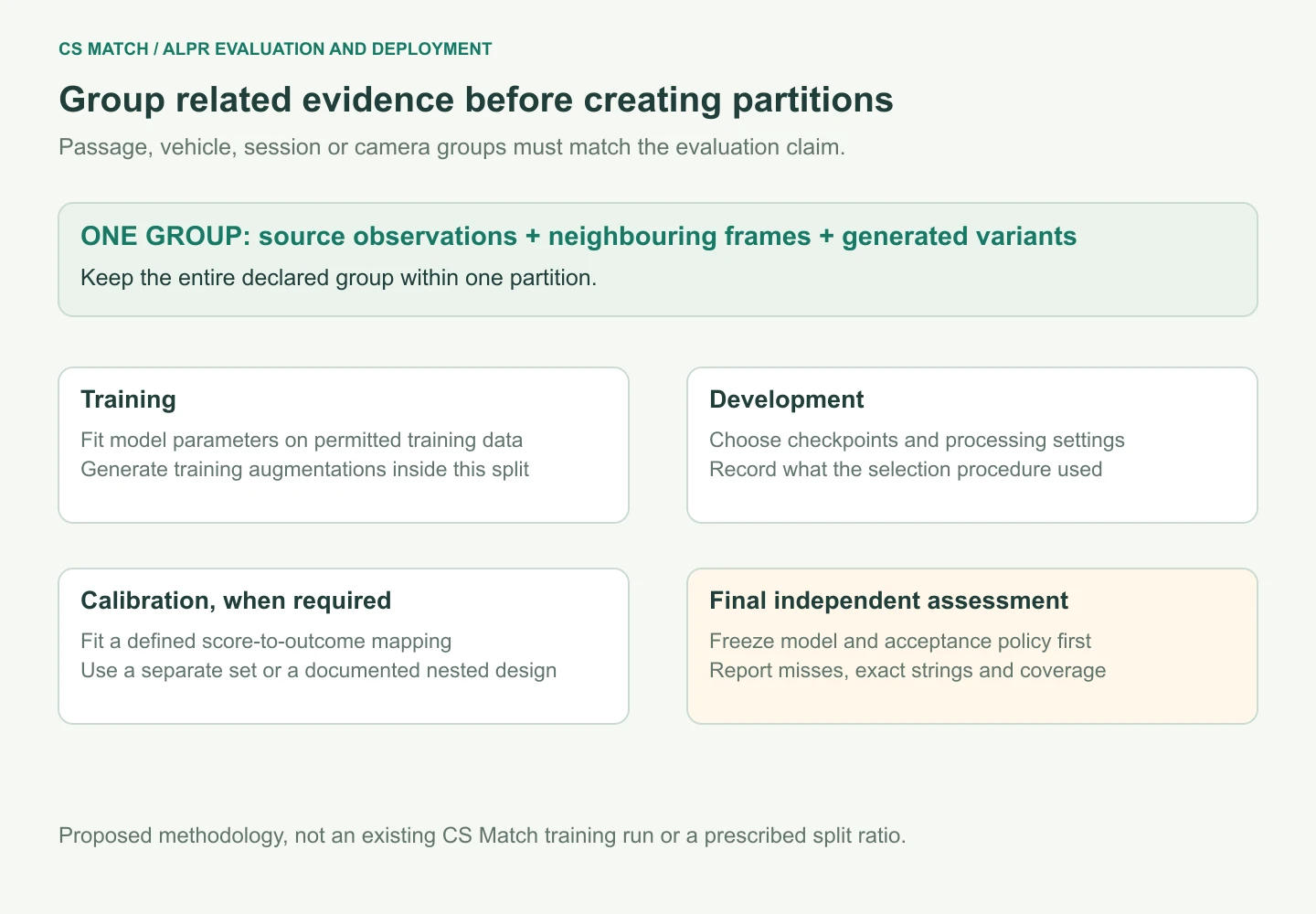
Choose groups according to the deployment question. Keep all frames and generated variants of one passage together; consider broader vehicle, session or camera groups when those dependencies matter. Scikit-learn's grouped cross-validation documentation provides mechanisms for keeping declared groups separate. A grouping tool cannot correct a missing or incorrectly assigned group identity.
Freeze independent training, development and final assessment partitions. If a calibration stage is needed, reserve suitable data or use a documented nested procedure. Generate augmentations only from the training portion. A held-out camera tests a different generalization claim from a held-out passage on a known camera, so name the protocol rather than describing every split simply as unseen data.
Fine-tune the component that limits the task
Begin with a suitable pretrained baseline and controlled target adaptation rather than replacing the entire system immediately. A plate detector trained for one appearance may need new localization examples; a recognizer may need an expanded dictionary or layout-aware input. These are distinct interventions with different labels, compute needs and failure checks.
PaddleOCR's versioned training documentation describes pretrained initialization, recognition datasets and dictionary configuration. The supported character mapping must agree across training and inference. A crop containing a required character outside the dictionary cannot be repaired by a regional regex after recognition. Conversely, changing the dictionary without compatible weights and decoding is not a completed adaptation.
For a proposed fine-tuning run, document trainable layers, initialization, learning schedule and checkpoint selection. Compare retaining a general baseline with adapting it on the target set, and inspect regressions on common layouts. A small biased collection can encourage memorization of fonts or backgrounds. Select the run through development evidence, not through whichever checkpoint looks strongest on the final test.
Make augmentation reflect plausible capture failures
Training transformations can represent scale changes, modest geometric variation, compression, noise and illumination differences. Their parameters should reflect the intended capture conditions. Inspect transformed examples at the actual training input size: a realistic-looking full frame can become a crop with erased strokes after resizing or an augmentation that clips the required final character.
A synthetic blur or contrast change is not automatically a faithful simulation of night-time IR, reflective clipping or motion-dependent shutter distortion. Use real target observations to check whether synthetic examples resemble the failure being addressed. Keep the unchanged reference only when the transformed image still supports that supervised task under the declared annotation policy.
Compare augmentation families through controlled ablations. If adding several transformations improves a score, remove them individually to learn which ones matter and where they introduce errors. Ultralytics training documentation exposes configurable augmentation and training settings; availability of an option is not evidence that enabling it helps a particular registration recognizer or layout.
Record more than the final weight file
A reproducible model package includes source revision, weight hash, dataset version, split manifest, dictionary, preprocessing and decoder configuration. Keep optimizer and schedule settings, random seeds and the checkpoint-selection rule. A filename such as best.pt does not say which examples were used, what best meant or whether the preprocessing matches the deployed worker.
Track development metrics by stage and condition while preserving a fixed final assessment. Use the development set to choose stopping and acceptance settings; do not repeatedly tune against the final test and continue calling it independent. If a test has influenced design choices, retain its role in the record and collect a fresh assessment for the resulting claims.
Training loss is a diagnostic, not a substitute for registration outcomes. A lower sequence loss can coexist with worse exact-string performance on stacked or unfamiliar designs. Save representative errors and accepted successes for each candidate. This makes checkpoint review concrete and helps distinguish a genuine transcription improvement from a decoder or filter that simply rejects more difficult examples.
Use paired comparisons to explain gains and regressions
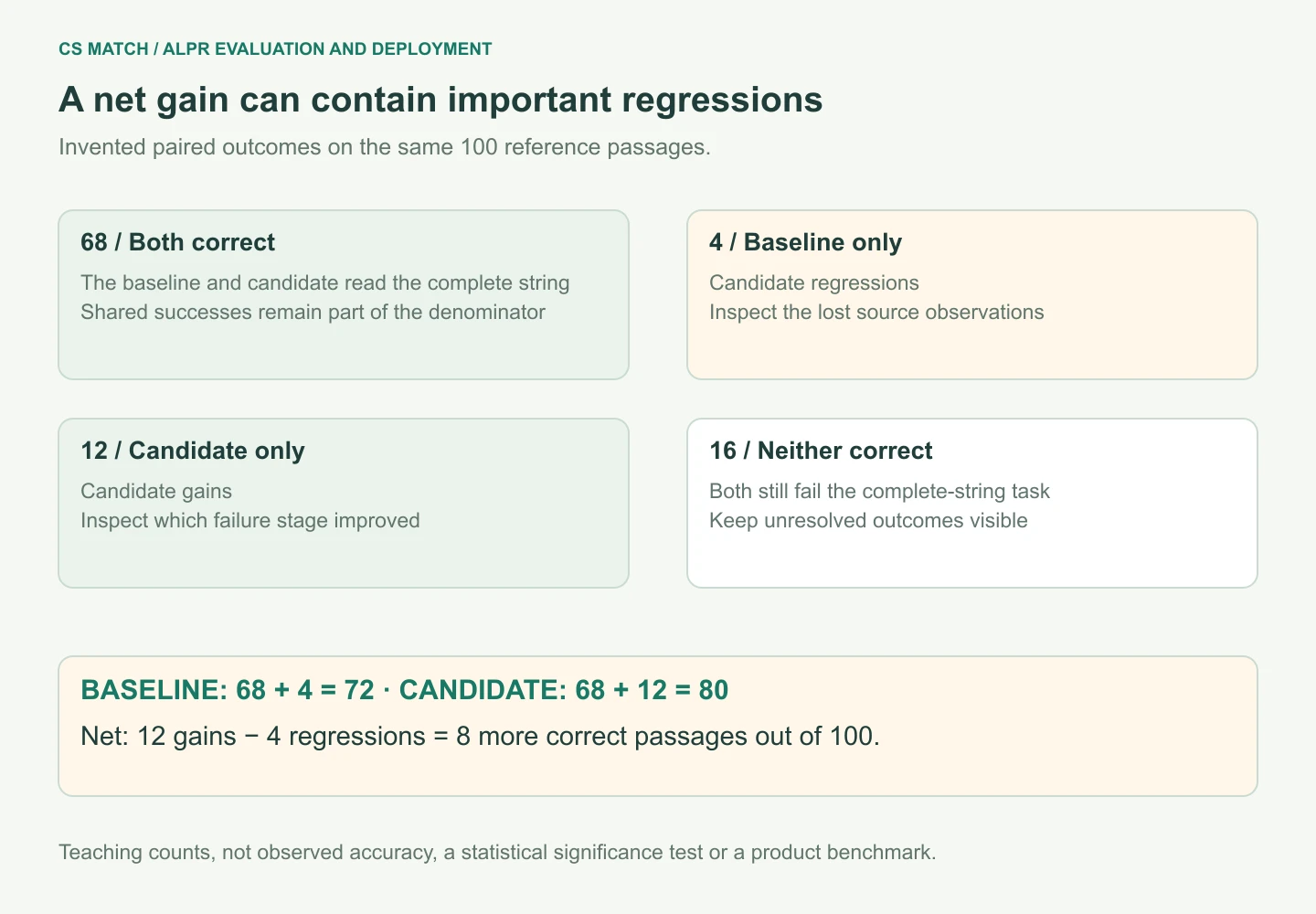
Evaluate baseline and candidate on the same frozen passages with a declared acceptance policy. Build a paired outcome table showing cases both read correctly, cases only the baseline gets right, cases only the candidate gets right and cases neither solves. An aggregate difference alone hides whether the new model fixes the intended defect or trades one layout failure for another.
For an invented 100-passage exercise, both systems read 68 correctly, only the baseline reads four correctly, only the candidate reads twelve correctly and neither reads sixteen correctly. The baseline has 72 correct passages; the candidate has 80. Its net gain is eight percentage points, composed of twelve gains and four regressions. These are teaching counts, not measured service results.
Repeat the comparison with one pipeline change at a time when feasible: detector, crop geometry, recognizer, normalization or temporal selection. Keep acceptance thresholds fixed for a component comparison, or clearly declare a separately tuned policy comparison. Inspect the gained and lost source observations before deciding whether a candidate meets the task's priorities.
Evaluate generalization across layouts and acquisition
Cross-dataset plate-recognition research examines how results change when training and evaluation sources differ. This is a warning to test transfer explicitly, not a universal numerical penalty. Plate design, camera position, compression and acquisition routines can all differ between collections. A model may exploit collection-specific appearance without learning the robust distinctions needed by a new scene.
Maintain condition-level reports for the actual target: relevant states and classes, front/rear views, near/far zones, steady night and transitions. Include counts and unresolved references. Do not discard an unfamiliar design because the current format rule rejects it; that would remove the very transfer failure the experiment needs to reveal.
Use an independent source as a stress test and state its limits. A result on a new public collection still does not automatically establish performance on a client's camera. When adding examples from that collection to training, stop calling it wholly unseen and create a new evaluation boundary. Generalization claims should follow the provenance of the evidence.
Benchmark the exported pipeline on the intended hardware
Measure the deployed artefact, including preprocessing, decoding and postprocessing. Export can alter supported shapes, numerical behaviour or operator execution. Compare candidate strings and boxes with the reference implementation on a fixed set before measuring speed. ONNX Runtime documents execution providers for different hardware; choosing one does not demonstrate that every operation is accelerated or equivalent.
Separate cold initialization, steady inference, source decoding, crop encoding and result persistence in a timing record. Report hardware, thread limits, input dimensions, batching and concurrent jobs. A millisecond figure for one warm crop is not the completion time of an uploaded video, especially when OCR opportunities vary with traffic density and the analysis sampling schedule.
For workload arithmetic only, ten minutes at 30 source frames per second contains 18,000 frames. A fixed every-thirtieth-frame schedule examines 600 positions before any adaptive additions. At an assumed two vehicle candidates per selected position, that implies 1,200 vehicle-crop opportunities, not a guaranteed number of OCR calls. Missing plates, multiple boxes and bounded retries change actual work.
Hypothetical fixed schedule: 600 s × 30 fps = 18,000 frames; / 30 = 600 selected positions.Assumed 2 vehicle candidates per position → 1,200 crop opportunities, not measured OCR calls.What a responsible CS Match evaluation would add
The repository has a video benchmark helper that checks expected counts and whether supplied plate strings appear among results. That is useful for regression smoke checks, but it is not a comprehensive passage-matched accuracy study. Presence somewhere in a recording does not establish that every string was associated with the correct passage or that all false readings were counted.
A stronger proposed evaluation would retain reference passage intervals, assignment rules, crop readability, exact-string outcomes, acceptance coverage and condition summaries. It would pin the complete pipeline and evaluate paired changes on independent footage. This article describes that methodology; it does not announce a newly trained model, a completed independent benchmark or additional metrics already present in the product.
Use the current report's saved observations, crops and source times to build that review evidence. Improve the demonstrated bottleneck and retain a rollback baseline. The defensible result is a reproducible improvement under a stated protocol, with failures visible. A collection of pretrained components becomes a dependable application through this evaluation discipline, not through a leaderboard percentage borrowed from another task.
Questions about this workflow
Can I train only on difficult rejected crops?
They are useful diagnostic examples, but they do not represent the whole task. Include ordinary passages and an independent evaluation set so gains on hard cases do not hide regressions or lost coverage elsewhere.
Why keep neighbouring video frames in the same split?
They can share nearly identical registration and background evidence. Splitting them across training and test can inflate results without demonstrating transfer to independent passages or cameras.
Does a public benchmark result predict our CCTV accuracy?
Only under comparable inputs and protocol, and even then transfer needs testing. Geography, layout, acquisition and the definition of success can differ substantially from the target workflow.
Does this guide introduce a newly trained CS Match model?
No. It explains a proposed training and evaluation workflow. Current observations and benchmark smoke checks are useful starting evidence, not a published independent accuracy study.
Continue with the next useful step
License Plate Confidence: Detection, OCR and Whole-Plate Accuracy
Interpret plate detector scores, OCR scores, exact-string accuracy, coverage, calibration and abstention. Use worked examples to distinguish a high-confidence candidate from measured end-to-end performance.
License Plate OCR: PaddleOCR, CRNN, LPRNet and Transformers
Understand OCR frameworks, character segmentation, CRNN and CTC decoding, LPRNet and transformer recognizers, with a worked repeated-character example and guidance for evaluating CCTV plate reading.
ALPR Architecture Choices: Open Models, Edge and Cloud
Compare classical pipelines, modular detectors and OCR, integrated plate networks, edge devices, self-hosted workers and managed ALPR. Evaluate task fit, retained evidence, runtime and operating effort without borrowed accuracy claims.