
Plate Format Validation: Helpful Rules Without Invented Characters
Separate normalization, format checks and OCR correction. Explore regional rules, ambiguous characters, Unicode lookalikes, unknown layouts and auditable rejection using the current CS Match implementation.
Sources checked · Cyber Search MatchA format rule can test whether a candidate fits a documented pattern; it cannot prove the candidate was read correctly. Preserve raw OCR, record normalization and keep corrections separate. Apply jurisdiction and class rules only when their context is justified, and retain unknown or rejected outcomes instead of forcing every crop into a plausible registration.
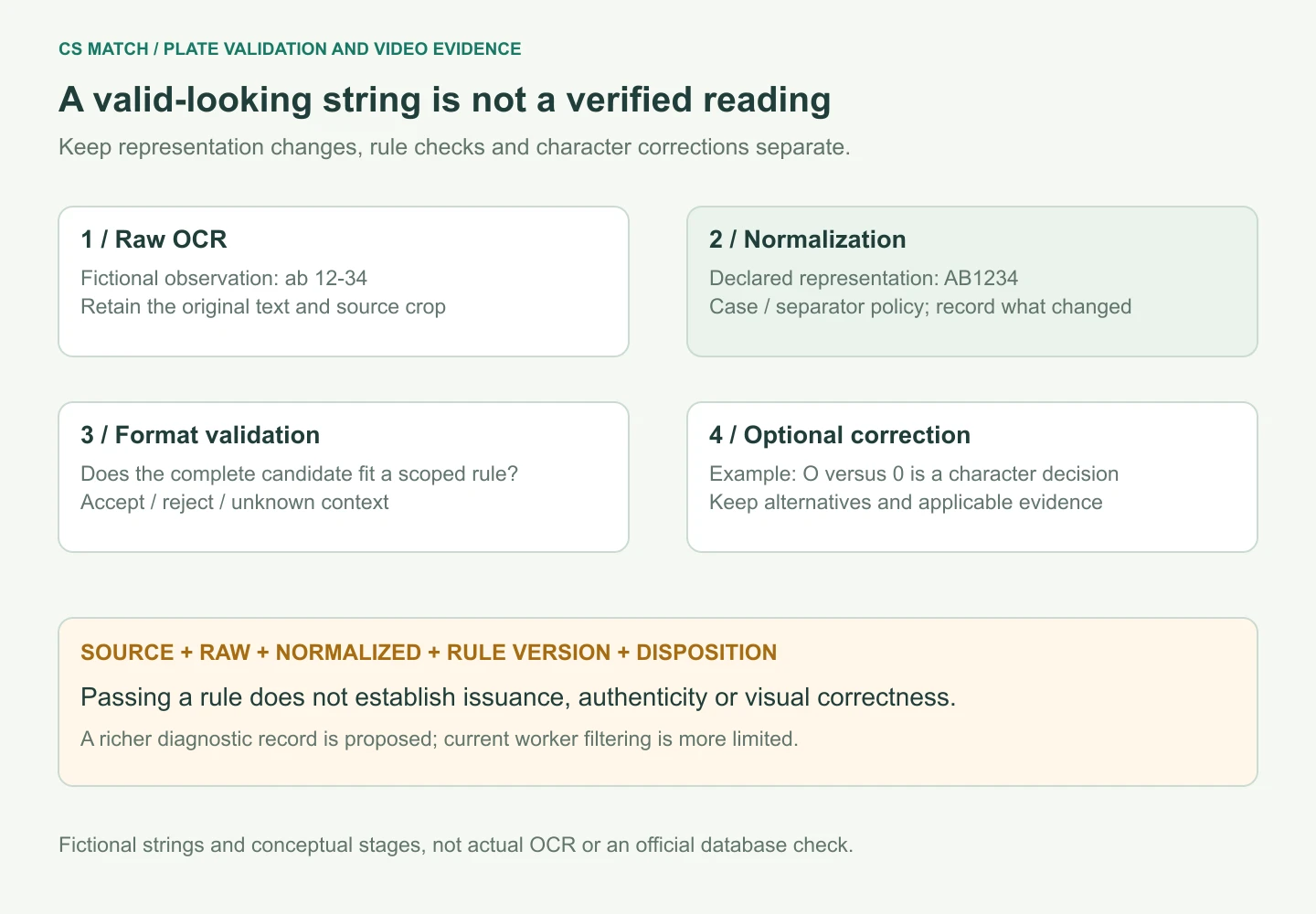
Normalization, validation and correction are separate operations
Normalization changes representation, such as letter case or spacing. Validation checks a condition, such as an allowed alphabet or a documented arrangement. Correction changes the proposed identifier, perhaps replacing a visually ambiguous symbol. Combining all three under one clean-up function hides what the system actually observed and what it inferred later.
For a fictional example, raw text ab 12-34 can become AB1234 through a declared formatting policy. That demonstrates representation handling, not an OCR improvement. Changing AB12O4 to AB1204 is a different operation because it chooses a digit instead of a letter. The choice needs image evidence or an applicable constraint, not merely a preference for familiar-looking registrations.
Keep an audit trail containing the raw string, normalized candidate, rule context and final disposition. If a reading is corrected, retain both versions and the reason. This makes it possible to diagnose whether an apparent recognition gain came from better character evidence or from a rule that silently changed difficult examples into expected answers.
A regular expression tests a language of strings
A regular expression can describe permitted characters, lengths and positional arrangements. Python's regular-expression documentation distinguishes operations that search inside text from operations that match an entire string. For validation, the intended boundary matters: finding a plate-like substring inside unrelated OCR output is not equivalent to confirming that the complete selected candidate has the required format.
A hypothetical rule requiring two letters, four digits and two letters would reject a seven-character personalized string even if every character were correctly read. A permissive alphanumeric rule might accept a slogan or truncated identifier. The rule's usefulness depends on its scope and the input selected by the preceding layout stage.
Test explicit positive and negative cases, including empty strings, unexpected whitespace, additional text, omitted prefixes and unfamiliar lengths. Record the difference between a valid registration outside the rule and a genuinely incorrect OCR candidate. Otherwise, validation can appear precise simply because legitimate difficult designs were removed before the remaining results were measured.
Understand the current broad regional checks
With regional validation enabled, the current helper uses a specific two-letter, four-digit, two-letter pattern for UA, a broad five-to-ten alphanumeric range for EU and a two-to-eight alphanumeric range for US. These are application filters. They are not exhaustive descriptions of legally issued registrations, all national alphabets or every special plate class.
The US check can accept AB1234 without knowing its state, design or class. Passing the check does not establish that AB1234 appears in a registration database or that the photographed vehicle carries it. Conversely, rejection can indicate an unsupported layout or normalization problem rather than incorrect visual recognition.
When presenting validation, describe which rule ran and why it applies. A useful proposed report can distinguish accepted, rejected, rule unavailable and context uncertain. The present worker filters candidate readings internally; this article's richer rejection record is an evaluation design, not a claim that every diagnostic field already appears in our user interface.
| Current region setting | Configured check | What it does not determine |
|---|---|---|
| US | 2–8 Latin letters or digits | Issuing state, design or authenticity |
| EU | 5–10 Latin letters or digits | Every European jurisdiction and class |
| UA | Two letters, four digits, two letters | Every Ukrainian plate category |
Establish jurisdiction and plate class before applying narrow rules
A narrow rule needs a justified context. A guessed state can select the wrong template, which then changes a correct raw reading into a string that appears to confirm the guess. Avoid that circular decision. Keep jurisdiction recognition, class recognition and registration transcription identifiable as separate outputs.
New York's personalized-plate guidance documents different character capacities for standard, motorcycle and picture plates. This is a concrete example of why a state label alone may not select a sufficient rule. A reference catalogue needs the relevant class and configuration, and a record of when the supporting document was checked.
Where context is unknown, use a limited generic consistency check or preserve multiple hypotheses. Do not reject every unfamiliar design just because a more specific rule exists for common passenger plates. Measure the coverage lost by narrow validation and retain examples that fall outside known rules so that the catalogue can be updated deliberately.
Resolve O/0 and I/1 with evidence, not unconditional substitution
Similar glyphs are a joint image-and-context problem. A recognizer may confuse O with 0, I with 1, or B with 8 depending on font and capture. A format that truly requires a digit at one position can help rank alternatives. It cannot supply a hidden stroke or prove that the candidate belongs to the assumed plate class.
California DMV's personalized-plate application guidance states that zero is not used in that configuration and the letter O is used instead. The scope is important: this does not justify replacing every zero in every California plate, much less in every American registration. Issuance instructions for one programme are not a universal image-reading rule.
Retain candidate alternatives when the pixels remain ambiguous. A proposed record might contain the raw O reading, a 0 alternative and the specific format that favours one of them. Evaluate whether that intervention improves complete-string correctness on independently verified references, including cases where the initial OCR was already right.
Spacing, dashes and symbols need an explicit policy
Display spacing and the comparison key serve different purposes. The AAMVA standard discusses spaces and dashes as not assigned values in its registration-number convention, while stacked registration characters remain meaningful. Treat this as documented guidance, not evidence that every historical record or external service uses one identical encoding.
A proposed application can preserve a display string and maintain a separate normalized key for a defined comparison. Keep symbol placement and source regions when they help explain a design. Removing a dash can be a declared normalization; removing a required small letter is a loss of identifier content even if the remaining string passes a broad rule.
Define compatibility at system boundaries. A user-entered reference, an OCR result and an external data source may encode separators differently. Apply the same documented policy before comparison, while retaining originals. Do not silently merge records from different jurisdictions solely because formatting removal produced the same alphanumeric key.
Visual similarity is not Unicode identity
Latin and Cyrillic characters can resemble each other while having different code points. Unicode's confusable-character guidance explains why visual appearance alone is insufficient to identify a stored string. That is a representation issue distinct from deciding which physical glyph the camera captured or which alphabet the registration programme uses.
The current normalizer uppercases when enabled, optionally removes whitespace and then retains only A–Z and digits. A non-ASCII letter can therefore disappear instead of being transliterated. Disabling uppercase also does not make the final allowlist accept lowercase letters. Inspect normalization when a raw reading loses a prefix or becomes an unexpectedly short valid-looking candidate.
Do not repair every lookalike through unrestricted transliteration. Use an explicit expected alphabet and a versioned mapping only when justified, with the original text retained. Test mixed-script inputs, unsupported characters and empty results. This prevents a formatting function from being mistaken for a multilingual recognizer or an authority on the intended registration.
For a proposed diagnostic record, note which positions were removed and whether the remaining string still passed a generic length check. Passing after a prefix disappears is not equivalent to preserving the registration. Compare the retained result with the original raw candidate and visible region, so an allowed-character filter cannot silently turn a complete unsupported reading into an apparently valid partial identifier.
Soft constraints rank candidates without certifying them
A decoder can combine visual evidence with a format-consistency term rather than discarding every nonconforming candidate immediately. For example, it can compare an unconstrained reading with alternatives compatible with a justified layout. The combined score is an engineering selection function, not automatically a probability that the whole plate is correct.
Layout-aware ALPR research provides an example of combining plate localization, layout classification and postprocessing. The architecture supports examining where constraints enter the pipeline. Its experimental results should not be transferred to our deployment or to plate classes absent from the study. Evaluate a particular implementation on the inputs and rules the application will actually use.
Bound candidate expansion. Replacing every ambiguous character with every plausible alternative can produce many strings, some of which will fit a template by chance. Retain the reason for each alternative and reject unsupported corrections. More valid-looking candidates do not mean the source image contains more evidence.
With four positions each admitting two alternatives, an unconstrained expansion already creates sixteen combinations. Additional ambiguity can grow the search quickly. This is combinatorial arithmetic, not an estimate of real recognition uncertainty. Limit alternatives using evaluated visual evidence and applicable context, then measure whether the selected correction improves independently verified strings rather than merely increasing the number that pass a rule.
Make rejected and unavailable outcomes understandable
A proposed validation result should distinguish no plate detected, no usable OCR, normalization produced no allowed characters, format rejected, and rule context unknown. These states identify different interventions. Treating them all as no result hides whether the system needs better capture, different text selection or broader format support.
Keep a short reason and the applicable rule version alongside the source observation. A rejected candidate can still be useful for manual review, especially when the crop clearly shows an unusual design. Preserve permissions and retention settings consistently with the rest of the recording workflow; a diagnostic record need not become an unrelated permanent plate registry.
When comparing versions, count rejected legitimate registrations as lost coverage. Count accepted wrong strings as errors. A system that rejects almost everything can have impressive conditional precision while answering very few real tasks. Present acceptance rate and complete-string correctness together so stricter filtering cannot disguise reduced usefulness.
Version rules and test their boundaries
A rule catalogue should identify jurisdiction, class, applicable design or issue context, source reference and revision. Do not encode a current common layout as an eternal property of a state. Retain an unknown path for new or unsupported designs rather than forcing them through the closest historical pattern.
Test the rule separately from OCR with known strings, then evaluate it on real OCR outputs. Include valid unfamiliar strings, invalid extra text, ambiguous substitutions and legitimate small-character prefixes. Use independently established references instead of labelling the rule's own output as ground truth. That would make an incorrect correction look successful by construction.
Review changes on a fixed regression set and examine both newly accepted and newly rejected cases. If a rule update improves a specialty class while harming ordinary plates, keep that tradeoff visible. Rollback should restore the previous rule and normalization policy together, because a catalogue version alone cannot reproduce results if the input representation changed.
In a fictional reference set of 100 registrations, suppose 70 are accepted and 63 of those are correct. Correctness among accepted outputs is 90%, but only 63% of the reference set receives a correct accepted reading. Seven wrong acceptances and thirty rejected cases remain relevant. These invented counts illustrate why a validation policy must report both errors and lost coverage.
Do not let validation errors dominate repeated-frame voting
Temporal aggregation magnifies whichever representation it receives. If every frame loses the same stacked prefix during normalization, voting cannot restore it from the shortened strings. If a narrow rule rejects the few sharp observations and retains only blurred but plausible candidates, the temporal winner can become less faithful than the original evidence.
Keep raw and normalized candidates linked to each source frame, with validation reasons recorded before aggregation. A proposed consensus stage can then distinguish genuine agreement from identical postprocessing. Multiple variants of one image should not count as independent observations simply because they produce separate OCR strings.
Choose the ordering deliberately: registration-region selection, OCR hypotheses, bounded normalization, applicable validation and temporal selection each have different responsibilities. Evaluate the full sequence on complete passages. The companion guide explains how to compare repeated readings without turning correlated errors into an unwarranted confidence claim.
Use the current settings as filters, with known limits
Our current helper normalizes text and applies the configured regional expression before retaining a reading. The worker can preserve rawText for accepted readings, but candidates rejected inside that path do not become a comprehensive diagnostic history in the report. The richer acceptance and rejection states described here are proposed evaluation improvements, not newly implemented features.
For a troublesome task, compare the retained crop, visible registration and displayed candidate. Check whether required characters were outside the selected region or removed during normalization. Review the chosen region setting before lowering thresholds. A lower OCR threshold can admit more candidate readings, but it does not make an inappropriate format rule correct.
Use a short reference passage and change one stage at a time. Keep the unconstrained interpretation available during a controlled comparison, then measure accepted complete strings and lost legitimate cases. Validation is most useful when it makes an uncertain reading easier to inspect. It should not hide a correction behind a polished identifier or imply official database verification.
Questions about this workflow
Does a regex match prove a plate was read correctly?
No. It establishes compliance with the configured string pattern, not visual correctness, issuance, authenticity or ownership.
Should O always be converted to 0?
No. The appropriate interpretation depends on captured detail and a justified jurisdiction/class rule. Retain ambiguity and original text when that context is uncertain.
Why might normalization remove part of a reading?
The current allowlist retains only uppercase Latin letters and digits. Unsupported characters can be discarded, and turning off uppercase does not make lowercase pass that allowlist.
Does the current report expose every rejected OCR candidate?
No. The worker filters candidates internally. This guide describes additional diagnostic states as a proposed design, not an already deployed rejection-history interface.
Continue with the next useful step
Combining License Plate Readings Across Video Frames
Explore best-frame selection, tracking, majority and weighted voting, edit-distance alignment, character consensus and image fusion, with worked examples and the current CS Match retry mechanism.
Why US License Plates Are Difficult for ALPR
Explore American plate designs, personalized strings, stacked characters, jurisdiction recognition and CCTV domain shift, with documented state examples and a practical evaluation strategy.
License Plate OCR: PaddleOCR, CRNN, LPRNet and Transformers
Understand OCR frameworks, character segmentation, CRNN and CTC decoding, LPRNet and transformer recognizers, with a worked repeated-character example and guidance for evaluating CCTV plate reading.