
Combining License Plate Readings Across Video Frames
Explore best-frame selection, tracking, majority and weighted voting, edit-distance alignment, character consensus and image fusion, with worked examples and the current CS Match retry mechanism.
Sources checked · Cyber Search MatchMultiple frames help only when they belong to the correct vehicle and contain complementary usable evidence. Select observations, preserve their source context, align candidate strings and treat repeated errors as correlated. A temporal winner is a candidate for review, not proof of correctness. The current CS Match retry mechanism is separate from the richer consensus algorithms described here.
Define the unit: frame, crop, track or vehicle passage
A frame is a recorded image, a crop is a selected region and a track is an association of observations. A vehicle passage is the event a review task may need to describe. These are not interchangeable counting units. One passage can contain many observations or fragmented tracks, and one frame can contain several vehicles.
Begin with a reference definition for the task. Decide whether the required result is one candidate per retained track segment or one reviewed registration per passage. Then retain the source observations supporting it. Without that boundary, a temporal method can appear to improve recognition simply by counting repeated easy views as additional successes.
The current report groups observations and preserves source times and crops. This supplies a useful evidence trail, but a task-local track ID is not a permanent registration identity. Before combining strings, inspect whether the observations belong together and whether their plate regions contain the same intended identifier.
Associate observations before using their text as evidence
Tracking can combine motion, spatial overlap and appearance to associate detections across frames. SORT and Deep SORT illustrate motion-based association and the addition of appearance information in general tracking research. Their results do not establish that our application uses those implementations or that every nearby vehicle can be linked correctly.
Our tracker is a separate project implementation. For temporal plate reading, the essential safeguard is to avoid mixing adjacent vehicles, fragmented reappearances or observations across a scene cut. A stable-looking identifier can emerge from incorrect association, especially when two vehicles have similar appearance and a shared partial registration pattern.
Do not use a guessed final plate string as unquestioned proof that uncertain tracks should merge. That creates a loop in which a recognition error validates its own association. Keep ambiguous groups separate or require independent spatial and temporal support. Review parent vehicle crops and surrounding frames when competing strings suddenly enter one track.
Select diverse usable observations, not every available duplicate
A bounded observation set can be more useful than hundreds of almost identical frames. Candidate quality can consider native character size, focus, exposure, viewpoint, obstruction and complete registration coverage. A high vehicle-detection score alone does not certify a readable plate. Select the evidence needed by the recognizer rather than the prettiest whole-car thumbnail.
Diversity matters alongside quality. Several consecutive frames can repeat the same glare or compression artifact. A later view may resolve a hidden suffix even if its overall image score is lower. A proposed selector can limit near-duplicates while retaining observations from meaningfully different visible conditions within the same supported association.
Keep the selection policy and rejected candidates inspectable during evaluation. If a method sees only hand-picked readable crops, report that boundary. Sampling can miss the usable interval before any selection stage begins, so compare the chosen observations with the source recording. Temporal aggregation cannot combine information from frames that were never captured or retained.
Define temporal windows using source time when comparing recordings with different frame rates. Ten consecutive frames can cover very different durations, while variable frame timing makes a fixed frame count less predictable. Retain timestamps in the selected set and avoid giving a higher-rate source more support merely because it stores more near-identical views of the same brief appearance.
Start with a best-frame baseline
The simplest temporal approach chooses one observation and returns its reading. It avoids string fusion and provides a clear source crop for review. Its weakness is selection: the chosen frame may contain an unresolved character that another observation reveals. Treat best-frame recognition as a baseline to beat, not as an obviously inferior approach.
Define best using a policy independent of the final reference string. Selecting whichever observation happens to match ground truth measures an oracle, not a deployable system. A candidate's OCR score can help ranking but must be evaluated for confident mistakes. Include no-read outcomes when no selected frame produces a usable candidate.
Compare every more elaborate method with that baseline on the same passages and observation budget. Record whether a gain came from an additional usable view, a better selector or a fusion algorithm. Otherwise, a consensus model that receives more evidence can be credited for an architectural improvement actually caused by denser sampling.
Majority voting can repeat the same mistake
Whole-string majority voting selects the most frequent candidate among associated observations. It is easy to inspect and does not create a new string from individual characters. Temporal-redundancy research in plate recognition investigates aggregation including voting and classifier outputs, providing a concrete precedent for comparing repeated evidence rather than treating frames independently.
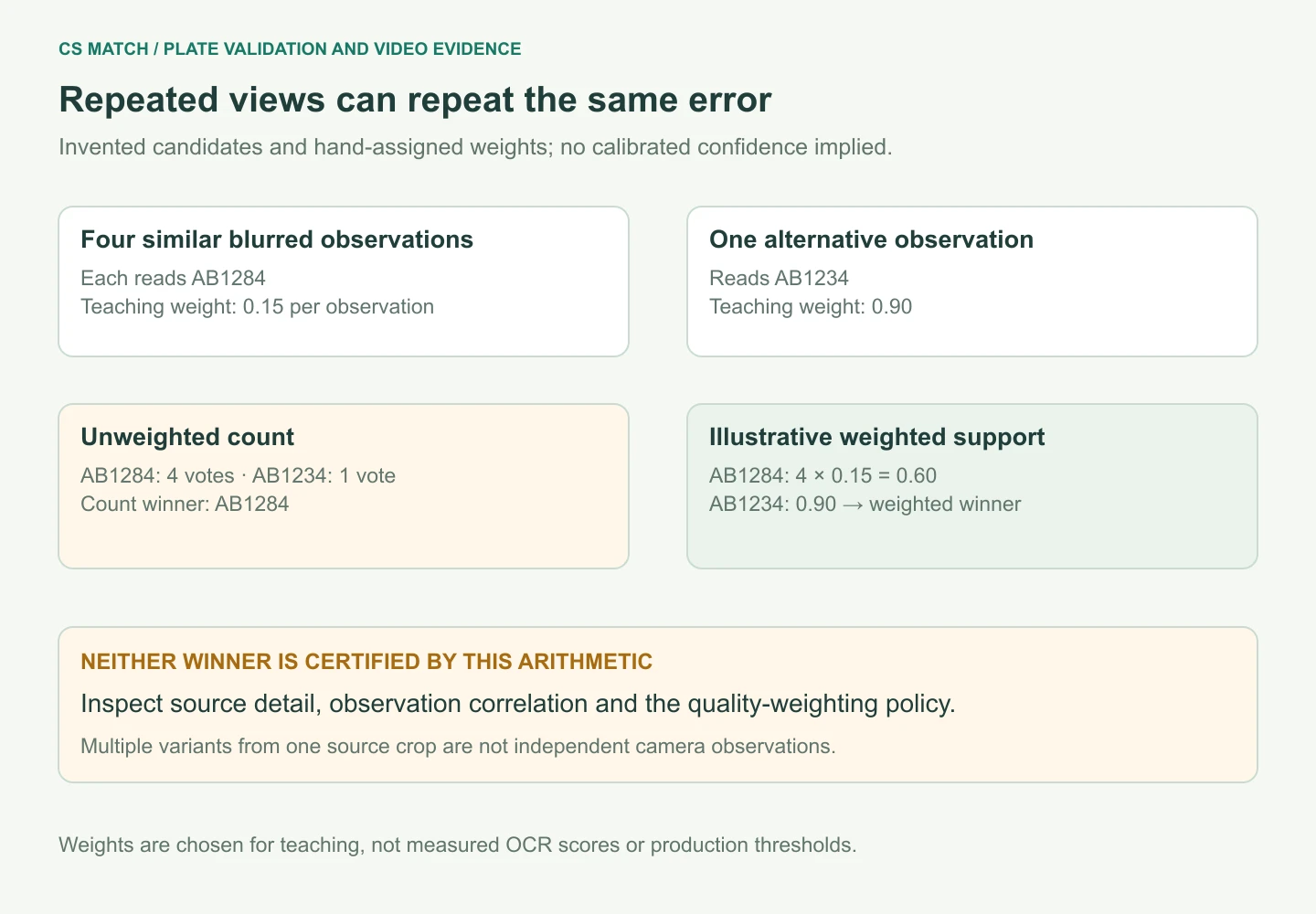
For a fictional example, four blurred observations read AB1284 and one clearer view reads AB1234. An unweighted count selects AB1284. If all four blurred views share the same merged stroke, their numerical majority does not establish that 8 is correct. The example isolates correlation; it is not a measured outcome or a claim that the clearer view must always be right.
Inspect disagreements and observation conditions. A tie, a dominant partial string or a winner supported only by near-duplicates can justify an unresolved result. Define how empty readings and variants from the same source count. Counting two enhancement variants as two votes can inflate support without adding a second camera observation.
Weighted voting needs a documented quality model
Weighted voting assigns a support weight to each eligible observation and sums support for matching candidates. The weight can represent an evaluated quality estimate, but must not be confused with a calibrated probability. Multiplying unrelated detector and OCR scores is not automatically a justified estimate of complete-string correctness.
Continue the invented example with weight 0.15 for each of four blurred readings and 0.90 for the clearer reading. AB1284 receives 0.60 support, while AB1234 receives 0.90 and wins this hand-designed vote. These weights are arbitrary teaching values, not measured confidences or recommended production thresholds.
Evaluate the weighting policy independently, including confidently wrong clear-looking crops. Consider limiting support from near-duplicate observations and retaining the top competing candidates. Report the selected support score as such. A winner's fraction of total weight describes the voting calculation, not the chance that the physical registration has been established.
Support(s) = sum of eligible observation weights for candidate sIllustration: 4 × 0.15 = 0.60; one alternative receives 0.90Use edit distance to compare strings with different lengths
Different readings can contain substitutions, missing characters or extra text. Levenshtein distance counts a minimum sequence of insertions, deletions and substitutions under defined costs. RapidFuzz documents these operations and configurable weights. It is a reference for the algorithm here, not a new dependency installed in our worker.
In invented examples, AB1234 and AB1284 differ by one substitution; AB1234 and AB134 differ by one deletion. Their positions cannot be compared blindly after a missing character because later indices shift. Align candidate strings before attempting character-level aggregation, and keep the alignment attached to its supporting observations.
A small distance does not establish vehicle identity. Two actual vehicles can have similar strings, and a dropped prefix can make unrelated registrations look close. Use distance only within a justified association or a separately evaluated matching procedure. A weighted medoid can select an observed candidate minimizing disagreement, which avoids synthesizing a new string but still needs source verification.
For an explicitly chosen unit-cost normalization, divide edit distance by the longer string length. One edit between two six-character candidates gives one sixth; one edit between two three-character candidates gives one third. That can make a comparison scale-aware, but neither value is a probability of identity. State the costs, denominator and treatment of empty strings before selecting a threshold.
Illustrative unit-cost distances: d(AB1234, AB1284) = 1d(AB1234, AB134) = 1Character consensus can produce a string never read in one frame
After justified alignment, a proposed character vote can combine evidence at each registration position. This can recover a complete candidate when different observations resolve different parts. It can also construct an unsupported combination if alignment, layout or association is wrong. Preserve character-to-observation support rather than displaying only the final assembled string.
Consider fictional equal-length readings AB12X4, AB1Y34 and ABZ234. A column-wise majority yields AB1234, which was not returned by any individual observation. That is not automatically incorrect: different views can contain complementary evidence. It must, however, be labelled as an aggregate interpretation and checked against the contributing character regions.
Missing regions should not become ordinary negative votes. A clipped suffix is different from a recognizer clearly selecting another character. Keep gaps, unknowns and ambiguous alternatives distinguishable, especially with stacked prefixes or multiple rows. The current CS Match worker does not expose the character-level distributions needed for a fully probabilistic version of this decoder.
Require position-level evidence from the observations that actually contain that character. A useful proposed record can distinguish a directly selected observed string from a medoid and a synthesized character candidate. Compare those output types separately during evaluation. Their supporting evidence differs even when their displayed characters happen to match, so the review interface should not erase how the candidate was obtained.
| Fictional observation | Returned string | Different uncertain position |
|---|---|---|
| Observation A | AB12X4 | Fifth character |
| Observation B | AB1Y34 | Fourth character |
| Observation C | ABZ234 | Third character |
| Column-majority candidate | AB1234 | Not a direct single-frame reading |
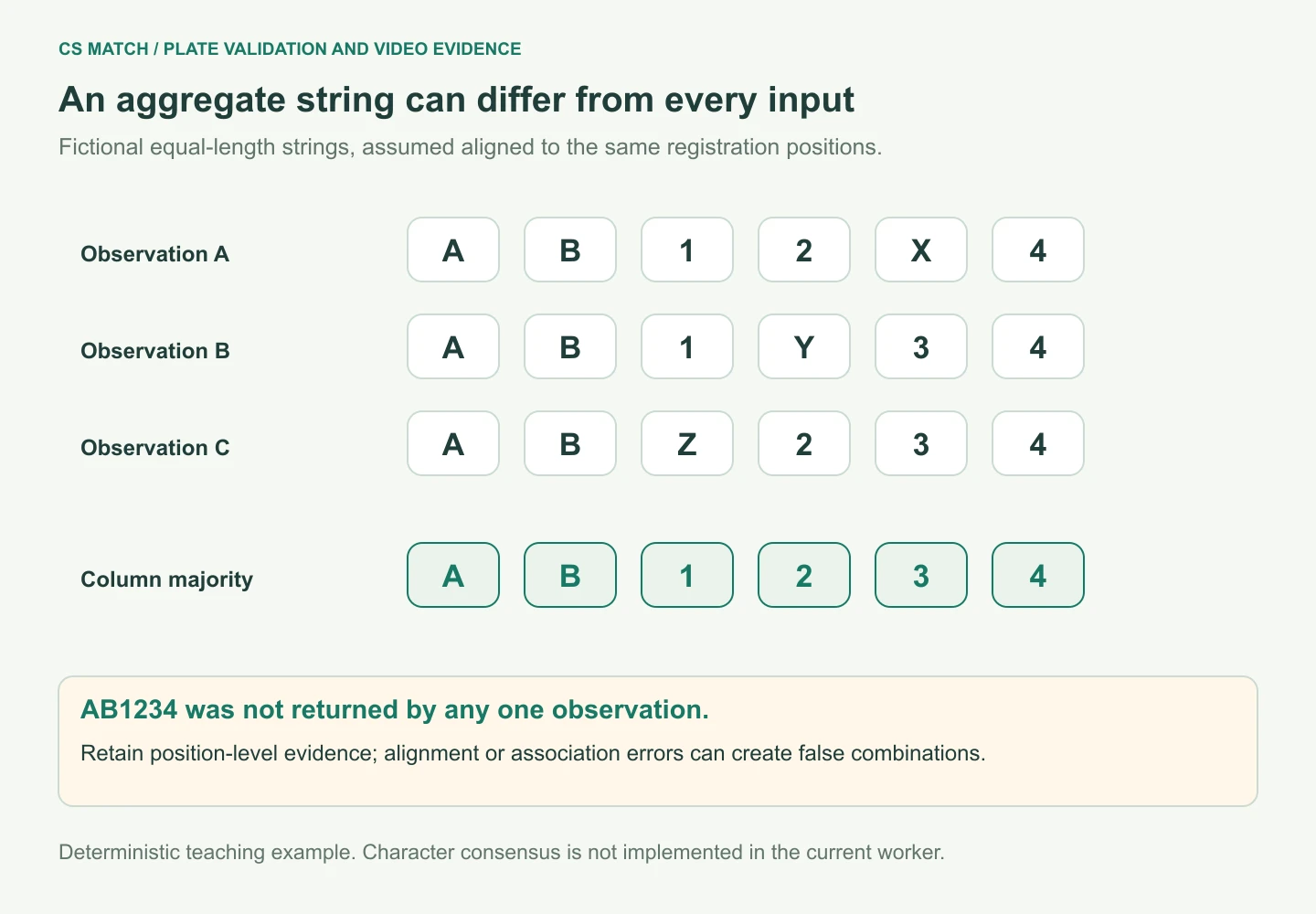
Image or feature fusion is a different architecture
A text-voting stage combines recognition outputs. Image-level or feature-level fusion combines information before final transcription. It may align neighbouring plate views, aggregate features and recognize from that representation. This changes the model and its input requirements rather than adding a final vote to independent OCR strings.
MF-LPR² studies multi-frame restoration and recognition using optical-flow alignment. It provides a concrete research example of the earlier-fusion approach. Its results and assumptions belong to its evaluation setting, not to every uploaded recording or to our current worker. Misalignment, occlusion and changing perspective remain failure modes to test.
Retain original observations even when a restored image looks sharp. A fused representation can help recognition, but its displayed characters should remain traceable to captured evidence. Compare complete-string accuracy, abstention, latency and memory against text voting and a best-frame baseline. Additional processing complexity needs a measured benefit under the intended source conditions.
A stopping rule should preserve unresolved outcomes
An online method may stop after sufficient evidence or a processing budget is reached. These are different reasons to stop. Reaching a budget does not turn a weak candidate into a confirmed reading, and early agreement can be produced by repeated artifacts. Keep the provisional status until the defined review or acceptance condition is satisfied.
Choose stopping behaviour on an evaluation set, including delayed readable views and initially misleading candidates. Measure whether early stopping prevents a later corrective observation from being examined. Compare accuracy and latency at the passage level rather than reporting only the speed of successful early decisions.
Allow no-read and unresolved outcomes when the source does not support a complete string. Retain the competing candidates and the observations behind them. A fixed requirement such as two identical readings can be a useful scheduling heuristic, but without evaluation and correlation handling it is not a universal confidence guarantee.
Evaluate passages without leaking neighbouring frames
Use the same passages, observation budget and reference labels for best-frame, majority, weighted and character-level methods. Report complete correct readings per relevant passage, wrong accepted readings and unresolved cases. Conditional accuracy among accepted outputs needs its denominator alongside coverage, or an aggressive abstention policy can conceal how little the system reads.
Keep neighbouring frames and related vehicles together when splitting data. Research on near-duplicates in plate datasets specifically examines how repeated visual content can affect evaluation. Random frame-level splitting can place almost the same registration view in training and testing, rewarding familiarity instead of generalization to another camera or design.
Break down improvements by capture quality and layout, and inspect whether association errors increased. Preserve the reference evidence and avoid labelling a vote winner as ground truth. A temporal method should be credited for independently verified complete readings, not for agreement with its own normalizer, selected candidate or tracker-generated grouping.
What CS Match currently does with repeated readings
The streaming pipeline currently bounds recognition attempts per crop segment. For eligible text of four to ten characters, it records distinct parent observations supporting the same string. A qualifying later OCR score of at least 0.85 after two such observations can mark the segment recognized for scheduling. This does not require treating multiple enhancement variants from one parent as separate confirmations.
Active-candidate selection and bounded closed-vehicle fallback retries then determine further work. The recognized flag is a processing heuristic, not a calibrated correctness probability or a character-by-character consensus result. The report retains plate observations; the worker does not implement the weighted vote, medoid or image-fusion architectures illustrated here.
For practical review, compare disagreeing readings with their saved crops and source times, then inspect the parent vehicle association. Establish whether better coverage, registration-region selection or a new aggregation stage addresses the failure. Preserve the original observations so a future consensus experiment can be evaluated against the current bounded workflow rather than an invented baseline.
Questions about this workflow
Do several identical readings prove the plate is correct?
No. Nearby frames can repeat the same blur, glare, layout or normalization error. Review their source evidence and correlation.
Are two enhanced versions of one crop two independent votes?
No. They share one observation. The current scheduling helper deduplicates support by parent observation rather than counting each enhancement as a new confirmation.
Can consensus create a string absent from individual readings?
Yes. Character-level aggregation can assemble complementary evidence. Label it as an aggregate candidate and retain position-level support; incorrect alignment or association can also create a false combination.
Does CS Match currently perform weighted character consensus?
No. It uses bounded attempts and repeated-string support for scheduling. The weighted, aligned and image-fusion methods described here are candidate architectures for separate evaluation.
Continue with the next useful step
Plate Format Validation: Helpful Rules Without Invented Characters
Separate normalization, format checks and OCR correction. Explore regional rules, ambiguous characters, Unicode lookalikes, unknown layouts and auditable rejection using the current CS Match implementation.
How License Plate Recognition Works: From CCTV to Text
Follow the complete ALPR pipeline: video sampling, plate detection, geometry, OCR, format rules, repeated readings and reviewed results, with the current CS Match implementation explained.
License Plate OCR: PaddleOCR, CRNN, LPRNet and Transformers
Understand OCR frameworks, character segmentation, CRNN and CTC decoding, LPRNet and transformer recognizers, with a worked repeated-character example and guidance for evaluating CCTV plate reading.