
Why CCTV License Plates Are Hard to Read
Understand plate pixel size, exposure, frame coverage, perspective, focus, night capture, WDR and compression, with worked examples and a practical diagnostic workflow for CCTV recordings.
Sources checked · Cyber Search MatchA CCTV image can clearly show a vehicle while containing too little reliable detail to read its plate. Diagnose the captured plate itself: its native size, stroke clarity, exposure, viewing angle and usable time window. More OCR attempts cannot reliably recover registration characters that were never resolved in the source recording.
Measure the plate, not the megapixel label
A camera's total resolution describes the whole image, not the number of samples covering a registration character. A wide view can place many useful scene details into one frame while leaving a distant plate tiny. Measure the native plate crop before enlarging it in a browser. Display zoom changes how large it appears on screen, not what the sensor recorded.
For an approximate front-facing example, suppose a 1920-pixel-wide image covers 12 metres at the plate's distance. A hypothetical plate 0.30 metres wide occupies about 48 pixels: 1920 multiplied by 0.30 divided by 12. Narrowing that scene width to six metres gives about 96 pixels under the same assumptions. These are geometric illustrations, not recommended universal thresholds or measured recognition rates.
The estimate ignores perspective, optical blur, distortion and unequal scene depth. Even equal plate widths can conceal different character sizes or crowded layouts. Inspect whether individual strokes and gaps are resolved, then test representative designs. A minimum accepted by one recognizer on one standard plate should not become a promise for every US specialty or motorcycle plate.
Approximate plate width in pixels ≈ frame width × plate width / scene widthIllustration: 1920 × 0.30 / 12 = 48 pixels; at 6 m scene width: 96 pixels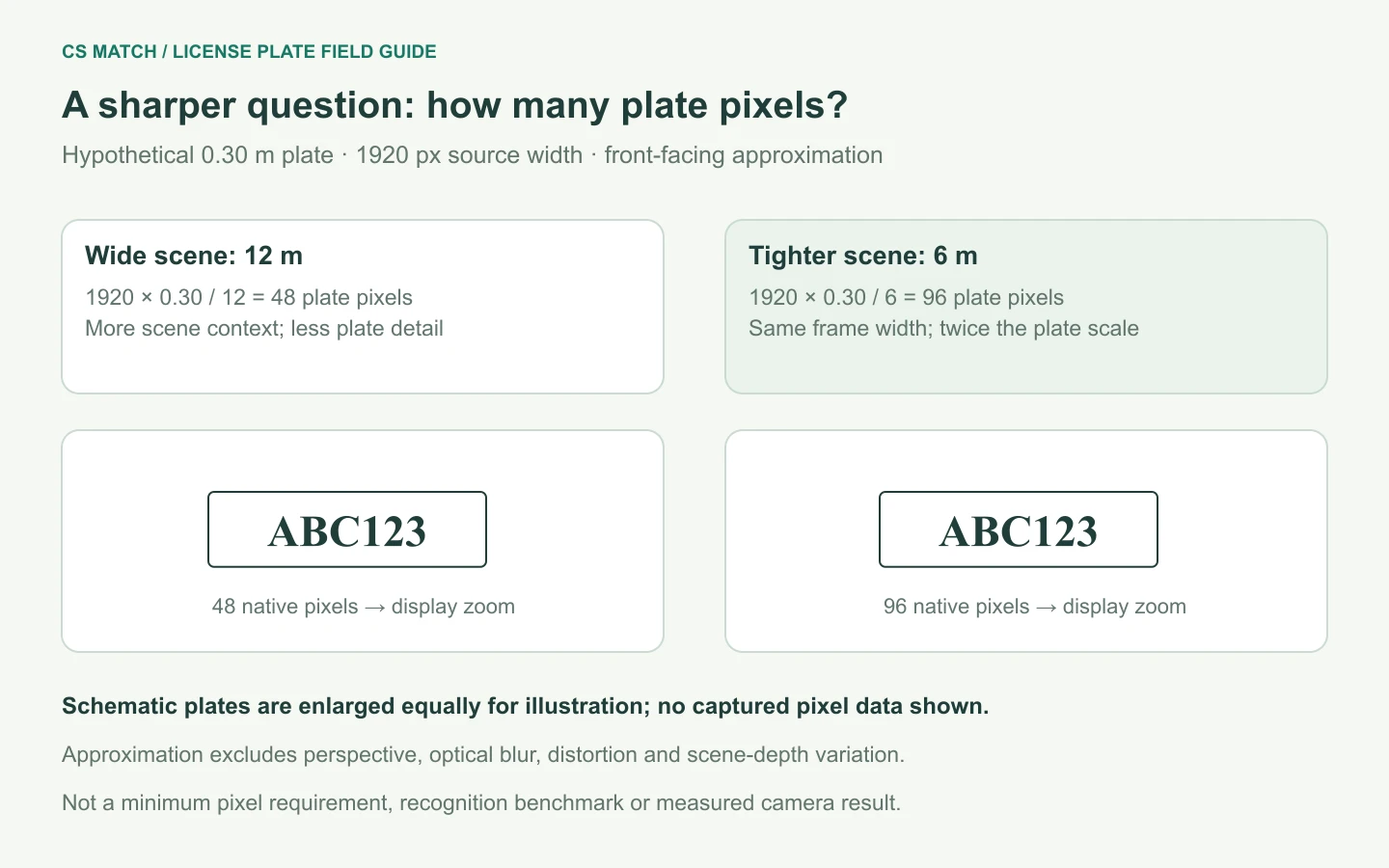
Motion blur depends on movement during exposure
Exposure time is the duration over which light contributes to an image. Basler documents it as a camera acquisition parameter with model-specific limits and interactions. For moving plates, distinguish that duration from the interval between frames. A source can record many images per second while each individual image integrates enough movement to smear character edges.
An approximate image-space model is blur distance equals image velocity multiplied by exposure time. If a hypothetical plate moves at 600 pixels per second, 1/60 second gives about ten pixels of travel during exposure; 1/1000 second gives about 0.6 pixels. This calculation assumes roughly uniform motion and is not a shutter recommendation for a particular road or camera.
Shortening exposure reduces that motion contribution but also changes the light available to the sensor. A usable setting must be evaluated with the actual illumination and image processing. Diagnose directional trails around characters and compare moving plates with stationary objects. If the frame already contains merged strokes, increasing the OCR input width cannot separate their original physical boundaries.
Illustrative motion contribution: b ≈ v_image × t_exposure600 px/s × 1/60 s = 10 px; 600 px/s × 1/1000 s = 0.6 px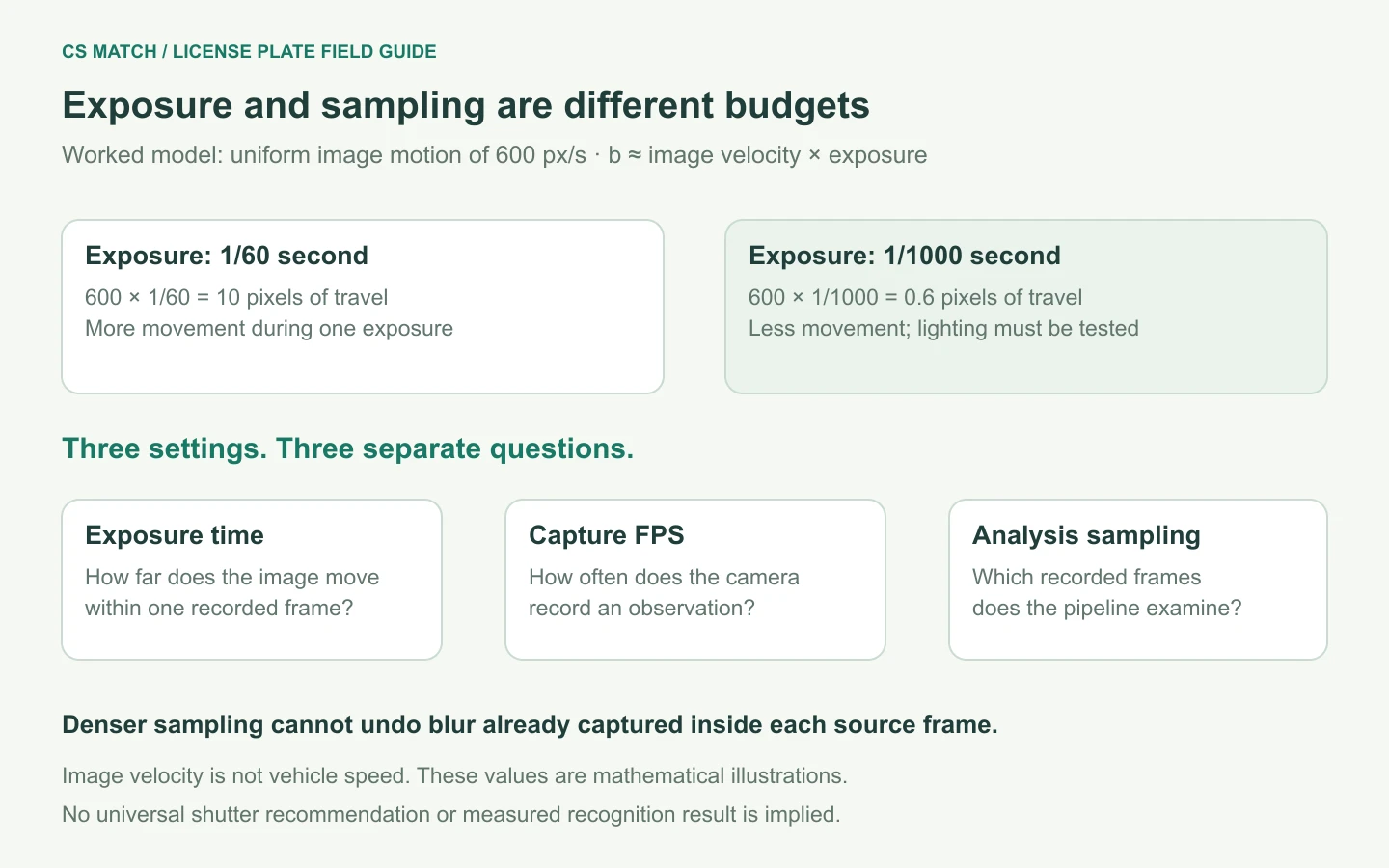
Frame rate and analysis sampling solve another problem
Capture frame rate controls how often images are recorded. Analysis sampling controls which recorded images are examined. Exposure affects sharpness within an image. Keeping these three concepts separate avoids a common mistake: expecting a denser analysis schedule to repair blur, or expecting a faster shutter to prevent a sparse schedule from missing the only readable moment.
Suppose a hypothetical plate is usable for 0.4 seconds in a 25 fps source. That interval contains roughly ten source frames. An analysis step of 50 frames creates about two-second gaps and can skip the interval entirely. A smaller step increases the chance of coverage, but the number of useful views still depends on timing, occlusion and the original capture.
For variable-frame-rate material, use actual timestamps when assessing the interval rather than assuming every frame step has an identical duration. Start with a short passage and inspect nearby source frames manually. If some are sharp and readable, sampling or candidate selection may help. If none contain readable strokes, the primary problem lies before OCR scheduling.
A plate can be large and still geometrically difficult
Viewing a plate obliquely compresses character widths and changes the relative scale across its surface. A high mounting position can add vertical foreshortening, while camera roll tilts the text. The full vehicle may remain easy to recognize even when the registration is a narrow, distorted patch. Measure the plate where reading is actually attempted, not at its best-looking position elsewhere in the journey.
For a flat, front-facing reference, projected width approximately follows a cosine relationship as horizontal viewing angle increases under simplified geometry. That intuition is useful, but real CCTV combines changing distance, pitch, lens projection and motion. A single advertised mounting angle should therefore not be treated as a complete prediction of readability.
Perspective correction can map four estimated corners into a rectangle. OpenCV documents the transformation operation, which resamples existing image content. It does not restore detail lost along the compressed direction. With uncertain corners or a plate partly behind a bumper, correction can worsen the patch. Compare the rectified candidate with the original and retain an explicit failure when geometry cannot be trusted.
Focus must hold at the useful reading distance
A sharp pavement marking does not guarantee a sharp plate moving through a different depth. Focus, lens performance and depth of field determine which distances preserve small detail. Edmund Optics explains depth of field in terms of acceptable resolution and contrast over object distance; it is not simply a large zone that looks generally sharp to a casual viewer.
Evaluate the expected reading region with actual character-sized details. Compare approaching and departing plates at several distances, rather than tuning the lens on one parked vehicle. A crop may improve briefly and deteriorate again because the plate crosses the best-focus plane. The useful interval can therefore be much shorter than the time the whole vehicle remains visible.
Do not classify every soft crop as motion blur. Defocus can affect multiple directions and may also soften stationary details at similar depth. Dirt, moisture or a protective cover can introduce additional loss. Inspect the camera-side image and exported recording separately before changing recognition settings. The diagnostic question is where small-detail contrast disappeared, not whether the scene still looks pleasant.
Night capture requires usable plate contrast
Dark scenes create a different capture problem from simply making the whole frame brighter. Axis's plate-capture guidance discusses short exposures, reflective plates, illumination reach and camera placement. Its advice belongs to a specific capture context, not a universal software guarantee. A wide overview camera and a deliberately configured plate-reading view can produce very different results at the same location.
Inspect the registration strokes rather than judging the visible brightness of the car. A plate can become an almost uniform bright rectangle while surrounding bodywork remains attractive. Another exposure may preserve the plate but leave the rest of the vehicle dark. For a review system, complementary context and detail views can be useful if their sources and timing remain traceable.
Infrared images may also remove colour cues that helped distinguish designs during daytime. Treat day and night as separate test conditions, including unfamiliar layouts and dirty or weathered plates. Do not assume that a bright patch is a readable patch, or that night performance follows from daytime OCR results. Preserve unsuccessful passages so that evaluation includes the conditions the camera actually encounters.
WDR and shutter behaviour can change character shapes
Wide dynamic range processing tries to represent bright and dark scene regions together. Axis describes multiple approaches and their different artifacts. In systems that combine sequential exposures, moving objects can occupy different positions in the component images, producing ghosting or uneven blur. A more balanced-looking scene is therefore not automatically a more faithful registration crop.
Electronic shutter design is another variable. Basler distinguishes global and rolling acquisition behaviours; sequential row timing can distort moving objects even when motion blur within each row is small. This is different from perspective caused by camera position. A four-corner warp chosen for a flat stationary plate may not model every timing-related deformation.
Test the relevant camera modes on moving plates. Look for doubled edges, bent vertical strokes or different sharpness across the identifier, and compare results with the mode changed under controlled conditions. Do not disable all processing blindly: the useful configuration depends on the scene. Keep a record of which exposure, shutter and WDR settings produced each evaluation sample.
Inspect the recording, not just the camera preview
Small registration strokes can suffer when footage is resized, compressed or repeatedly exported. Block boundaries, ringing and smeared fine detail may look like character parts to a recognizer. A live preview, an NVR substream and a downloaded clip can have different settings. Compare the exact file used for analysis with the best available original export.
Codec names alone do not settle the question. The useful detail depends on encoding settings, source complexity, resolution and the entire export chain. Axis's image-quality discussion emphasizes matching image quality to the intended task rather than judging general appearance. Test frames containing moving plates instead of assuming a stream is suitable because a static background looks clean.
When a compatible copy is necessary, preserve the original and document whether the video was re-encoded or stream-copied. FFmpeg distinguishes copying compressed streams from decoding and encoding them again. Stream copy cannot improve existing plate detail; re-encoding can introduce additional changes. Avoid screenshots of a scaled player as the input when the source video or native frame can be retained.
Separate image defects from difficult plate designs
A clear plate can still be difficult because the recognizer does not understand its layout. Graphics may sit behind characters, a registration may use multiple rows, and small stacked letters may carry meaning. AAMVA maintains plate-design and reader-program guidance; these design concerns should not be collapsed into a generic claim that OCR merely needs a sharper image.
Use a human-reviewed reference that records exactly which visible elements belong to the registration. A model that adds a correctly read state name to the number has a layout-selection error, not necessarily a character-recognition error. Conversely, a tightly cropped image may remove a small required prefix. Retain enough surrounding plate context to diagnose both possibilities.
Physical obstruction introduces a different limit. A holder, hitch, another vehicle or accumulated material may hide part of the string. Search nearby views before concluding the information is absent, but do not fill unseen characters from a likely pattern. If every relevant frame hides the same position, the defensible result can remain partial even when the rest is perfectly readable.
Enhancement is a hypothesis to verify
Resizing, sharpening and contrast adjustment change the representation supplied to OCR. They can help a recognizer use captured information, but they can also emphasize artifacts or erase weak strokes. Treat each output as a candidate interpretation of the same source. Save the original crop and compare registration characters rather than rewarding whichever thumbnail looks most polished.
The current CS Match worker tries a bounded set of original and enhanced plate views. It does not provide a generative reconstruction of unreadable registrations or a dedicated four-corner plate rectifier. A crop enlarged to the worker's configured processing width should not be described as a plate captured at that resolution. Source pixel size remains the relevant capture measurement.
If an image-generation or super-resolution model produces a crisp-looking digit, that digit can reflect learned expectations as well as evidence in the input. Such a visualization should not replace the original observation. Distinguish presentation aids, OCR preprocessing and verified recovery in both evaluation and reports. A readable-looking answer is useful only when its characters remain supportable from captured evidence.
Diagnose one passage from source to reading
Begin with the original file and locate a passage manually. Identify the best visible plate frames, their native crop sizes and the time interval during which characters are usable. If no frame resolves the text, record the capture failure. If a readable frame exists, check whether analysis sampled it and whether the saved area included the necessary vehicle and plate.
Next inspect vehicle and plate detections. Is the plate inside the parent crop? Does its rectangle retain the complete registration? Compare OCR variants only after those checks. If the raw reading is correct but the displayed result is absent or changed, inspect normalization, format validation, confidence filters and the selected report view.
Change one factor at a time on a short interval. Denser sampling tests coverage; a revised area tests inclusion; a different crop tests localization. Changing every threshold, enhancement and region together obscures the cause. Keep the failed run alongside the revised run so improvement can be attributed to a specific change rather than to a different vehicle or viewing moment.
| Visible symptom | First check | Why it matters |
|---|---|---|
| No usable source frame | Native crop, exposure, focus and obstruction | OCR cannot validate absent detail |
| Readable source, no plate result | Sampling, area and parent/plate boxes | The recognizer may never receive the right pixels |
| Characters plus unrelated words | Text layout and registration selection | Clear OCR can still select the wrong text |
| Raw reading differs from the report | Normalization, rules and filters | Postprocessing is a separate failure stage |
Test the camera and pipeline as one system
Build a representative review set around actual passages, not only attractive crops. Include different speeds, lanes, distances, lighting transitions, weather and relevant plate designs. Record a reference string only when it can be independently established; retain an unreadable label when it cannot. Mixing uncertain reference labels into accuracy calculations can make a careful system appear wrong or reward invented characters.
Count missed passages as well as wrong strings. Separate capture failure, localization failure, OCR error and postprocessing rejection. Split related footage carefully when comparing models or tuning settings, and report conditions alongside aggregate results. A gain on one close daytime plate does not demonstrate improved performance on distant night traffic or specialty layouts.
For CS Match, use a short uploaded recording, a deliberate interval and enough source-frame coverage. Inspect saved plate crops and vehicle observations before expanding the task. The interface supports reviewing recorded evidence; it does not change the camera's historical exposure or supply live capture controls. The most useful improvement is the one that fixes the identified stage while preserving an honest path back to the source.
Questions about this workflow
Will a 4K camera always read plates better?
Not necessarily. The plate must occupy enough native pixels with usable focus, exposure and contrast. A wide 4K view can retain less registration detail than a tighter view with fewer total pixels.
Should I increase FPS or shorten exposure?
They address different problems. FPS affects captured opportunities; exposure affects movement within each image. Analysis sampling is a third choice. Diagnose which stage lost the readable observation.
Can contrast or AI enhancement recover a hidden character?
It can alter how visible information is presented, but it does not independently verify an obscured character. Keep the original and treat unsupported reconstructions as hypotheses.
Why can the car look clear while its plate is unreadable?
Vehicle shape requires much coarser detail than small character strokes. Distance, motion, exposure, compression or an unfamiliar layout can prevent plate reading while vehicle detection still succeeds.
Continue with the next useful step
How License Plate Recognition Works: From CCTV to Text
Follow the complete ALPR pipeline: video sampling, plate detection, geometry, OCR, format rules, repeated readings and reviewed results, with the current CS Match implementation explained.
Choose a Video Frame Sampling Interval
Balance coverage and processing with source-frame intervals and optional adaptive sampling. See why short events need closer sampling.
Troubleshoot Video Analysis: Uploads, Missing Results and Tracks
Work through source errors, empty reports, missing plates, fragmented tracks and processing delays with focused checks before rerunning a video.