
Reading License Plates at Night: Infrared, Glare and Exposure
Diagnose night-time CCTV plate failures through native pixels, exposure, infrared illumination, clipping, focus, shutter behaviour and controlled tests. Separate camera capture improvements from recorded-video processing.
Sources checked · Cyber Search MatchNight-time plate reading depends on preserving character contrast during a short usable view. Diagnose blur, clipping, focus and insufficient signal separately before changing OCR. Infrared can support capture, but it is not a universal repair. For existing footage, inspect the original frames and retain unreadable outcomes when the recorded detail cannot support a complete registration.
Define the night-time reading task before changing settings
A camera can show a recognizable vehicle while losing the much finer strokes of its registration. A bright overview, an attractive monochrome preview and a successful plate transcription are different outputs. Start with the intended reading zone and the passage you need to review, then inspect whether the registration itself remains usable at native scale.
Separate a new installation from historical footage. For a new camera position, exposure, optics and lighting are adjustable inputs. In an uploaded recording, those choices have already been made. Software can select or transform retained pixels, but it cannot change the illumination that reached the sensor during the original exposure. This distinction prevents endless OCR tuning around a capture failure.
Define an honest success condition: a complete supported string attached to the correct vehicle observation and source time. Include missing and unreadable passages in the review. Do not judge a night configuration only from the one stationary car parked close to the camera; the moving approach, far lane and departure can expose very different weaknesses.
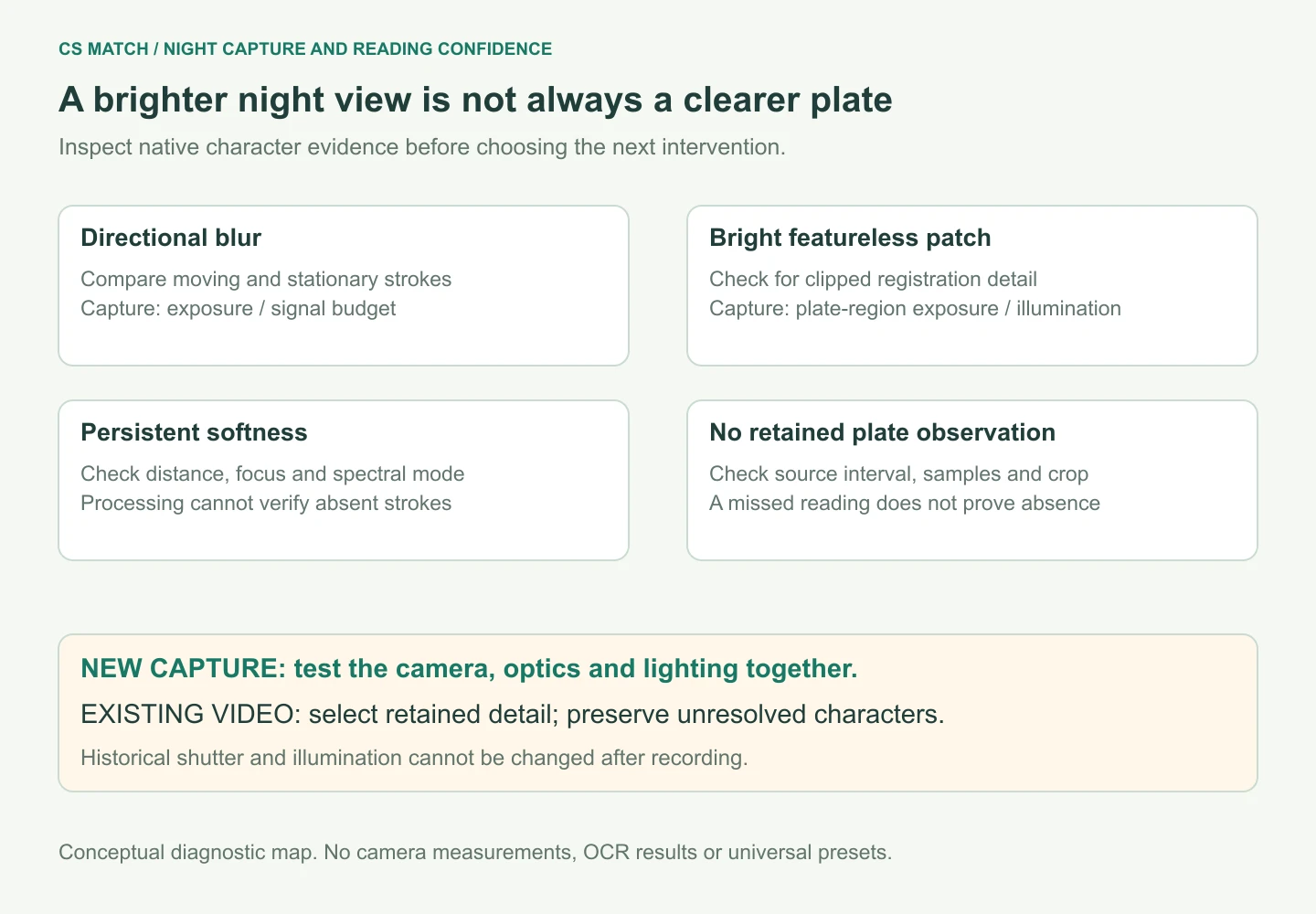
Use image motion to reason about exposure
Exposure is the integration interval for one image, while frame rate controls when images are acquired. Basler documents exposure-time controls and their camera-specific limits. A higher capture rate does not by itself guarantee short exposures, and dense analysis sampling cannot undo movement accumulated within every recorded frame. Diagnose timing and within-frame sharpness as separate constraints.
For a deliberately hypothetical example, an edge moving at 800 image pixels per second travels eight pixels during a 10 millisecond exposure and 0.8 pixels during one millisecond. This is uniform image-plane arithmetic, not a shutter prescription. Vehicle speed in metres per second cannot be substituted directly without the viewing geometry and image scale.
Estimate the relevant movement near the actual reading zone rather than averaging it across the whole scene. A vehicle approaching obliquely can change apparent scale and direction. Test whether the smallest required stroke remains separated in the original image. If a shorter exposure darkens that stroke beyond usability, the next problem is the signal budget, not an invitation to restore the old blur.
Illustrative image travel = image speed × exposure: 800 px/s × 0.010 s = 8 px; × 0.001 s = 0.8 px.Separate amplification from captured signal
Gain makes an image brighter through amplification; it does not provide another exposure opportunity. Basler distinguishes analogue gain before digitization from digital gain after conversion. Their practical effects depend on the camera, but neither setting should be evaluated only by the brightness of the displayed scene. Inspect retained registration strokes and the strongest highlights together.
When comparing configurations, keep a native plate crop and a surrounding vehicle crop for each passage. Look for unstable speckles, merged narrow gaps and bright regions that become featureless. A gain increase that makes the bodywork easier to see can still reduce the usefulness of the reflective registration. Record exposure and illumination changes so that the cause is identifiable.
A controlled test should vary one meaningful factor at a time within a repeatable setup. If exposure, gain, zoom and enhancement all change together, a better-looking crop does not tell you which adjustment helped. Keep the baseline and the failed examples, including an unreadable label. Choose settings around supported complete readings rather than around the most pleasing preview.
Treat infrared as an illumination-and-sensor system
Near-infrared surveillance uses reflected illumination rather than simply revealing registration characters through darkness. Axis explains the difference between reflected IR imaging and thermal imaging, and describes wavelength, illumination and camera sensitivity as parts of the system. An IR-equipped camera is therefore not equivalent to a thermal camera, and neither label alone specifies plate-reading performance.
For installation review, document the illuminator, camera mode, lens, operating distance and the observed plate designs. Verify that the intended illumination actually reaches the reading zone and that the camera is configured to use it. A light source aimed at a nearer wall can produce a convincing overall night view while leaving the vehicle approach poorly served.
Do not select an illumination wavelength or advertised range in isolation. Test the complete combination with real passages at the relevant distances, retaining the original monochrome frames. A manufacturer's range statement under one exposure or scene condition is not automatically the distance at which a moving, angled registration remains transcribable in your installation.
Recognize clipping before trying to increase contrast
A reflective plate can return much more illumination than surrounding bodywork. Axis's plate-capture guidance discusses the resulting exposure problem and the relationship between camera and illumination placement. Treat that guidance as a starting point for a specific installation, not a universal set of settings for every material, distance and plate design.
Clipping is different from a dim but structured image. In a clipped region, distinct bright values have already collapsed to the recording's upper limit. Lowering display brightness can turn a white rectangle into a grey rectangle without restoring the missing dark-light boundaries. Check whether the registration strokes exist in the original crop before attempting contrast changes.
Use paired observations to distinguish an exposure problem from occlusion or an incorrect crop. If one nearby frame retains strokes and another does not, inspect position and timing as well as brightness. For future capture, test settings around the plate region. For an existing recording, preserve the usable observation and do not claim that a cosmetic edit verified the clipped characters.
Diagnose headlight flare and filtering separately
Headlights can interfere outside the plate rectangle through flare or reduced local contrast. The symptom may change as the car approaches even when the registration occupies enough pixels. Compare the full source frame with the isolated crop: a recognizer receives the crop, but the reason its strokes vanished may be visible only in the wider optical scene.
An IR-cut filter and an IR-pass filter serve opposite spectral purposes. The Axis Q1700-LE documentation describes its day/night IR-cut operation. Filter availability and switching are device-specific. Do not assume that an uploaded black-and-white recording proves which filter was active or that software grayscale conversion has replicated the optical filtering used at capture.
A useful commissioning comparison includes approaching headlights, rear views and transitions into the reading zone. Record which source detail is retained, not merely which lamp appears less bright. Optical changes can affect the whole scene and must be validated with the intended camera configuration. Historical flare remains a property of the source; later cropping does not remove its effect on already obscured strokes.
Verify focus in the operating spectral mode
Focus should be checked on registration strokes at the working distance, not on a nearby fence or the preview controls. Edmund Optics explains chromatic focal shift: different wavelengths can focus at different longitudinal positions. That optical principle is a reason to verify the actual day and night configuration rather than assuming a daytime adjustment transfers perfectly.
Compare stationary and moving observations from similar positions. Persistent softness on a stationary registration suggests a different problem from directional smear that appears only in motion. Also inspect the near and far limits of the reading zone. A single sharp point does not show that every lane or approach distance has adequate usable detail.
Document the lens, focus procedure and operating mode with the test recording. If zoom changes the reading zone, repeat the focus and passage checks rather than treating zoom as free magnification. For existing footage, locate the sharpest supported observation and keep its time reference. Sharpening may emphasize an edge but cannot establish a missing stroke that the source never resolved.
Check dynamic-range processing and shutter geometry
Wide dynamic range describes a family of techniques, not a guarantee of moving-text sharpness. Axis's plate-capture guidance cautions that some WDR implementations produce motion artefacts and makes its recommendation conditional on camera specifications. Verify the particular capture mode instead of transferring an ordinary surveillance preset directly to registration reading.
Rolling shutter introduces another issue: image rows are exposed at different times. Basler's shutter documentation describes distortion when camera or subject motion interacts with this timing. A short per-row exposure can reduce blur while leaving geometric skew. That is distinct from an oblique plate plane and should not be diagnosed solely as a perspective-correction problem.
Keep these mechanisms separate in an experiment log. Compare the original moving crops with the relevant camera processing mode documented. A double edge, slanted character and featureless white patch can have different causes even if OCR fails on all three. Prefer a reproducible explanation of the defect over a general instruction to enable every image-improvement option.
Include weather, contamination and lighting transitions
A reading zone is not tested fully by one clear, dry night. Include the operating conditions the task will encounter: wet surfaces, precipitation, dirt, partial obstruction and changing background lights. These factors can alter the visible registration or the optical path. Label the actual symptom in each example instead of placing every failure in a single night category.
Inspect the lens cover and plate separately when possible. A flare that affects several vehicles at the same screen position can suggest a scene or optical-path issue; a defect that follows one registration may have another cause. These are diagnostic hypotheses, not definitive conclusions from one crop. Preserve enough context to test them against additional observations.
Lighting transitions deserve their own short recordings. A car entering an illuminated area, a camera changing day/night mode or a sudden headlight approach can make an otherwise stable configuration behave differently. For evaluation, retain the transition passages and their unresolved outcomes. Removing them as inconvenient outliers would hide a condition that the deployed workflow still has to handle.
| Visible symptom | Compare first | Do not infer automatically |
|---|---|---|
| Directional smear | Moving and stationary source strokes | More FPS will remove blur |
| Bright blank plate | Native highlights and nearby frames | Lower display brightness restores strokes |
| Persistent softness | Distance, focus and day/night mode | OCR alone caused the failure |
| Intermittent missing result | Source coverage, crop and transitions | The vehicle was absent |
Review the native recording before preprocessing
For uploaded CCTV, begin with the original source rather than a screenshot of a browser preview. Confirm that the selected interval contains the useful approach and that the analysis area includes the parent vehicle and registration. Compare saved observation times with the original playback. A short preview can be convenient without representing every frame used by analysis.
Sampling determines which captured opportunities the pipeline examines. A sharper view between two selected frames can be missed, while many extra samples of one blurred interval provide little new evidence. Use a short test around a known passage, then inspect which observations were actually retained before increasing the duration or analysing an entire night of footage.
Keep the native crop beside any processed version. The current worker applies controlled enhancement and attempts OCR on selected variants; it cannot adjust the source camera's historical shutter, gain or IR illumination. If no available observation supports a character, the correct outcome remains unresolved. Plausibility from a regional format is not a replacement for a visible stroke.
Build a small paired night-time acceptance test
Use a review set with a defined unit, such as one vehicle passage, and an independently established reference where available. Include all eligible passages in the chosen intervals, not only detected plates. Record whether the source was readable, whether the plate was localized and whether the complete normalized registration matched the reference. Mark genuinely unknown references separately.
For each change, compare the same evaluation conditions and report which stage improved. An illumination adjustment may increase readable capture; a crop fix may increase OCR opportunities; a threshold change may merely suppress more answers. These are different outcomes. Keep day, steady night and transition results visible so an aggregate improvement cannot conceal a new failure mode.
Avoid using adjacent frames of one passage as many independent successes. Summarize at the passage level while retaining the supporting observations. Keep a baseline configuration, a change log and a fixed test split. The practical goal is a repeatable reading zone with understandable limitations, rather than a gallery of unusually easy examples chosen after the settings were tuned.
What the current CS Match workflow can change
CS Match reviews recorded video using a selected interval, analysis area, sampled observations and vehicle-related plate reading. The resident worker extracts plate rectangles, creates an enhanced variant and can try the original crop when the enhanced reading does not satisfy its stopping condition. Its output retains text, scores, crop references and source context for accepted readings.
This path does not supply live camera control, a dedicated night-camera commissioning tool or an IR-specific restoration model. It also does not turn a passing format rule into a verified registration. The appropriate first action is to inspect the actual saved plate and parent vehicle crops, then identify whether coverage, localization, character evidence or filtering explains the result.
For a new source, fix capture where possible and evaluate it with a short representative recording. For an existing source, preserve the best supported observations and report uncertainty honestly. Separating capture from recognition keeps processing costs useful: additional work should address an identified failure stage, not repeatedly transform a crop whose required detail has already been lost.
Questions about this workflow
Will infrared make every night-time plate readable?
No. The camera, optics, illumination, distance, exposure and plate material form one capture system. Test complete moving passages and inspect native character detail rather than relying on an IR label or advertised range.
Is a bright white plate a good OCR input?
Only if its character boundaries remain recorded. A clipped patch can look bright while losing the information needed to distinguish strokes. Changing display brightness does not restore those missing differences.
Should I increase frame rate to remove blur?
Frame rate changes observation opportunities; exposure controls movement accumulated inside a frame. Check both, and distinguish captured frames from the smaller subset selected for analysis.
Can CS Match repair a historical camera exposure?
No. It can select recorded observations and test crop processing, but it cannot change the light or shutter interval used when the video was captured. Unsupported characters should remain unresolved.
Continue with the next useful step
Why CCTV License Plates Are Hard to Read
Understand plate pixel size, exposure, frame coverage, perspective, focus, night capture, WDR and compression, with worked examples and a practical diagnostic workflow for CCTV recordings.
Combining License Plate Readings Across Video Frames
Explore best-frame selection, tracking, majority and weighted voting, edit-distance alignment, character consensus and image fusion, with worked examples and the current CS Match retry mechanism.
License Plate Confidence: Detection, OCR and Whole-Plate Accuracy
Interpret plate detector scores, OCR scores, exact-string accuracy, coverage, calibration and abstention. Use worked examples to distinguish a high-confidence candidate from measured end-to-end performance.