
License Plate Detection and Perspective Correction
Compare axis-aligned boxes, rotated rectangles and four-corner plate geometry. Learn homography, corner checks, resampling, coordinate mapping and how to evaluate rectification on CCTV.
Sources checked · Cyber Search MatchPlate detection finds a candidate region; rectification maps an estimated plate plane into a more convenient view. A rotated rectangle corrects in-plane tilt, while a four-corner projective mapping can address perspective. Neither operation creates missing characters. Evaluate geometry, retained registration content and OCR together, preserving the original crop whenever a correction is uncertain.
Define the region that the recognizer needs
Before choosing a detector, define its target. The outer metal border, reflective panel and registration text area are not necessarily the same rectangle. A detector trained on one annotation convention can produce crops that appear plausible but exclude a small prefix expected by another stage. Consistent labelling is part of the algorithm, not merely dataset administration.
For an OCR pipeline, the region must retain every required registration character and enough context to interpret its layout. Excessive background can introduce unrelated text, while a crop that hugs the main digits may remove stacked letters. Compare both types of error before deciding how much margin to add. One fixed margin cannot guarantee suitable coverage for all designs.
Keep the detected region attached to its parent vehicle and original frame. A corrected patch is an interpretation of that source region, not a replacement for its provenance. This makes failures reviewable: the user can distinguish a missed character outside the crop from a recognizer error inside an otherwise correct selection.
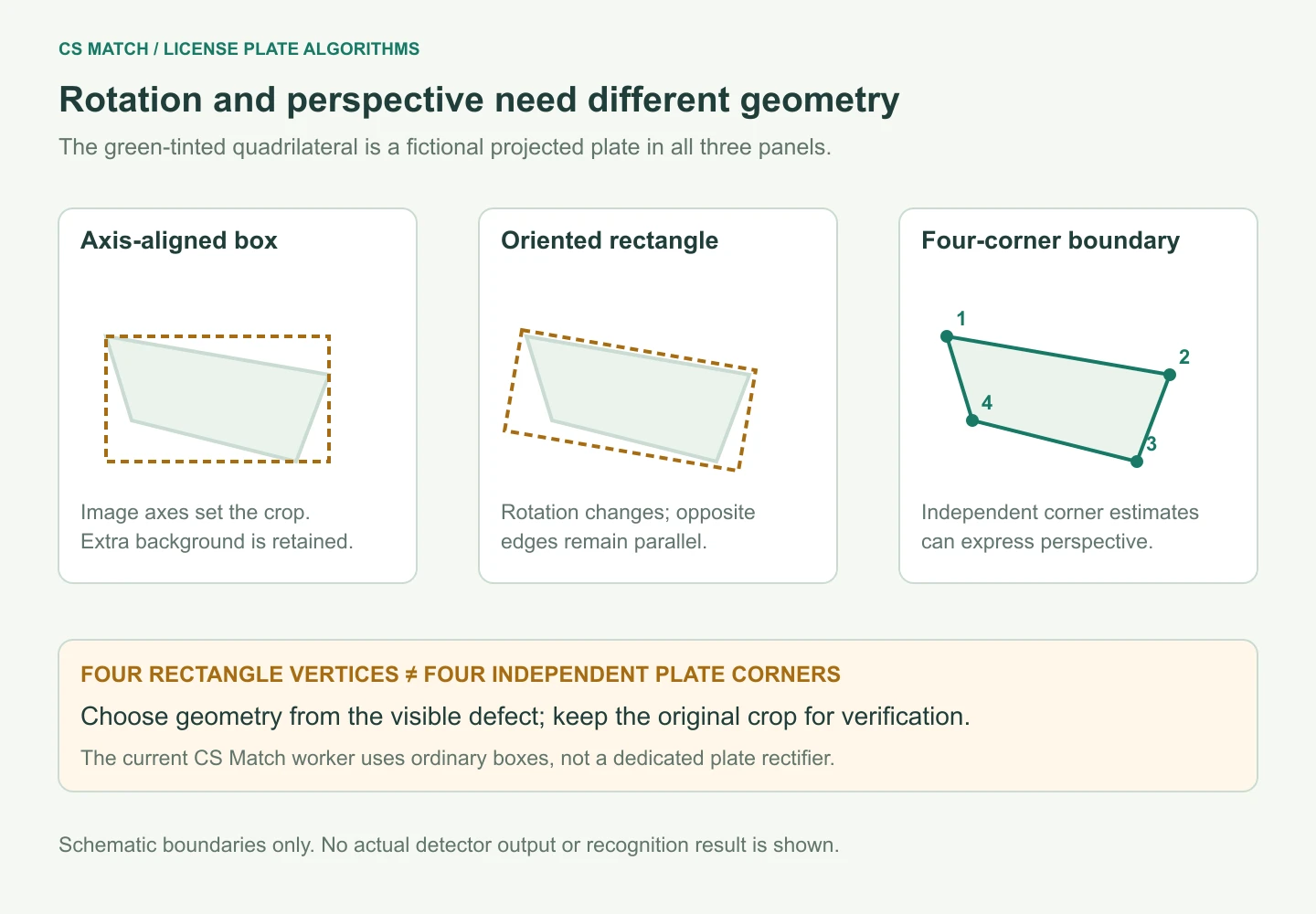
Three geometric representations solve different problems
An axis-aligned box uses horizontal and vertical image boundaries. It is simple to crop and can retain useful context, but a tilted plate brings extra background with it. An oriented box adds rotation while remaining a rectangle. A four-corner quadrilateral can describe unequal apparent edge lengths caused by viewing a flat plate obliquely.
Ultralytics documents oriented bounding boxes separately from ordinary detections. Four reported vertices of a rotated rectangle are not automatically four independently estimated physical plate corners. A rectangle still has parallel opposite sides. That distinction matters when comparing a rotation-aware detector with a model designed to estimate perspective geometry.
Choose the representation using the actual failure cases. If roll is the dominant defect, rotation may be enough. If the plate appears as a trapezoid, rectangular rotation leaves perspective compression. If the source is too blurred to distinguish its boundaries, predicting a more complex shape can add uncertainty without improving the evidence supplied to OCR.
| Representation | What it expresses | Remaining limitation |
|---|---|---|
| Axis-aligned box | Image-aligned location and extent | Tilt and perspective remain |
| Oriented rectangle | Location, extent and in-plane rotation | Opposite edges remain parallel |
| Four-corner quadrilateral | A candidate projected plate boundary | Corner estimates and resampling can still be wrong |
Detection recall comes before geometric refinement
A plate-specific detector proposes regions from a source frame or vehicle crop. Its confidence describes that detection task, not whether every registration character is resolved. Retaining a high-scoring rectangle around an unreadable plate can be correct detection. Missing the only readable view is a detection or coverage failure even if OCR performs well on the remaining examples.
Our current worker runs the detector on selected vehicle crops. This limits the search space but creates a dependency on the parent crop. Inspect whether the complete plate reaches the plate detector before adjusting its threshold. A downstream corner estimator cannot recover a region that was excluded from its input.
When comparing models, keep the source observations and crop policy fixed. Measure missing plates, partial boundaries and false plate-like regions separately. Cropping evaluation only around successful predictions hides recall failures and can make the geometry stage look stronger than the complete pipeline. Retain difficult viewpoints in the test set rather than silently dropping them as unsuitable crops.
Estimate the boundary, not four convenient image points
Several architectures can estimate plate geometry. A detector can predict corner coordinates, a keypoint model can locate corners within a candidate crop, or a segmentation mask can supply boundary evidence. Each needs an annotation convention and handling for partially hidden edges. A mask's largest contour is not automatically the physical plate plane.
Silva and Jung's unconstrained-ALPR work provides an example of plate localization and unwarping integrated into a recognition pipeline. Its specific implementation should not be conflated with every four-corner homography method. The useful lesson is to evaluate geometry as a purposeful stage, with its own inputs and errors, rather than assuming any rectangular crop has already been rectified.
Inspect cases with a holder, screw, shadow or bumper crossing an edge. A model may lock onto the holder's outline instead of the intended plate boundary. Annotate uncertainty when the corner is not observable, and compare conservative fallback crops with the corrected view. A visually tidy quadrilateral does not prove that its interior retains all required characters.
Map the estimated plate plane to a target rectangle
A homography maps points between two views of a plane using a projective transformation. In homogeneous coordinates, a source point is multiplied by a three-by-three matrix and the resulting coordinates are normalized. It can account for perspective changes that an in-plane rotation cannot. The planar assumption is a model of the observed plate surface, not a reconstruction of a complete vehicle.
Use corresponding source corners and destination corners to define the mapping. A rectangular destination is convenient for OCR, but its width and height are processing choices. They should match the expected recognizer input and layout, rather than turning every plate into the same excessively stretched strip. Preserve the matrix and the coordinate convention so selected text regions can be traced back.
OpenCV's homography tutorial explains the planar mapping and its assumptions. For a proposed plate rectifier, the practical question is whether the chosen correspondences are reliable enough for this crop. A valid matrix can still encode the wrong plate edges. Confirm the result against the original instead of treating a successful transformation call as successful recognition.
[u, v, w]ᵀ = H × [x, y, 1]ᵀDestination coordinates: x′ = u / w; y′ = v / wCorner order controls orientation and handedness
Corresponding points must refer to the same physical corners. One possible convention is top-left, top-right, bottom-right, bottom-left for both the source and destination. The exact convention is less important than consistency. Mixing clockwise and counterclockwise order can mirror a patch; pairing diagonal corners incorrectly can create a crossed or severely distorted mapping.
Do not rely blindly on sorting points by coordinate sums. Extreme perspective, a nearly vertical plate or uncertain detections can break simple heuristics. Validate the polygon's shape and establish the intended orientation. Where possible, retain the model's documented keypoint identities instead of rediscovering them from a generic unordered point list.
Test the mapping with labelled synthetic corners before testing OCR. Verify that each labelled source corner reaches its intended destination and that text is not mirrored or upside down. These are geometry checks with known answers, unlike judging correctness from whichever candidate happens to produce a high text score. Separate orientation validation from recognition confidence.
Reject a numerically possible but unusable warp
A useful rectifier checks more than the existence of four points. Reject duplicated corners, self-intersecting boundaries, negligible area and points inconsistent with the available image. Nearly collinear points can produce an unstable mapping. Strongly foreshortened regions may also magnify small corner errors into substantial distortion of the characters.
Define checks relative to the source crop rather than inventing one universal pixel threshold. A minimum polygon area can reject degenerate predictions, but it cannot establish enough character detail for every design. Evaluate the relationship between geometric rejection, retained passage coverage and complete-string accuracy on representative footage.
A fallback should be explicit. Keep the original crop, record that correction was withheld and allow review or another observation. Selecting the warp with the highest OCR score from many unstable alternatives can reward a spurious interpretation. Limit the alternatives, retain their geometry and compare supported registration content rather than optimizing an isolated confidence number.
Resampling changes pixels, not captured information
Warping requires assigning source information to destination pixels. Interpolation determines how neighbouring samples contribute, while border handling controls locations outside the source. OpenCV's remapping documentation describes this sampling operation. An enlarged output can meet a recognizer's tensor dimensions without containing the detail of a genuinely higher-resolution capture.
Avoid unnecessary repeated resizing. A proposed implementation can combine geometric transformations before resampling when its coordinate conventions permit that, then retain a comparison with the unmodified source crop. Repeated filtering can alter narrow gaps or faint strokes. Evaluate the effect on difficult characters rather than deciding that a sharper-looking display is inherently more truthful.
A correction cannot reveal an occluded suffix or reliably separate strokes already merged by capture blur. Test crops where the original is genuinely readable and crops where it is not. The latter are important abstention cases, not a challenge to generate a convincing-looking identifier. Record whether an improvement came from geometry, preprocessing or a different observation.
Maintain a coordinate ledger back to the recording
A pipeline can involve source-frame coordinates, a vehicle crop, detector preprocessing, plate-local coordinates and a rectified patch. Every crop, resize, padding step and warp changes how a point should be interpreted. Losing one offset can produce correct-looking thumbnails with incorrect source boxes, which weakens both association and review.
For an original illustrative translation, a vehicle crop starts at source position (100, 50) and a plate begins at local position (20, 30). Without intervening scaling or padding, the source plate origin is (120, 80). If the detector used a resized or letterboxed image, undo that preprocessing before adding the crop offset. These numbers are bookkeeping examples, not recorded detections.
Store the necessary transforms and test round trips on known points. A text-region box in a rectified patch should map back to its intended source region within the expected numerical tolerance. Keep the source time and parent detection reference unchanged by image warping. Spatial correction does not create a new moment or establish a different vehicle identity.
Translation-only illustration: source point = crop origin + local point(100, 50) + (20, 30) = (120, 80)Perspective is not the only source of distortion
Lens distortion, motion blur, rolling-shutter deformation and a bent plate are different from the projection of one flat plane. A single homography is not a universal cure for all of them. Identify the visible defect before selecting a model; otherwise, a flexible transformation can create an attractive but physically inappropriate correction.
Camera calibration can estimate lens parameters and support undistortion, as described in OpenCV's calibration documentation. It requires appropriate calibration data and a consistent camera configuration. Applying parameters from another lens, zoom setting or image resize can introduce errors. Preserve the relationship between calibrated image coordinates and any subsequent plate mapping.
For recorded footage without calibration, compare conservative geometric handling with the original. Do not interpret an unsuccessful correction as proof that OCR needs a more powerful network. A different source observation may provide better geometry without an aggressive warp. Review several frames of the same vehicle while keeping temporal association separate from image transformation.
Measure the effect on complete recognition
Evaluate detection coverage, boundary quality, character retention, geometry rejection and exact registration accuracy. Rectangle overlap alone can hide the loss of a tiny required prefix. Corner distance alone can also be misleading when the annotation convention differs. Use both geometric labels and the complete registration outcome to understand which mistakes matter.
Compare original crops, rotation-only correction and four-corner correction on the same observations. Include frontal plates so a new method is tested for regressions as well as gains on oblique views. Separate ordinary lines, stacked characters and compact layouts. Record added latency and memory under the same hardware and batch settings rather than importing speed claims from a different experiment.
For an invented evaluation example, imagine 100 relevant passages, 80 retained plate crops and 72 complete correct readings. Accuracy conditional on the retained crops is 90%, while correct-reading coverage across all passages is 72%. Report both denominators. These arithmetic values illustrate evaluation boundaries; they are not measurements of a model, camera or CS Match task.
Review failures by category: missed plate, clipped character, incorrect corner order, unstable warp, wrong layout or OCR error. Hold related vehicles and recordings together when separating training and evaluation data. A useful correction stage improves supported complete readings while making uncertain cases explainable; it does not merely increase the proportion of crops that look rectangular.
How this relates to the current CS Match worker
The current resident worker receives vehicle crops, predicts ordinary plate boxes, clamps them to the image and saves plate crops. It creates enhanced variants with resizing, contrast adjustment and sharpening, with optional grayscale conversion. It maps plate boxes back to the source using the parent crop offset. That is localization and preprocessing, not dedicated four-corner rectification.
The worker does not currently replace its plate detector with an oriented-box model, estimate plate corner keypoints or apply a plate homography. Those are candidate extensions described here for evaluation. A library supporting these operations does not mean they are automatically active in our deployment. The original crop and source observation remain the basis for checking a reading.
For a difficult task, first establish whether any sampled frame contains the complete readable plate. Inspect the vehicle crop, plate boundary and returned text. If geometry is the identified failure, evaluate a bounded correction stage on a reference set before expanding the feature. The next guide explains the recognizers that could consume a correctly prepared patch and the separate errors they can introduce.
Questions about this workflow
Are four vertices from a rotated rectangle enough for perspective correction?
They describe a rectangle, not necessarily four physical plate corners. A useful perspective mapping needs trustworthy corresponding points for the actual projected plate plane.
Does a successful homography mean the text is correct?
No. A matrix can map incorrect corners successfully. Check orientation, retained characters, source correspondence and complete-string accuracy.
Can rectification recover a hidden character?
It reorganizes captured image information. It does not reveal an obscured character or independently verify a registration that was never resolved.
Does CS Match currently perform four-corner plate correction?
No. The current plate worker uses ordinary bounding boxes and enhanced crops. Dedicated plate-corner estimation and homography are possible extensions described for evaluation.
Continue with the next useful step
License Plate OCR: PaddleOCR, CRNN, LPRNet and Transformers
Understand OCR frameworks, character segmentation, CRNN and CTC decoding, LPRNet and transformer recognizers, with a worked repeated-character example and guidance for evaluating CCTV plate reading.
Why CCTV License Plates Are Hard to Read
Understand plate pixel size, exposure, frame coverage, perspective, focus, night capture, WDR and compression, with worked examples and a practical diagnostic workflow for CCTV recordings.
US Specialty Plates: Graphics, Stacked Letters and Multiple Lines
Learn to separate registration characters from slogans, graphics and labels, order stacked and multiline text, and evaluate layout-aware OCR using documented US examples and annotated schematics.