
US Specialty Plates: Graphics, Stacked Letters and Multiple Lines
Learn to separate registration characters from slogans, graphics and labels, order stacked and multiline text, and evaluate layout-aware OCR using documented US examples and annotated schematics.
Sources checked · Cyber Search MatchSpecialty-plate OCR is partly a layout-understanding task. Detecting every visible word is not enough: the system must select registration regions, retain required small characters, determine their reading order and preserve uncertainty. The examples below use original fictional schematics to explain those decisions; official state documents establish the real design variations.
Label text roles before flattening the image
Begin with a distinction between visible text and registration text. A crop may contain the issuing jurisdiction, the identifier, a slogan, a plate-type label and a sticker. Several regions can be correctly recognized by OCR while only some belong in the registration string. A parser that simply concatenates all text can therefore be wrong without misreading a single letter.
For an illustrative plate, label a top band as jurisdiction, a large central line as registration and a bottom message as slogan. These are annotations for a fictional teaching diagram, not universal crop coordinates. A special-interest design can move the identifier sideways, and a small prefix can carry registration meaning. Region roles should follow the actual layout rather than typography alone.
Store each selected region's polygon or box, recognized text and role hypothesis before producing a flattened string. This intermediate representation explains whether a failure originated in text detection, selection, ordering or recognition. It also permits alternative interpretations to be compared without repeatedly discarding and recreating the relationship between text and source pixels.
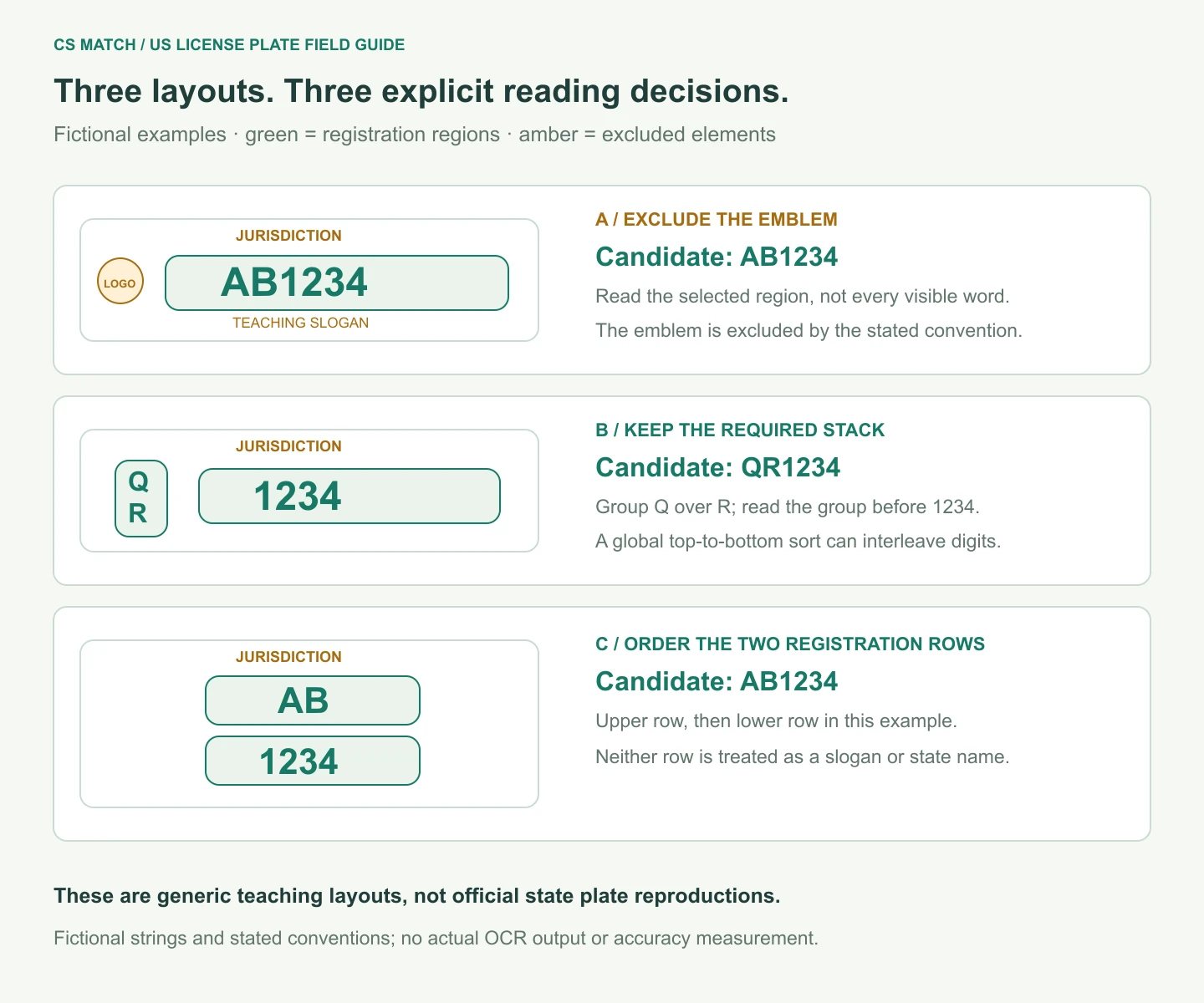
Case one: a graphic competes with registration strokes
A graphic beside the identifier can reduce the space available for text or make its starting position unfamiliar. A graphic behind the identifier can create edges that resemble strokes. The first problem concerns layout and scale; the second concerns image interpretation. Treating both with a more aggressive contrast filter can obscure rather than clarify the failure.
California's REG 17 form documents multiple special-interest families, including graphic designs. Use such primary references to define what should be annotated, then test actual captures. The schematic here deliberately uses a generic circular emblem without copying an agency design or implying that its invented identifier is issued. It isolates the placement problem from a particular programme's branding.
A proposed registration-region detector can retain the text area while excluding a known graphic region. Compare it with whole-plate OCR on the same observations. Check that a mask does not remove valid characters when the layout differs from the training example. Region selection should improve complete-string correctness, not merely make the resulting crop look cleaner.
Case two: stacked letters must keep their order
The AAMVA standard describes stacked registration characters as a sequence, with the upper character preceding the lower one. That guidance is not a detector: the system must still identify a stack, establish its role and place it correctly relative to the main line. Historical or unfamiliar designs require the applicable format rather than an assumption based only on resemblance.
In a fictional example, place Q above R to the left of 1234. If the known layout defines that pair as a registration prefix, the intended flattened candidate is QR1234. A naive global sort by vertical coordinate can interleave the main digits between Q and R. Sorting solely by horizontal coordinate can also be unstable when both letters share an x-position.
Represent the pair as one local group with an internal top-to-bottom order, then order that group relative to the main registration run. Preserve a different candidate if its prefix-versus-suffix role is unresolved. This is a proposed parsing strategy, not an operation performed by the current CS Match text-fragment joiner.
A documented stacked format is not an optional decoration
Maryland's PTP Integration Guide includes a tag-format entry with four numeric characters and stacked DA letters. It also records other series for that class. This is a useful primary example because the letters appear in a registration-format table, not merely in an enthusiast photograph. The document supports the format distinction; it does not provide an OCR accuracy measurement.
The engineering consequence is that a parser must not discard the pair merely because it is smaller than the digits. Build a reference annotation that retains the full identifier and identifies the required regions. Use a fictional numeric sequence in illustrations rather than presenting an unverified real plate as a ground-truth test case.
Test three outcomes separately: the stack was never detected, its characters were recognized incorrectly, or correct characters were placed in the wrong order. All can create an incorrect full string, but they need different repairs. Additional main-line training cannot fix a selector that explicitly excludes the stacked region before recognition begins.
Case three: two rows are not one long text line
A compact plate may arrange registration content across more than one row. First establish which rows belong to the identifier; do not assume the top row is a state label or the bottom row is a slogan. Then determine the ordering convention for that layout. A text-line detector's return order is an implementation detail, not an official registration convention.
Pennsylvania also documents a dedicated vertical motorcycle plate, illustrating that an American recognition pipeline cannot assume every plate has a wide horizontal form. Plate orientation and text reading order are separate questions. The fictional two-row example below is a parsing stress test, not a reproduction of that Pennsylvania design or a claim about New York's motorcycle layout.
In the fictional two-row schematic, AB occupies the upper registration row and 1234 the lower one. Under the stated teaching convention, the candidate is AB1234. Cropping only the visually dominant lower line would produce a valid-looking partial string. Stretching the whole patch into a thin horizontal strip could instead distort both rows and confuse a recognizer trained on single lines.
Candidate architectures include recognizing rows separately and joining them according to a layout hypothesis, or using a model trained directly on complete multiline plates. Evaluate ordering and full-string correctness on the same source set. When row roles are uncertain, retain alternatives or abstain rather than silently imposing the convention from a different design.
Symbols need a representation policy, not a guessed letter
A symbol can look text-like without being an ordinary registration character. California's Kids Plate options include a heart, star, hand and plus sign on the application form. That establishes the existence of symbol choices; it does not justify converting a photographed symbol into a letter or inventing a universal cross-state database representation.
Keep the visual observation distinct from the normalized comparison key. A proposed record can retain symbol location and a typed annotation while storing the chosen alphanumeric representation separately. The appropriate normalization depends on the intended application and verified issuing-jurisdiction conventions. A design reference should not be mistaken for access to an official registration database.
Test whether a symbol causes adjacent characters to be merged, split or reordered. In a fictional diagram, a circle between AB and 1234 is explicitly an excluded emblem, so the teaching result is AB1234. Another layout can assign a different role to a mark. The important property is an explicit, reviewable decision rather than a hidden substitution introduced by an OCR dictionary.
Do not delete or retain words just because they look familiar
A visible state name, slogan or plate-type label should be classified by its role and location. A word-like registration can resemble an ordinary message, and a stylized jurisdiction label can be harder to read than the identifier. A dictionary of common words is consequently not enough to distinguish registration content from other text.
A robust proposed selector can use relative geometry, character scale, line relationships and a layout hypothesis together. Avoid one decisive shortcut such as always selecting the largest line or discarding every top-band detection. Evaluate the selector on designs with offset text and small required prefixes, where those shortcuts are most likely to fail.
The AAMVA standard discusses plate-type identifiers, messages and graphics as distinct design elements. Use that distinction to organize annotations, without assuming every observed plate exactly follows the recommendations. The resulting role labels should be inspectable: a reviewer needs to see which text was excluded and why, particularly when the excluded region contains something that resembles a plausible registration.
Correct geometry before trusting relative positions
Perspective can make two characters in the same physical row appear at different vertical positions. Camera roll can make a horizontal registration look slanted, and a tight crop can remove the reference edges needed to interpret the patch. Estimate usable geometry before using text-box positions to decide row membership or reading order.
A four-corner homography can map a flat plate to a reference rectangle; OpenCV supplies the transformation functions. Corner estimation and validity checks remain separate responsibilities. Retain the inverse mapping so a selected text region can be located in the original frame. Compare transformed and original views when the corners are partially hidden or the estimate is unstable.
Geometry cannot supply missing strokes or prove the semantic role of a region. A perfectly rectified slogan is still a slogan. The current CS Match plate path does not include a dedicated four-corner rectifier, so this stage describes an additional architecture to evaluate. Test whether it improves actual region selection and complete-string accuracy rather than assuming that a rectangular-looking crop must be better.
Build a decoder that can explain its selection
One proposed modular decoder starts with the full plate and detected text regions. It groups compatible boxes into lines or stacks, assigns candidate roles, and constructs several registration sequences. Each sequence retains the contributing boxes, their internal order and the layout hypothesis. Recognition and validation then compare alternatives rather than receiving a single irreversible concatenation.
For a sequence recognizer using CTC, the character alignment is inferred during transcription. That is different from deciding which physical rows or semantic regions belong in the input. CRNN research explains an image-based sequence architecture; it should not be interpreted as an automatic solution to every specialty-plate layout. Prepare and test the actual input arrangement the model expects.
Layout-aware ALPR research provides another approach by combining plate localization with layout classification and postprocessing. Compare that approach with the modular selector using a fixed dataset and a defined runtime budget. Keep a layout-unknown path and preserve the unconstrained reading. A confident layout mistake can be more damaging than a character ambiguity because it can systematically exclude an entire required region.
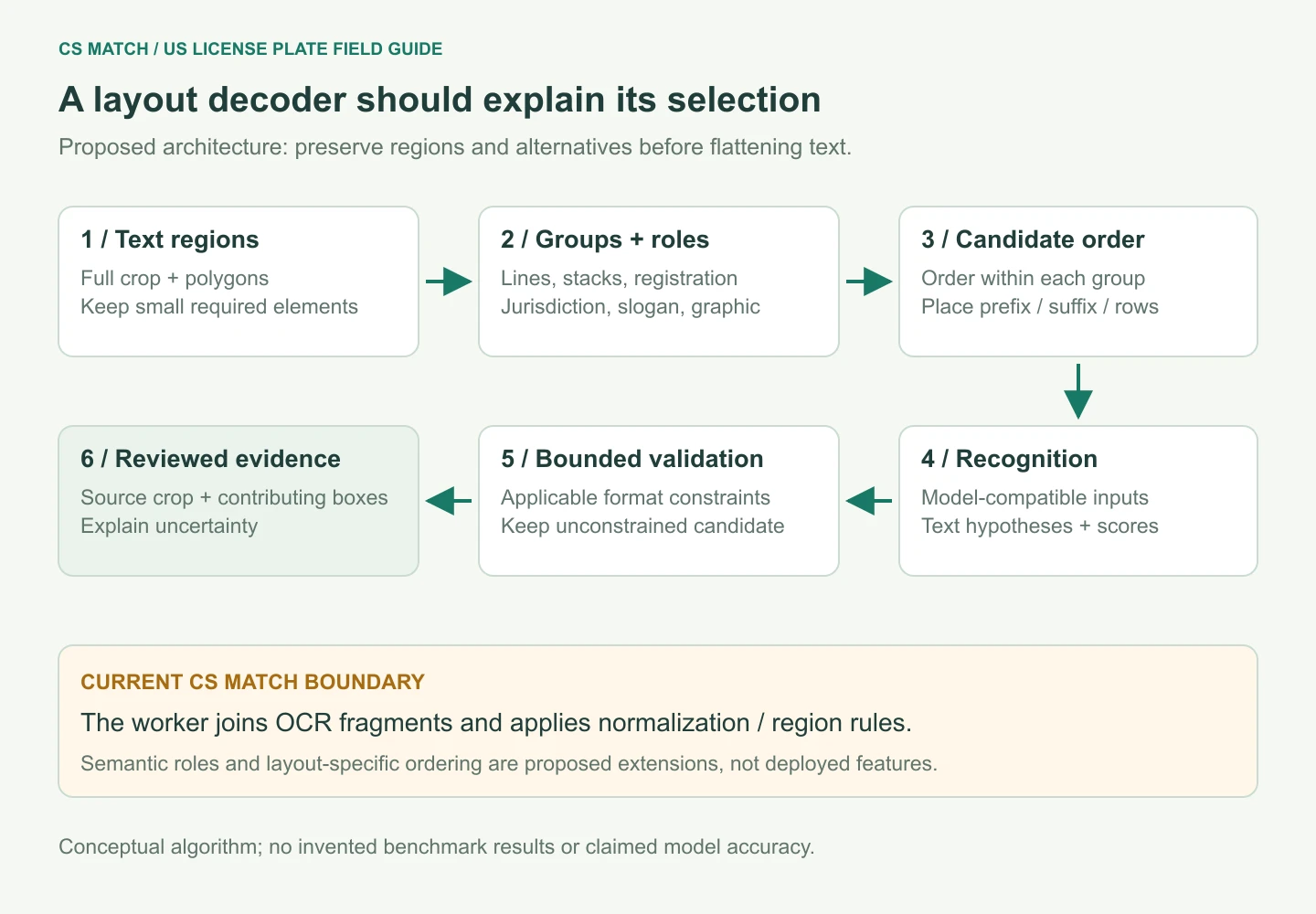
Keep alternative readings attached to evidence
Suppose two candidate layouts produce different strings from the same plate crop. One uses only the main line; another includes a possible small suffix. Record both with their selected regions and explain which interpretation remains unresolved. Do not compare only text confidence if the candidates differ in what the application considers part of the identifier.
In video, another observation can help establish whether the small mark is a letter, a logo edge or a sticker. Associate the views with the correct vehicle before transferring that evidence. Repeated recognition of an excluded or misordered region can repeat the same structural error; more identical outputs are not independent confirmation of the chosen layout.
A useful review card can show the original crop, highlighted registration regions, reading order, raw text and normalized candidate. This is a design for evaluating a future parser, not an existing CS Match interface claim. The current report already provides source observations and crops; those remain the starting point for diagnosing which additional information would genuinely help a reviewer.
Evaluate layout accuracy separately from OCR accuracy
Create annotations for the plate boundary, each registration region, its role and order, and the complete reference string. Record visible non-registration text as a separate category when evaluating selection. This allows a correctly read but wrongly included slogan to be identified as a selection error instead of being mixed with ordinary character confusions.
Measure missing registration regions, added non-registration regions, ordering mistakes and complete-string errors. Test stacked characters at their native size and evaluate layouts under day, night and oblique views. Use the same inputs when comparing parsers. A selector that succeeds only after manual perfect cropping has not demonstrated end-to-end performance on the source footage.
Keep related frames, vehicles and near-identical plate designs from leaking across evaluation splits. Dataset-bias research is relevant because a model can exploit repeated backgrounds or familiar design cues. Hold out a design family when testing generalization to new releases. Report abstentions and small category counts so that unfamiliar-layout failures remain visible rather than disappearing into a favourable aggregate.
| Error type | Illustrative output problem | First stage to inspect |
|---|---|---|
| Selection | A slogan enters the identifier | Text-region roles |
| Retention | Required small letters disappear | Detection and region inclusion |
| Ordering | A stack or row is interleaved | Grouping and sequence construction |
| Recognition | Correct region, wrong character | OCR input and model |
| Normalization | An unsupported substitution appears | Postprocessing policy |
Use the current report to locate the next improvement
In the current worker, PaddleOCR returns text fragments that the parser joins; it does not retain semantic registration-region roles for a specialized selector. Normalization then removes non-alphanumeric content, and the configured regional rule may reject the result. A broad US rule cannot tell whether a missing prefix or appended short label caused the final string to be wrong.
Start by comparing a saved source crop with the displayed reading. Identify the complete visible registration, note any excluded small element and inspect nearby observations from the same vehicle. If the relevant detail is unresolved in every view, record the capture limit. If it is clear but omitted or misordered, a layout parser is a more focused intervention than changing every camera or OCR setting.
This separation makes the development path testable: establish a reference set, add one proposed stage, and measure complete strings and failure categories before expanding the feature. Our inspectable crop-and-observation workflow supplies the evidence for that comparison. It does not yet implement the layout decoder illustrated here, and the article's fictional schematics are teaching aids rather than measured product results.
Questions about this workflow
Should all small text be removed before OCR?
No. Small stacked characters can belong to the registration. Decide text roles from the relevant layout and preserve the full crop for review.
Is top-to-bottom sorting enough for stacked letters and multiple rows?
Not generally. Group stacks and registration rows first, establish their roles, then apply the ordering convention for that layout. Global box sorting can interleave unrelated regions.
Are the illustrated plate numbers real test results?
No. The schematics use fictional registrations and generic graphics to isolate layout decisions. They are neither official plate reproductions nor recognition benchmarks.
Does CS Match already perform this semantic layout decoding?
No. The current worker joins OCR text fragments and applies normalization and regional validation. Semantic region roles, layout-specific ordering and dedicated plate rectification are additional approaches described for evaluation.
Continue with the next useful step
Why US License Plates Are Difficult for ALPR
Explore American plate designs, personalized strings, stacked characters, jurisdiction recognition and CCTV domain shift, with documented state examples and a practical evaluation strategy.
How License Plate Recognition Works: From CCTV to Text
Follow the complete ALPR pipeline: video sampling, plate detection, geometry, OCR, format rules, repeated readings and reviewed results, with the current CS Match implementation explained.
Why CCTV License Plates Are Hard to Read
Understand plate pixel size, exposure, frame coverage, perspective, focus, night capture, WDR and compression, with worked examples and a practical diagnostic workflow for CCTV recordings.