
Face recognition in CCTV: from video frames to reviewed evidence
Explore face recognition in security-camera footage, controlled access and video archives: detection, tracking, gallery search, image quality and operational evaluation.
Sources checked · Cyber Search MatchCCTV recognition is a video-analysis system with an identity-search stage, not simply an ArcFace model pointed at a camera. Capture quality, track association, an appropriate gallery and a decision process determine whether a candidate is useful. Finding a face, following a person and establishing an identity remain different tasks.
What the camera system is actually being asked to do
The phrase facial recognition can describe several very different products. A camera may count visible people without determining who they are. A recording-review tool may help an analyst locate appearances. A controlled entrance may compare a person with an enrolled reference. An identification system may search a probe against a gallery and return candidates. Their inputs and consequences differ even if each contains a face detector.
A useful specification starts with the question and the permitted response. “Show potentially relevant moments for review” allows an uncertain candidate list. “Unlock this entrance” needs a much more explicit enrolment and authorization process. “Count visitors” may not need biometric identity at all. Choosing the more complicated identity task when a simpler task answers the question adds work and risk without necessarily adding useful information.
NIST’s Face in Video Evaluation describes applications including crowded-space screening, examination of recorded footage, meetings and television material. Its 2017 report is historical evidence about evaluation design and capture difficulty, not a ranking of current models. It helps explain why cooperative portraits and incidental faces in video should be tested separately.
| Scenario | Technical question | Useful output |
|---|---|---|
| Footage review | Where does a relevant face or person appear? | Frames, timestamps and candidates for inspection |
| Controlled access | Does this capture match the enrolled claim? | Verification evidence plus access policy |
| Gallery search | Is there a sufficiently close enrolled candidate? | Ranked candidates or an explicit no-match |
| Occupancy analysis | How many people are visible? | Counts or tracks; identity may be unnecessary |
A recognition pipeline has more stages than one network
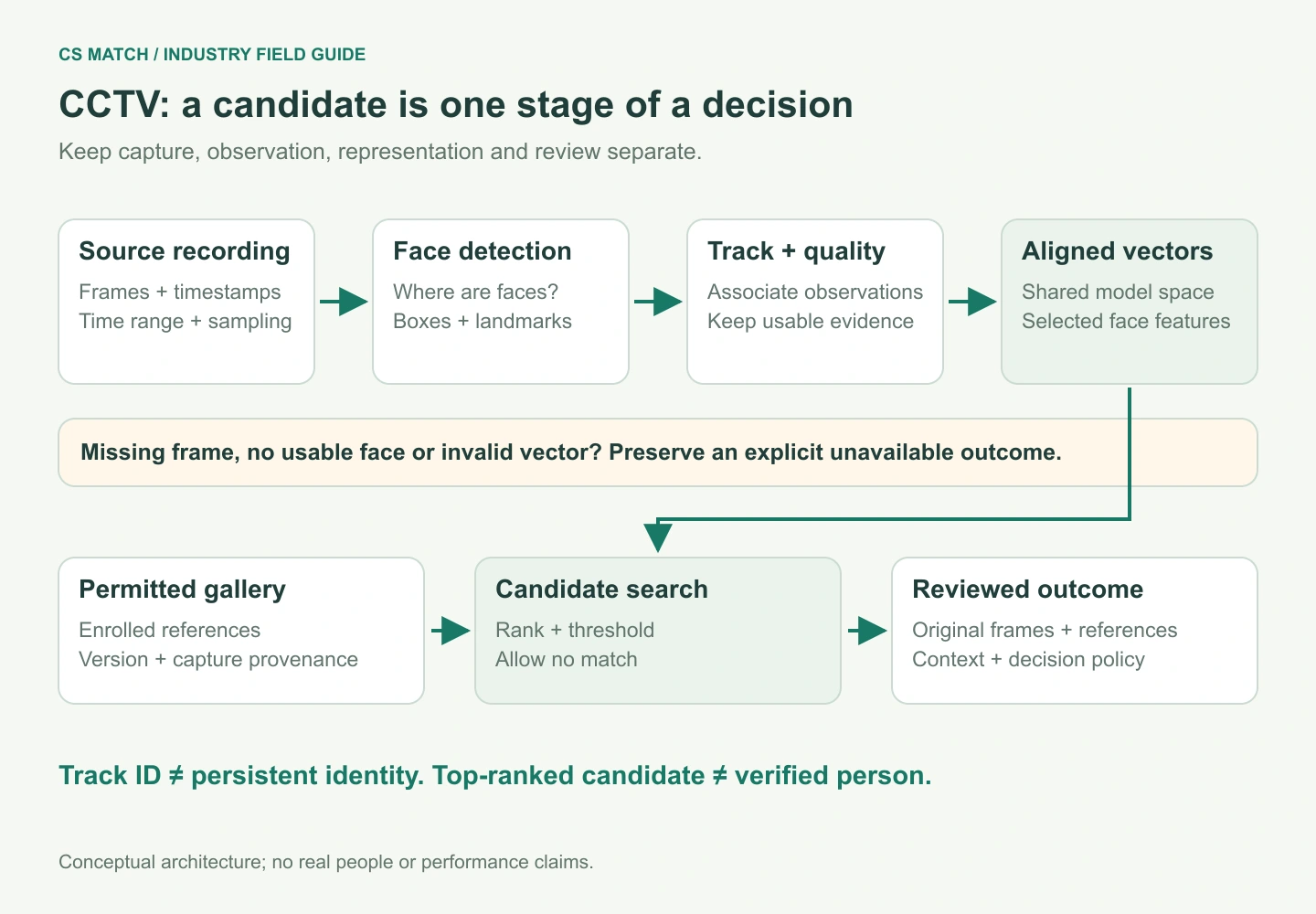
A typical design decodes frames, selects observations, detects faces, associates related observations, checks usable image quality, aligns facial patches, extracts embeddings and searches an appropriate gallery. Candidate results then enter a decision or review stage. The diagram illustrates these roles; it is not a claim that every commercial camera follows one identical architecture.
Each stage can fail independently. A sampling schedule can skip a brief appearance before detection ever runs. A tracker can associate the wrong two observations. Alignment can be unstable on a tiny profile, and a search can return a similar-looking person who is not the subject. Increasing the final similarity threshold cannot repair a missed frame or incorrect track.
The original recording and timestamps connect a result back to its context. A cropped face is useful for inspection, but the surrounding frames may reveal a scene cut, an obstruction or a mistaken association. A reviewed system preserves that route back to the source rather than retaining only a name and a percentage.
The camera position can matter more than a newer model
A face occupying a small part of a wide scene contains little recoverable detail. Motion blur, uneven light, compression and a head turned away from the camera can remove information before the recognizer sees it. Rotating a sideways crop can correct in-plane orientation; it cannot expose an eye hidden by a profile view or recover a face absent from the sampled frame.
This is why controlled capture points and incidental CCTV footage need different expectations. In a cooperative flow, the user can approach the camera, face it and repeat the capture. In an archive, the available source may already be fixed. The appropriate result can be “insufficient evidence” rather than a confidently displayed best candidate.
NIST’s account of FIVE emphasizes that video quality and presentation strongly affect identification. The report discusses small, unevenly lit and non-frontal faces. Its findings support testing the actual camera conditions; they do not justify borrowing a portrait benchmark percentage for a surveillance installation.
Visual enhancement should also be kept separate from evidence. An image that looks sharper after processing may contain inferred texture. Preserve the original and label transformations. A pleasing enlargement is not, by itself, confirmation that the identity-bearing details were present in the recording.
Tracking continuity is not identity recognition
A track groups observations that appear to belong to one moving subject in a recording. It is an association over time, not a permanent identity record. Occlusion, a scene cut or leaving the image can split one person into several tracks. Conversely, nearby people can produce an incorrect association that needs review.
Some recognition systems construct a template from several accepted face observations. Conceptually, they may select a strong frame or combine representations after quality checks. For example, a normalized average of compatible embeddings can reduce some frame-to-frame variation. That is a design option, not a description of a feature implemented in every tracker or of our current video identity model.
Combining more frames is only useful when they belong to the correct person and contain informative detail. Repeating the same blurred view hundreds of times does not provide hundreds of independent identity observations. An incorrectly associated frame can contaminate an aggregate. Evaluation therefore needs to include the association and template-building stages, not just pre-aligned still images.
Our Video Analysis reports expose observations, crops and source times so that users can inspect a track. Track identifiers belong to the analysis job and are not persistent identities across cameras or separate recordings. A face crop can be sent to a separate Face Search action; the existence of a track does not establish who the person is.
The person may not be in the gallery at all
In a closed-set demonstration, the correct identity is assumed to be present. In an open-set deployment, many probes may have no enrolled counterpart. A search engine can always rank something first; a ranking alone does not mean any candidate should be accepted. The system needs a no-match outcome and a policy for uncertain cases.
NIST’s current 1:N evaluation distinguishes identification with thresholds from investigative candidate review. It defines FPIR as the fraction of non-mated searches that return one or more candidates above threshold, and FNIR as the fraction of mated searches failing to return the mate above threshold. Those are search-level outcomes, not the same quantity as one pair’s cosine similarity.
Gallery scale changes the number of opportunities for incidental similarity. As a mathematical illustration, if each of G different-person comparisons has false-accept probability p, the expected count of accepted false candidates is G × p. With invented values G = 10,000 and p = 0.00001, that expectation is 0.1 per probe. This is not a measured error rate for CS Match and is not the probability of at least one false result; that probability also depends on the joint behaviour of the comparisons.
Repeated video observations add another counting problem. A single mistaken association may trigger many frame-level alerts. Operational reporting should distinguish candidates, reviewed events and repeated observations so that the same error is not disguised as many independent confirmations.
Evaluate the event and the operator workload
A practical evaluation includes representative cameras, capture distances, lighting, compression settings and people absent from the gallery. Keep development examples separate from the final test. Record gallery size and enrolment quality, because an installation with a small cooperative roster answers a different question from an archive search over a broad collection.
Measure missed appearances and invalid representations before summarizing recognition errors. Then assess search outcomes at the intended threshold, false alerts per unit of observation time, duplicate alerts per event, end-to-end latency and review workload. A model can look excellent on isolated pairs while producing an impractical number of candidate events in a busy scene.
Human review is a defined task, not a magic correction layer. The reviewer needs the probe, candidate reference, original frames and enough context to reject every candidate when appropriate. Record the review outcome and its basis. Automatic ranking can prioritize attention, while independent evidence and the intended use determine what may follow from that review.
The final test should cover the complete chain, including the camera and the presentation of results. Treat published model results as evidence for choosing candidates to evaluate; they cannot replace a deployment-specific trial.
Where video-based recognition fits, and where it adds little
Security-footage review is one application: narrow a time range, identify usable observations and inspect candidate appearances. Controlled access is another: an enrolled person presents a claim in a deliberately designed capture area. The same underlying embedding idea may appear in both, while their enrolment, thresholds, anti-spoofing controls and decision authority differ.
Transport and venue workflows can connect a presented credential to a face captured at a controlled point. This is conceptually closer to verifying an enrolled traveller or ticket holder than identifying arbitrary people from a distant crowd. A face match still does not establish ticket validity, access permission or whether the capture is a live presentation.
For building occupancy, queue length or movement through a region, ordinary detection and tracking may answer the operational question without identifying individuals. Begin with that simpler measurement when identity is unnecessary. For archive research, the useful deliverable may be a set of source moments rather than a named-person database.
Edge and server processing solve different constraints
Edge processing can reduce the amount of video sent from a camera and shorten a local response path. Central processing can simplify model versioning, consolidate a permitted gallery and provide more compute. A hybrid can produce detections locally and send selected observations. These are architecture choices to test against bandwidth, compute, maintenance and the required evidence trail.
Data minimization should follow the stated purpose: which original frames, crops, embeddings and review records are necessary, who can access them and when they expire. A numerical face vector remains a biometric representation; replacing photographs with vectors does not automatically remove the need to protect the data. Audit and deletion behaviour belong to the system design.
A camera integration also needs rules for degraded operation. What happens when the source disconnects, the recognizer fails, or the gallery version does not match the embeddings? Explicit unavailable states and reviewed fallbacks are more informative than silently producing a zero score or continuing with stale results.
How to explore the problem with CS Match
Our current Video Analysis workflow processes uploaded recordings, with a selected interval, analysis area and sampling settings. It is useful for examining observations and returning to the original moment. It is not a live CCTV connection service or a cross-camera identity registry.
Use the video report to find a usable face observation, then inspect the source frame. A separate Face Analysis comparison can compare a permitted crop with a chosen reference, while Face Search explores indexed public image sources. These steps keep capture evidence, pairwise resemblance and source research visible as separate operations.
The benefit of this approach is inspectability: a user can see whether the crop is usable and whether the reference is the intended person. It does not turn a similarity score into an automatic surveillance decision. A production identity or access system would need additional enrolment, attack resistance, authorization and operational evaluation around the recognition stage.
Questions about this workflow
Does a track ID identify a real person?
No. It groups associated observations within a task. Identity verification and cross-recording recognition are separate operations.
Can a top-ranked gallery result be a false candidate?
Yes. A ranking exists even when the subject is absent. Open-set evaluation needs explicit no-match behaviour.
Does CS Match connect to live CCTV cameras?
The current tool analyzes uploaded recordings. It does not provide a live CCTV connection or a persistent cross-camera identity registry.
Can enhancing a tiny face establish an identity?
A sharper-looking image is not proof that the required detail was captured. Preserve the original and inspect the available evidence.
Understand the pipeline, the vectors and the limits.
How face detection and alignment work
Follow a photo through CS Match: image preparation, SCRFD detection, five facial landmarks, person crops and 112 × 112 alignment for comparison.
Face vectors, ArcFace and the recognition model
Understand our 512-value face embeddings, RGB preprocessing, L2 normalization, angular similarity and the difference between model training and inference.
How a face is compared with a reference
Follow our exact comparison request: reference selection, two inference passes, cosine similarity, the 0.45–0.72 display scale and report decisions.
Face comparison errors, accuracy and practical limits
Diagnose false matches, missed matches and unavailable comparisons. Learn what image quality changes, how to test results and why a score is not identity proof.
Pretrained face models: training, benchmarks and real-world use
Understand how ArcFace models learn, how published accuracy is measured and how CS Match turns a fixed checkpoint into a practical face-comparison workflow.
ArcFace and the alternatives: choosing a practical face pipeline
Compare ArcFace, FaceNet, CosFace, AdaFace, MagFace and detector sizes. See why CS Match combines an R50 recognizer with rotation-aware detection and inspectable reports.
Face recognition in phones, payments and online identity checks
Compare Face ID, payment passkeys, face-based checkout and selfie-to-ID verification, with documented examples from Apple, Visa, Mastercard, Stripe and AWS.