
Text-Dependent vs Text-Independent Voice Verification
Compare fixed phrases, prompted text and free-speech speaker verification. Separate interaction from model design, evaluate speaker and content errors, inspect datasets and understand the current CS Match choice.
Sources checked · Cyber Search MatchText-dependent verification uses an expected phrase or constrained speech content as part of its task. Text-independent verification compares speaker evidence without requiring identical wording. Prompted speech adds a content challenge, while active and passive describe the interaction. These distinctions affect enrollment, models and evaluation; none alone guarantees liveness or security. Our current recorded-audio comparison uses a text-independent encoder and separate transcription.
Define whether the task checks a speaker, content or both
A speaker hypothesis asks whether the test speech belongs to the intended voice under the declared comparison task. A content hypothesis asks whether the expected words or sequence were supplied. A phrase-based authentication proposal may need both, plus additional conditions about the session and signal. Collapsing these hypotheses into a single unexplained percentage makes failures harder to interpret.
Text-dependent systems constrain content, commonly through a fixed phrase or a defined phrase set. Text-independent systems permit different wording between reference and test. The distinction concerns the task and how evidence is modelled, not whether the interface happens to display a microphone or an instruction. A generic embedding extractor can be used inside a prompted interaction without becoming a phrase-dependent acoustic model.
Write down the actual acceptance rule and what each subsystem contributes. Does wrong wording invalidate a trial? Is the phrase checked explicitly, represented through an acoustic sequence model or merely requested? Is the sample expected to be fresh? These questions make a meaningful comparison possible before choosing a dataset or interpreting an attractive benchmark number.
Fixed phrases constrain phonetic content without removing recording variation
Repeating a fixed phrase gives enrollment and test a more consistent phonetic sequence. A suitable system can exploit that structure instead of treating each passage as arbitrary speech. Variation in pace, pronunciation, microphone and background sound remains. A short familiar phrase is not automatically a sufficient sample for every person, channel or operational requirement.
Phrase-dependent modelling can use temporal or phonetic alignment, including HMM-based approaches, as well as neural representations trained for the task. Research on RedDots describes phone-specific HMM statistics for speaker modelling. The mechanism differs from simply comparing an unstructured average vector, but the actual training data and scoring configuration remain essential to interpreting its performance.
For evaluation, include the correct speaker saying the wrong phrase and another speaker saying the correct one. A system that recognizes wording well can still confuse speakers, and a strong speaker model can ignore a phrase mistake. Keep these errors distinct. A fixed-phrase benchmark cannot establish free-conversation performance merely because both systems output a speaker score.
Text-prompted speech adds a changing content requirement
A text-prompted interaction asks for content specified for that attempt rather than relying only on a permanently repeated phrase. It introduces a question about whether the response matches the prompt. That requires a content-verification policy, including acceptable pronunciation variation and the handling of incomplete or unclear speech. Asking for words and actually validating them are separate implementation steps.
Prompt freshness can make reuse of an unrelated old utterance less directly applicable, but it is not universal proof of a live human response. Generated speech and manipulated capture paths remain separate threats to assess. Do not describe a changing prompt as a replacement for an evaluated spoof-resistance layer or for the surrounding session and account-binding controls.
Measure the whole interaction: instruction understanding, response capture, content validation and speaker comparison. Retries and an unavailable response matter to usability as well as security evaluation. A prompt-dependent workflow should report how it differs from a fixed-phrase or free-speech task instead of transferring their error rates to a new acceptance rule without testing.
Text-independent encoders support different wording, not unlimited invariance
A text-independent speaker encoder learns a representation intended to preserve useful speaker information across utterances with different content. It can compare a conversational reference with another passage without demanding the same sentence. This flexibility suits recorded material whose wording was not chosen for verification, including interviews, conversations and selected passages from longer sources.
Freedom from identical wording does not imply immunity to language, delivery, duration or channel changes. A short whisper and a clear conversational sample can offer very different evidence. Preserve those conditions in evaluation. The question is whether a concrete checkpoint and pipeline support the intended comparisons, not whether a family label promises universal performance.
Our default SpeechBrain ECAPA VoxCeleb path supplies this type of embedding. The worker averages reference-window vectors, normalizes the profile and scores analysis windows with cosine. It does not use the reference transcript as a required phrase. That makes the task appropriate for reviewing supplied recordings, while leaving identity verification and spoof resistance outside the current implementation.
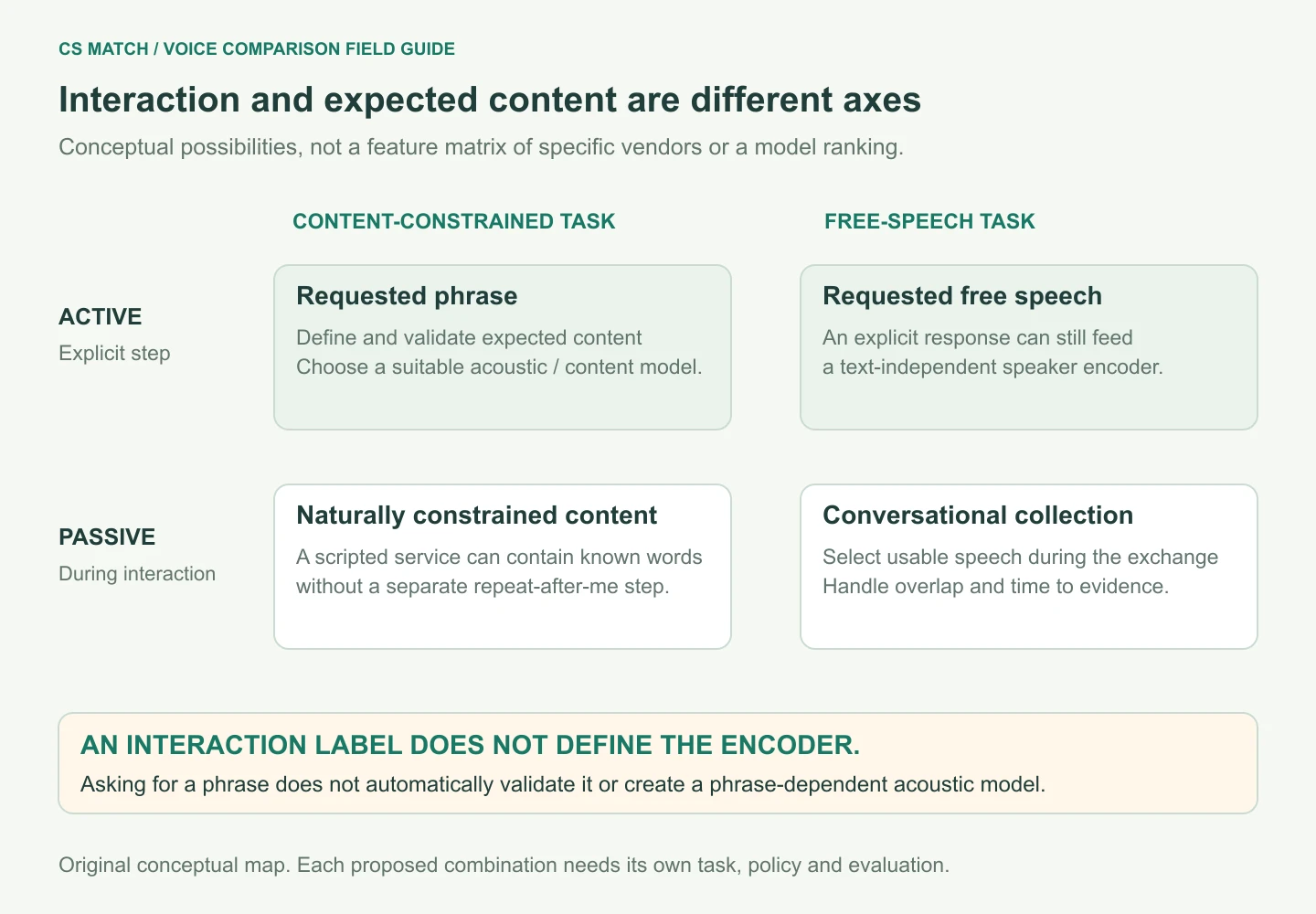
Active and passive are a second axis, not synonyms for the model families
An active workflow asks the person to contribute speech for a defined step. A passive workflow collects speaker evidence from ordinary interaction. Either description leaves open which model, content constraint and decision rule are used. For example, an active free-speech response can feed a text-independent encoder; the explicit request does not create a fixed-phrase model.
Likewise, phrase-constrained speech can occur naturally in a scripted service interaction without a separate repeat-after-me screen. Calling that collection passive still does not mean the model accepts arbitrary wording. The two-axis map separates interaction from expected content so architecture discussions do not mix user experience with acoustic assumptions.
Measure the consequences of the selected combination. A dedicated prompt can define a clean capture interval but require extra effort. Conversation-based collection can avoid that step yet wait for sufficient isolated speech and cope with interruptions. These are workflow tradeoffs to evaluate, not a ranking in which one label automatically delivers better accuracy, convenience or attack resistance.
Test speaker and phrase correctness in separate trial cells
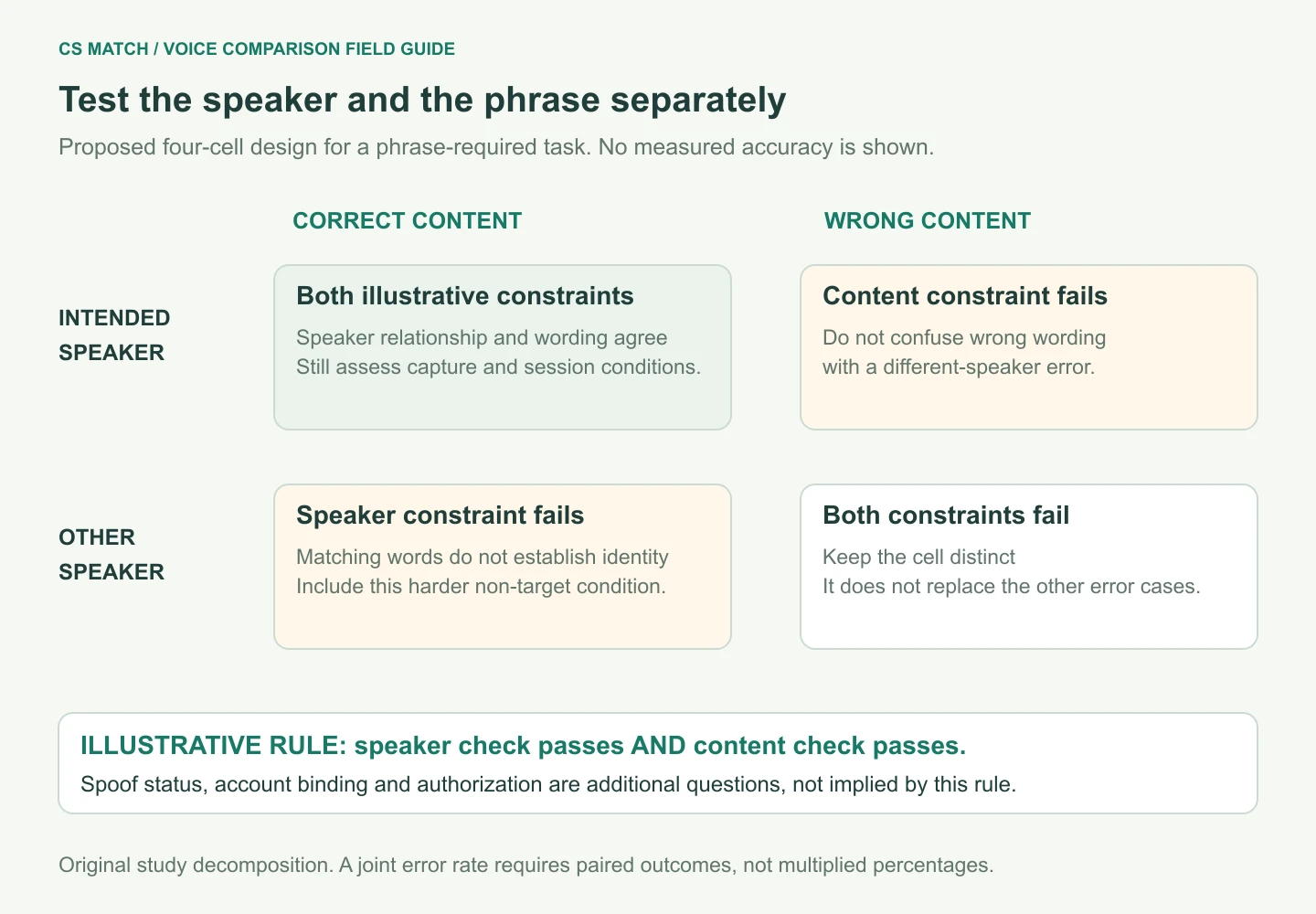
A phrase-required policy needs more than ordinary target and non-target pairs. Define whether the speaker is the intended one and whether the wording is correct. This yields four basic cells. Under that illustrative policy, only intended-speaker, correct-phrase speech satisfies both conditions; the other cells help reveal which subsystem or rule failed.
Use trusted labels and document how content correctness is decided. If ASR provides the content check, evaluate recognition mistakes separately from the acoustic speaker score. Accents, short words and background noise can affect that stage. Do not label every rejected genuine speaker as a speaker-model failure when the actual reason was an incorrectly recognized prompt.
The four-cell design is a proposed task decomposition, not measured performance or a complete authentication protocol. Add capture and spoof conditions as separate dimensions where relevant. A synthesized response may have correct content and a target-like representation, so it cannot be assessed adequately by a table that records only speaker identity and phrase labels.
An illustrative logical policy can require both a passing speaker decision and a passing content check. This is an AND condition, not multiplication of confidence numbers. Its combined error rate depends on the joint outcomes, so separate component rates cannot determine the final result without corresponding paired trials.
Illustrative joint rule: speaker check passes AND content check passes.This is a task decomposition, not the current application or a complete authentication protocol.| Speaker relationship | Phrase content | What the cell tests |
|---|---|---|
| Intended speaker | Correct | Genuine completion under the phrase-required task |
| Intended speaker | Wrong | Content rejection without confusing identity |
| Other speaker | Correct | Speaker rejection despite matching wording |
| Other speaker | Wrong | Both constraints; not a substitute for harder cells |
Enrollment must match the task and keep its binding separate
A fixed-phrase profile should be constructed with the phrase and capture rules expected at test time. A free-speech profile needs representative single-speaker material appropriate to its task. Merely renaming a stored vector does not establish compatibility between these designs. The enrollment evidence, model revision and aggregation policy belong together in the system record.
Multiple repetitions can expose within-speaker variation, but they can also repeat a poor capture or contamination. Inspect the material rather than treat repetition count as a quality certificate. Account or identity binding remains a separate process: a perfectly consistent set of utterances can still be enrolled under the wrong relationship if that connection was never established appropriately.
When changing models or moving between phrase-dependent and free-speech designs, plan for compatible profile regeneration or a deliberately validated mapping. Equal vector dimensions are insufficient. Keep a defined recovery process when a person cannot provide the expected speech, and evaluate the effect of that alternative route instead of excluding it from the claimed end-to-end experience.
Datasets and model objectives encode different verification tasks
RedDots was designed to collect prompted mobile speech for speaker-recognition research, supporting investigation of constrained-content tasks under realistic variation. HI-MIA provides far-field text-dependent speech around a wake-up phrase. These resources illustrate different capture and wording conditions. Neither dataset name alone specifies which speaker, phrase and session splits justify a particular evaluation claim.
Neural phrase-dependent research also exists: Heigold and colleagues describe joint optimization of a reference-and-test scoring system on an internal wake-phrase benchmark. That is evidence about its defined task and training setup, not proof that any general embedding model becomes equivalent when given the same phrase. Traditional sequence modelling and neural approaches both require a concrete reproducible configuration.
Match the dataset and objective to the application question. A wake-word result does not automatically transfer to telephone passphrases, and an interview-trained text-independent encoder needs its own short-prompt evaluation. Keep task-specific trial labels and training exclusions explicit. Cross-protocol benchmark numbers should guide research choices without being rearranged into an unsupported universal model ranking.
Short speech, language and delivery remain evidence constraints
A short phrase provides less acoustic material than a long passage, though its controlled sequence can be useful to an appropriate model. There is no universal duration that guarantees reliable verification. Evaluate the actual phrase length, speaking style and capture route. Silence padding adds file duration without supplying more speaker evidence, and repeated words do not create independent sessions.
Text-dependent tasks also need a language and pronunciation policy. Correct-content labels may allow defined variants or may require a more specific sequence; state that choice before scoring. Text-independent comparison removes the identical-word requirement but not the need to assess cross-language conditions. Interface translation changes neither model training nor the source's phonetic evidence.
The current worker's default three-second detected-reference-speech gate is a processing minimum, not validation of a banking passphrase or a universal sample requirement. Its configured transcription languages and speaker encoder are separate components. A useful source-quality outcome can acknowledge insufficient or mixed evidence without forcing a confidence-looking result from a passage that does not support the intended task.
Content knowledge is not a liveness certificate
A fixed phrase can be known to others or appear in earlier recordings. A content checker asks what was said, not whether the current signal came from the intended person speaking now. A speaker matcher asks about resemblance, not whether the waveform was generated. Keep those hypotheses explicit instead of assigning every security property to a phrase's familiarity or complexity.
A changing prompt can contribute interaction-specific evidence, but must be assessed against the relevant threat model and capture route. Neither active nor passive collection automatically supplies spoof detection. ASVspoof resources help distinguish genuine and manipulated speech conditions; their existence does not imply that our application runs those countermeasures or that one benchmark covers every attack.
Phrase choice does not remove a modality restriction. NIST SP 800-63B-4 prohibits voice-based biometric comparison within its authentication framework. A fixed phrase cannot make that modality conformant there. Applicable requirements and technical model capability are separate questions.
Compare the complete task instead of only the easiest score
Keep reference and test sessions independent according to the claim, and include the same relevant channel and duration conditions when comparing candidate systems. For phrase-required designs, preserve all four speaker-content trial cells. For free-speech designs, define target and non-target relationships without quietly selecting identical sentences that make the trial easier than ordinary use.
Evaluate content failures, speaker errors, insufficient inputs, retries and time to usable evidence separately, then assess the combined policy. Report the operating point and denominators. A speaker-only EER does not summarize phrase validation, spoof rejection or service recovery. Likewise, fewer content mistakes cannot establish that a speaker model has better discrimination.
Use development data to choose settings and reserve final trials for the selected configuration. Benchmark a named checkpoint and profile policy, not a broad method category. Where two systems solve different tasks, explain the difference rather than manufacture a single winner. The useful result is a bounded decision about the actual recording or interaction requirement.
Why text-independent comparison fits our current recording-review task
Users supply existing analysis and reference recordings whose words often differ. A text-independent encoder lets the current workflow compare those sources without requiring a new spoken phrase. Separate transcription helps readers inspect content, while source-linked windows and speaker groups provide context. That combination fits recorded-material review and is the practical rationale for the current design.
The transcript is not currently used as a prompt-response validator, and the reference does not train a phrase-specific model. The workflow also lacks trusted account enrollment and anti-spoofing. Those limits should remain visible when a recording contains a familiar passphrase: recognizing its text and finding speaker resemblance do not transform the report into an authentication decision.
Phrase-dependent models remain useful alternatives for appropriately defined tasks, not inferior technologies to dismiss. If a future requirement needs constrained content, evaluate a suitable model and interaction on its own terms. Our choice is justified by fit to the current task and inspectability, while stronger accuracy or security claims require independent evidence and the complete surrounding system.
Questions about this workflow
Is active verification always text-dependent?
No. Active describes an explicit speaking step; text-dependent describes a content constraint and modelling task. An active free-speech response can use a text-independent encoder.
Can a general speaker embedding automatically validate a passphrase?
Not by itself. Speaker resemblance and content correctness are separate questions. A phrase-required policy needs an explicit, evaluated content rule or an appropriate joint model.
Does a random prompt guarantee that the response is live and genuine?
No. It can contribute interaction-specific evidence, but generated speech, capture integrity and spoof resistance need separate assessment under the intended threat model.
Why does our tool use a text-independent encoder?
It compares existing recordings whose wording can differ. Separate transcription supports review; the current workflow does not implement a passphrase-authentication or liveness protocol.
Continue with the next useful step
Voice Biometrics in Banking: Enrollment, Verification and Call-Center Authentication
Explore banking voice biometrics: trusted enrollment, one-to-one verification, call capture, fraud controls, replay and synthesis threats, standards, lifecycle and the limits of recorded-voice comparison.
ECAPA-TDNN and VoxCeleb: Training, Checkpoints and Real-World Limits
Understand ECAPA-TDNN training, VoxCeleb trial protocols, pretrained checkpoints, augmentation, reproducibility and the limits of applying benchmark results to real voice comparison.
Speaker Verification Metrics: FAR, FRR, EER, minDCF and Calibration
Read voice-verification metrics correctly: trial labels, false accepts and rejects, ROC and DET, EER, detection costs, calibration, uncertainty and the limits of current report scores.