
Voice Biometrics in Banking: Enrollment, Verification and Call-Center Authentication
Explore banking voice biometrics: trusted enrollment, one-to-one verification, call capture, fraud controls, replay and synthesis threats, standards, lifecycle and the limits of recorded-voice comparison.
Sources checked · Cyber Search MatchBanking voice biometrics compares a caller with a previously established voice profile inside a broader identity and service workflow. Its value depends on enrollment, capture quality, decision policy, spoof resistance and recovery together. A speaker-similarity model alone does not provide that system. Read bank deployment descriptions as scoped product evidence, and assess applicable authentication requirements separately from research benchmarks or recorded-audio review.
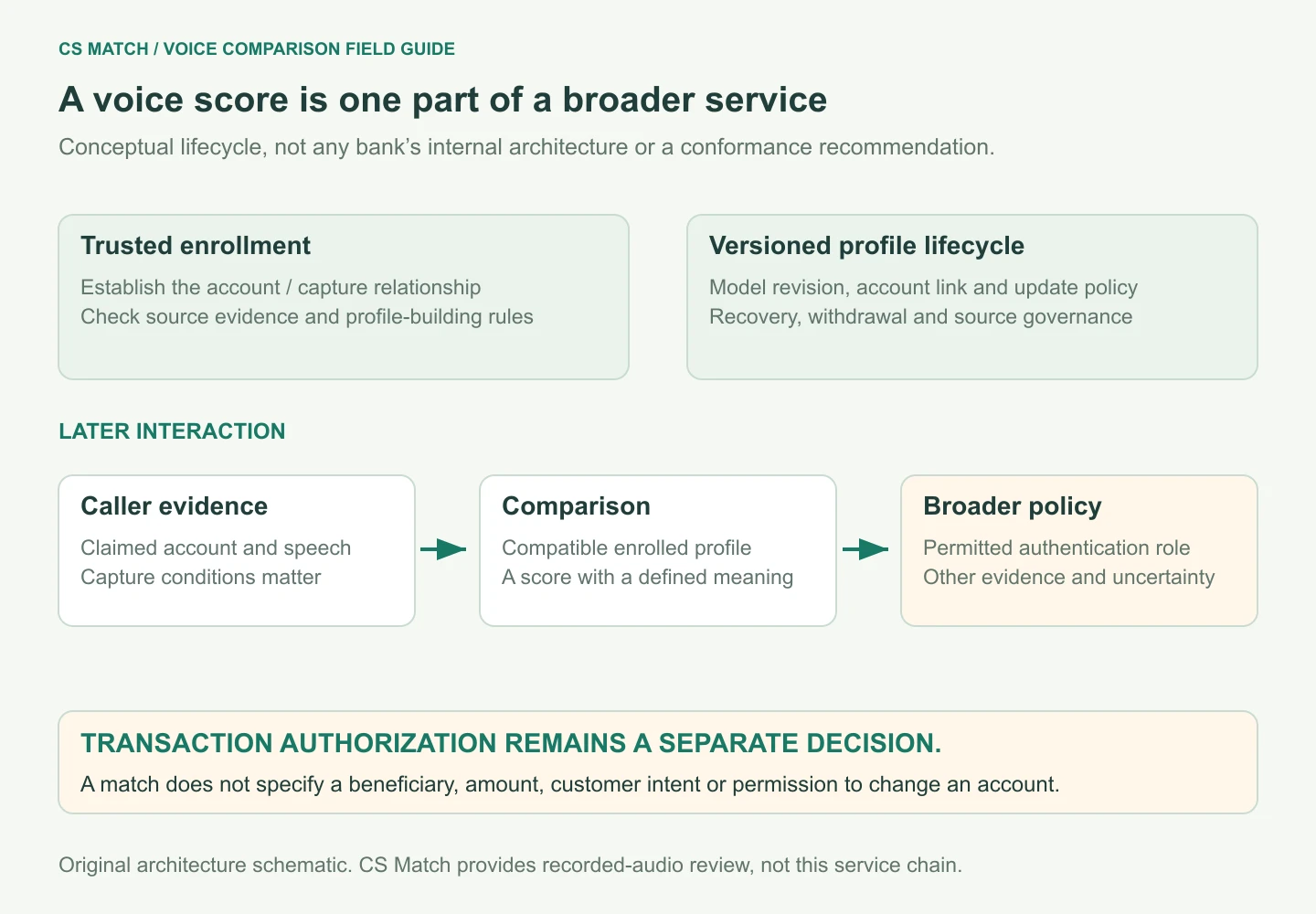
Separate voice resemblance, authentication and transaction permission
Voice comparison asks whether recorded speech resembles a reference under a defined model. Authentication asks whether a claimant has supplied acceptable evidence for a claimed account or identity. Authorization determines what an authenticated session may do. These are connected layers, but a favourable similarity score does not specify a payment amount, beneficiary or permission to change an account.
A banking design therefore needs an explicit task and decision boundary. Is the system helping an agent recognize a returning caller, contributing to a risk assessment or participating in an authentication process? Those roles require different evidence and controls. Calling them all voice identification hides the difference between an assistive signal and an action that grants access.
This distinction also clarifies our product scope. CS Match compares two submitted recordings and helps review relevant speech intervals. It does not bind a voice profile to a bank customer, authorize transactions or supply a banking authentication service. Understanding a banking architecture is useful for evaluating technology without pretending that an audio-report feature already implements that architecture.
Enrollment establishes the relationship the later score relies on
Enrollment is more than averaging a few recordings. A service needs a trusted process connecting the intended account holder with the capture session and the resulting profile. If the wrong person supplies the enrollment sample, an accurate later comparison may faithfully recognize that wrong relationship. Recognition quality cannot repair an identity-binding error made before the model runs.
A reproducible enrollment record identifies the capture route, source quality, model revision and profile-building rule. It should distinguish a completed profile from an inadequate sample that needs another attempt. Multiple utterances can help characterize variation, but combining unrelated voices or contaminated passages can degrade the reference. More speech is useful only when it contributes appropriate evidence.
Keep the account-binding process separate from later profile maintenance. An update derived from an uncertain call should not silently acquire the same trust as an authenticated enrollment. Define who can request a change and how the prior profile remains recoverable or revocable under the service's policy. These are lifecycle design questions, not capabilities supplied automatically by a pretrained encoder.
One-to-one verification and searching a population are different workloads
A claimed account can select one enrolled profile for comparison. Searching many profiles instead asks which candidate, if any, resembles the caller. The candidate population and number of comparisons affect the opportunity for false matches. A rate measured on a fixed one-to-one trial list should not be transferred unchanged to a large search or a fraud-watchlist workflow.
An application should record which task produced an alert and what evidence supports it. A candidate-list result is not a verified identity, and a watchlist resemblance is not proof of wrongdoing. Human review and a defined action policy may be necessary depending on the service role. Preserve uncertain and contradictory evidence instead of making the interface hide the distinction.
For evaluation, freeze the population, source conditions and decision rule. Include callers absent from the enrolled set where the task permits that outcome, and assess false alerts at the actual search unit. This avoids a misleading comparison between a convenient pairwise benchmark and the operational system. Our current tool has no bank-account enrollment database or public voice-identity search.
Prompted speech and ordinary conversation change the interaction
An active interaction explicitly asks the caller to provide speech for verification, often by repeating a phrase. A passive interaction obtains usable speech during the conversation. These labels describe user interaction, not a complete model specification. A system can request a phrase while using a text-independent encoder, so active does not automatically mean a text-dependent acoustic model.
A controlled prompt can make the expected content and capture interval easier to define, but introduces instruction-following and accessibility considerations. Conversational collection can reduce a separate speaking step while leaving uncertainty about when sufficient single-speaker speech becomes available. Measure time to usable evidence, not merely the duration of the model's final forward pass.
Describe the actual route rather than infer it from a vendor category. Identify how speech is selected, whether content is validated and how interruptions are handled. An agent speaking over the caller can contaminate a window regardless of whether the workflow is called active or passive. The appropriate interaction depends on the service task, model evidence and applicable requirements.
What current bank descriptions demonstrate, and what they do not
As checked in October 2026, Lloyds Bank describes an optional telephone Voice ID service in which customers say a fixed passphrase after supplying their details. Its page also describes alternative verification for people who do not use Voice ID. This is evidence of a particular customer-facing workflow; it is not an independent public error-rate study of its full system.
HSBC USA describes comparison of a caller's speech with a stored voiceprint and a simple phrase-based interaction. That establishes how the bank presents the service to customers. Statements about convenience or security on a product page should remain attributed to the bank, rather than be treated as reproducible evidence that every replay, synthetic voice or difficult call will be rejected.
These examples do not establish that all banks use identical models, thresholds or capture policies. Availability and requirements can vary by jurisdiction and product. We do not infer a particular vendor, neural architecture or anti-spoofing engine from these descriptions. A meaningful technical comparison would need the selected implementation, evaluation conditions and failure policy, which customer pages do not fully specify.
Telephone capture is part of the recognition system
A call can involve handset changes, speakerphone, codecs, network interruptions and background speech. An enrollment captured through one route may be compared with another. Standardizing a working waveform does not erase those differences. Include the relevant combinations in evaluation rather than assume that a clean microphone reference represents every phone session equally well.
Speech selection matters during agent-assisted calls. Hold music, announcements, interpreters and another participant near the caller can enter the capture. A speech detector identifies activity, not the account holder. A diarization label likewise groups related passages without proving personal identity. Review how the application obtains target evidence before crediting the speaker encoder for the final outcome.
A process should have an understandable outcome when the signal is insufficient, rather than repeatedly pursuing a score until something passes. Measure how often that occurs across capture conditions and what service path follows. Such cases affect customer experience and usable coverage even when they are excluded from an encoder-only benchmark. Keep both conditional recognition performance and complete-workflow behaviour visible.
Treat the comparison as one defined input to a service decision
The service needs a policy for combining account context, permitted authentication evidence, session state and any voice-related signals. It also needs separate rules for actions after access. A high score alone does not establish consent to a transaction or protect an already compromised session. Write down what decision the score may influence and what remains outside its authority.
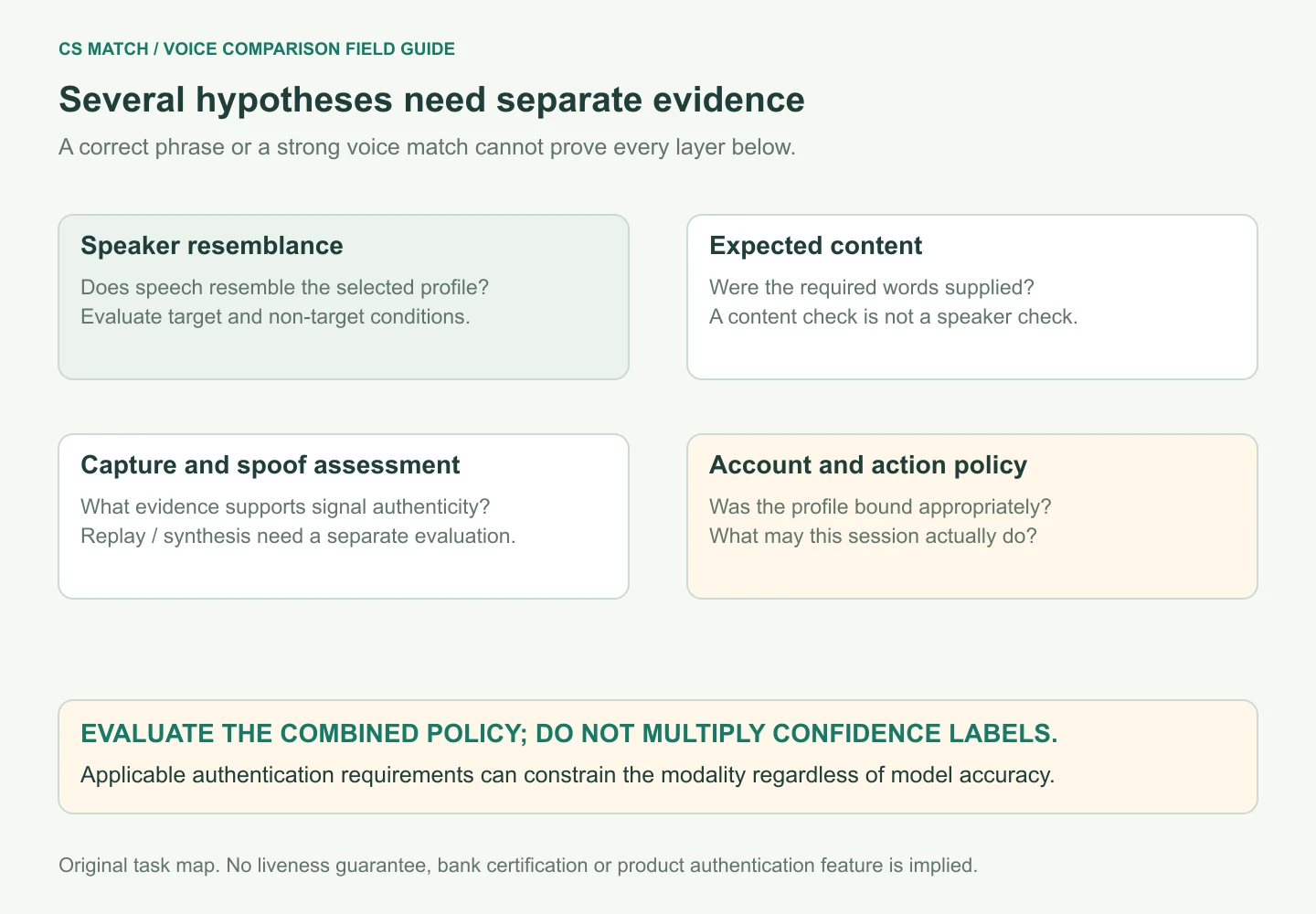
Risk signals are not automatically independent. Device, network and voice-quality indicators can share a common cause, and multiplying confidence-looking percentages can create unjustified certainty. Evaluate the actual combined policy on representative scenarios. If several layers fail together under a capture or account-recovery condition, isolated component accuracy can conceal the relevant operational weakness.
Define escalation and alternative service routes so an uncertain result does not become an unsupported accusation or an endless sequence of retries. Evaluate completion, false rejection and the effect of overrides as part of the workflow. This is an architecture discussion, not a recommendation to use our similarity thresholds for account access or a claim that our report already supplies those controls.
Speaker match and spoof resistance answer different questions
A speaker verifier can find a recording similar to the enrolled voice without determining whether the current signal is a fresh human utterance. Replay, synthesis and voice conversion introduce another hypothesis to evaluate. A fixed phrase is not a secret in the same sense as a protected cryptographic key, and correct wording does not itself establish that a live account holder supplied it.
ASVspoof provides research tasks and data for evaluating spoofed speech, including logical-access, physical-access and deepfake conditions. These are distinct from ordinary target-versus-non-target speaker trials. A countermeasure needs its own model, operating point and evaluation, followed by assessment of the combined system. Neither an ASV benchmark nor a spoof-detection benchmark alone certifies a banking workflow.
Keep the capture and decision context explicit. A content challenge can contribute evidence about an interaction, but it should not be described as universal protection against every generated or manipulated response. Our current comparison path does not run an anti-spoofing model or certify liveness. A favourable report score should not be used as a shortcut around that missing layer.
Read authentication requirements in their actual scope
NIST SP 800-63B-4 states: Biometric comparison based on voice SHALL NOT be used. Within that authentication framework, another factor or a more accurate voice model does not remove the prohibition. A conformance claim must respect this boundary rather than substitute an accuracy benchmark for an allowed modality.
The publication has a defined digital-authentication scope. Its requirement is not a universal worldwide ban on bank telephone services. Equally, a bank's product page does not certify a separate implementation's conformance. Establish which requirements govern the actual service before selecting its authentication role.
Keep research capability, deployed-service descriptions and compliance claims separate. An organization considering adoption needs to establish which requirements apply before choosing an authentication architecture. This guide does not certify any bank or vendor and does not supply a legal determination. It explains why evidence that a voice can be compared is insufficient to establish that it may serve a particular authentication role.
Profiles need a lifecycle, not just a storage column
An enrollment profile, original audio, comparison scores and account link are different records with different purposes. Identify which are retained, why they are needed and who can access them. A vector representation is not automatically anonymous simply because it is not directly playable as speech. Its linkage and use within the service matter to privacy and operational control.
For a UK example, ICO guidance distinguishes a lawful basis from the additional condition needed when special-category biometric data is processed for unique identification. It also explains that consent is not appropriate in every context. These requirements should not be reduced to a generic checkbox or exported as one universal legal rule for all countries and service designs.
Maintain a defined process for withdrawal, deletion, recovery and changes to the account relationship under the applicable policy. Protect the integrity of profile updates and record model revisions so old and new representations are not mixed silently. The engineering goal is a traceable lifecycle and a service alternative where needed, rather than treating a successful enrollment as a permanent, unchangeable identity certificate.
Evaluate the complete service, including recovery and failures
A useful study includes independent genuine callers, non-target callers, relevant capture routes and insufficient-speech cases. Spoof scenarios require a separate declared evaluation. State the decision unit, threshold policy, source relationships and exclusions. Report usable coverage as well as conditional false-accept and false-reject rates so difficult calls do not disappear from the claimed experience.
Measure enrollment failures, time to evidence, repeated attempts and the handling of a changed or unavailable voice. Assess any alternative or recovery route under the same service objective. A strong matching component can be undermined by a weak binding or override process, while an inaccessible interaction can create operational problems even when its scored trials look favourable.
Keep development separate from final assessment and test the combined policy actually proposed for use. Published research numbers and vendor case studies can guide investigation, but are not a substitute for that evidence. Our evaluation guides explain how to structure the comparison; no new banking deployment, customer study or calibrated operating policy is asserted by this article.
Why our recorded-audio approach has a narrower, useful role
CS Match takes an analysis recording and a supplied reference, prepares speech windows, builds a normalized reference profile and exposes resemblance with source intervals. Transcription and speaker grouping provide additional ways to inspect the material. This is useful for reviewing recordings and understanding model behaviour without pretending that file upload establishes an account holder's identity.
The modular design allows a focused evaluation of source selection, embeddings, reference aggregation and scoring. Its current limits remain explicit: no trusted banking enrollment, anti-spoofing layer, calibrated identity probability or transaction authorization. Fallback acoustic representations also require provenance and separate treatment. A completed report does not imply that a bank-grade control chain has run.
The reasonable rationale for this implementation is its fit to source-linked recording review and the ability to test improvements independently. Banking systems solve a broader and differently constrained problem. Their existence offers useful architecture lessons, but does not justify a claim that our service replaces them or is universally more accurate. Keep that distinction visible when choosing and interpreting a voice-comparison tool.
Questions about this workflow
Does a bank using Voice ID prove voice matching is universally secure?
No. A product description establishes a scoped workflow, not independent performance under every attack or capture condition. Enrollment, policy, spoof resistance and applicable requirements still matter.
Does NIST SP 800-63B-4 permit voice biometrics if another factor is added?
Its biometric-use section prohibits voice-based comparison within that authentication framework. Adding another factor does not remove the prohibition; applicability to a particular service is a separate question.
Is saying the right passphrase enough to establish a live account holder?
No. Content, speaker resemblance, capture authenticity and account binding are separate questions. A fixed phrase or a high match score does not independently answer all of them.
Can CS Match authenticate a banking customer from an uploaded reference?
No. It compares supplied recordings for review. It does not provide trusted customer enrollment, a banking authentication policy, anti-spoofing or transaction authorization.
Continue with the next useful step
Text-Dependent vs Text-Independent Voice Verification
Compare fixed phrases, prompted text and free-speech speaker verification. Separate interaction from model design, evaluate speaker and content errors, inspect datasets and understand the current CS Match choice.
Speaker Verification Metrics: FAR, FRR, EER, minDCF and Calibration
Read voice-verification metrics correctly: trial labels, false accepts and rejects, ROC and DET, EER, detection costs, calibration, uncertainty and the limits of current report scores.
Training and Evaluating Voice Comparison on Real Recordings
Build a reproducible speaker-comparison study: source labels, speaker and session splits, trial conditions, baseline checkpoints, adaptation, calibration, full-recording evaluation and uncertainty.