
Voice Deepfakes, Replay and Anti-Spoofing: A Separate Detection Problem
Learn why speaker similarity cannot certify authentic speech. Explore replay, synthesis, voice conversion, AASIST, self-supervised countermeasures, ASVspoof tasks, joint metrics and defensible evaluation.
Sources checked · Cyber Search MatchSpeaker verification asks whether speech resembles a reference speaker. Anti-spoofing asks whether the signal supports an accepted bona fide capture hypothesis rather than a spoof condition defined by the evaluation. A familiar-sounding voice can satisfy the first question without satisfying the second. Countermeasures therefore need separate training labels, scores and held-out tests, followed by evaluation of any combined decision. Our current voice-comparison report does not run such a detector or certify liveness.
Speaker resemblance and authenticity are separate hypotheses
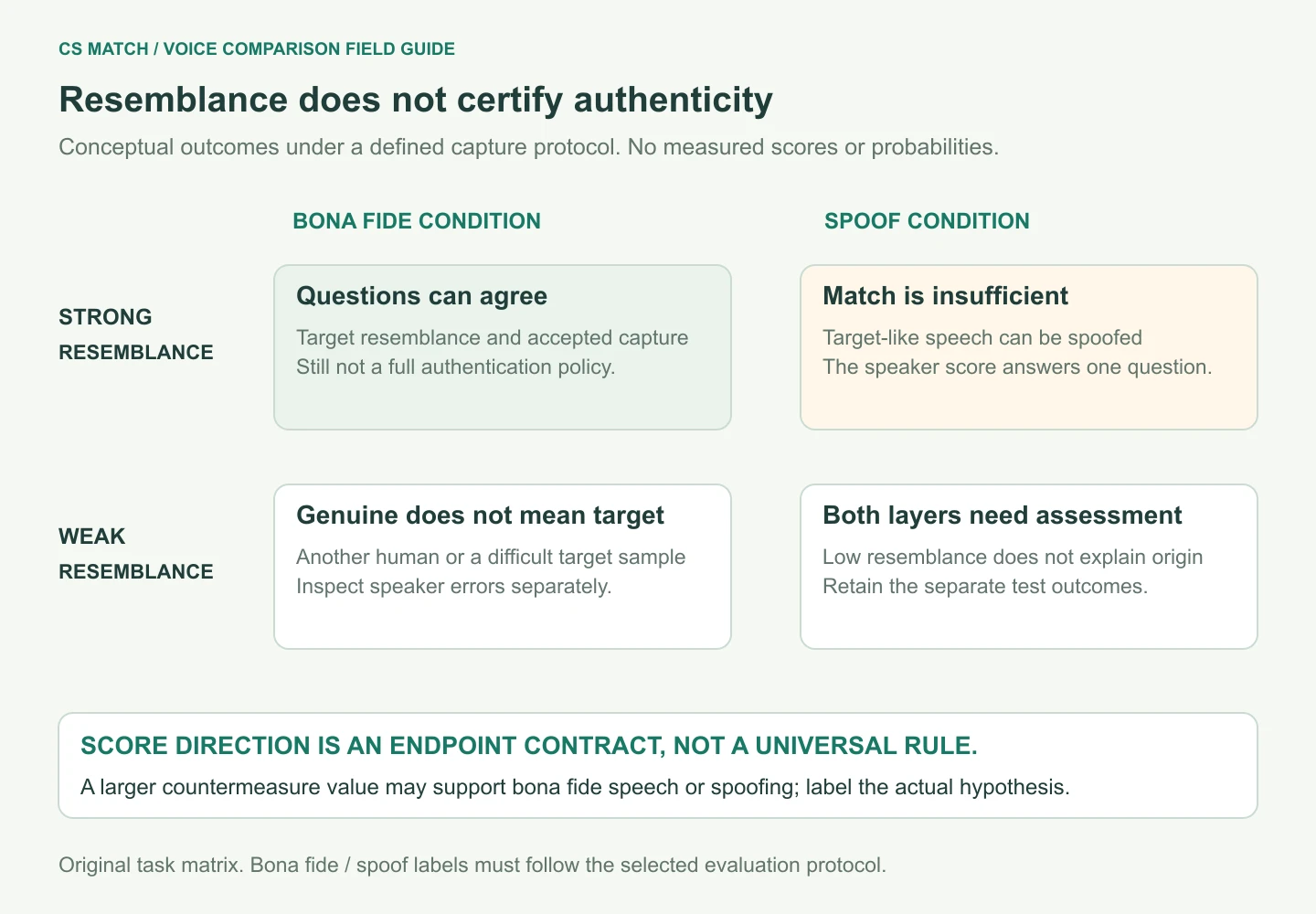
An automatic speaker verifier is trained or configured to distinguish target and non-target relationships. It can produce a strong match for speech carrying the target's vocal characteristics even when that speech did not arrive through the intended capture process. This is not a contradiction: authenticity was not the question represented by the speaker score in the first place.
A countermeasure instead distinguishes bona fide and spoof conditions under a specified protocol. Those labels need careful definition. A genuine human recording can be unacceptable when replayed in a session requiring a fresh response, while an archival analysis may legitimately process old recordings. The application determines what capture hypothesis matters; the same file is not a universally valid or invalid identity credential.
Keep both questions visible in the architecture and interface. A speaker score should retain its speaker meaning, and a countermeasure score should name the hypothesis and direction it supports. Do not relabel one as a general trust percentage. The conceptual matrix below shows why a signal can resemble the reference while still requiring rejection under a separately defined spoof policy.
Replay changes the capture claim without changing the original speaker
Replay involves reusing recorded speech where the interaction expects an acceptable current capture. Physical playback introduces a loudspeaker, room and microphone path. A digital reuse route can avoid some of those acoustic stages. These categories expose different evidence to a detector, so successful performance on room playback should not automatically be presented as protection against every reused recording.
A physical recording may carry reverberation, frequency response or other traces of its path, but ordinary genuine speech can also come through poor microphones and noisy rooms. A model that simply associates degraded quality with spoofing risks rejecting legitimate users. Evaluation should vary both genuine and spoof capture conditions so the detector cannot succeed merely by recognizing one conspicuous recording setup.
For archived files, distinguish the acoustic observation from the alleged event. Finding playback-like characteristics does not by itself establish who replayed the audio, when it happened or whether its use was deceptive. Preserve the source and capture context where available. A countermeasure can contribute a scoped observation, while broader conclusions about origin and intent require evidence outside the waveform score.
Synthesis and voice conversion pose related but different shifts
Text-to-speech generates audio from linguistic content, potentially conditioned on a voice representation. Voice conversion changes characteristics of existing speech toward another voice while retaining aspects of the source utterance. These are broad technical categories, not a guarantee that all outputs share a single detectable fingerprint. Different generators, training data and output processing can create different evidence.
A convincing target resemblance does not prove that a generated signal will fool every speaker verifier, nor does audible naturalness determine its countermeasure score. Evaluate both tasks directly when the combined outcome matters. Listener impressions can help find unusual passages, but should not replace a labelled test or become ground truth for whether a file was generated.
Mixed recordings create another complication. A file may combine authentic and manipulated intervals, several speakers or edited transitions. A whole-file classifier can dilute a short manipulated passage or produce an alert without identifying its location. Define whether the task is file screening, interval localization or session acceptance before choosing the aggregation rule and interpreting a detector's final result.
A detector learns from labels, sources and the split design
A supervised countermeasure learns patterns that separate labelled training examples. Those patterns may include generator artefacts, but also source databases, silence conventions, channels or processing choices correlated with a label. Strong test results can therefore be misleading when related material crosses partitions. The model should be challenged on the distinction the application needs, rather than on accidental dataset membership.
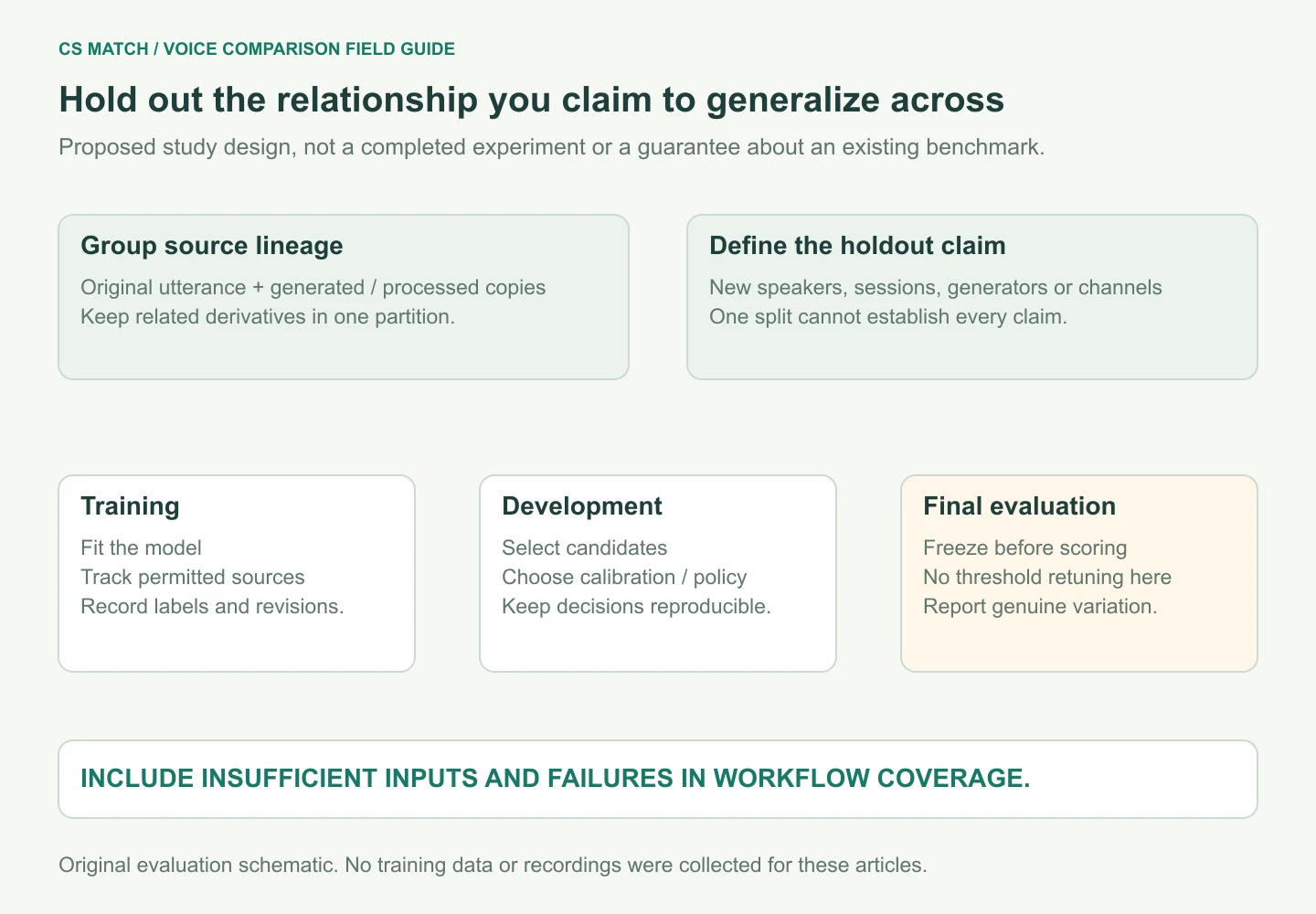
Group an original utterance and its derivatives when constructing partitions. For an unseen-generator experiment, hold out generator families or versions deliberately rather than scatter their outputs randomly. Also separate speakers and recording sessions where required by the intended generalization claim. These choices describe different experiments; no single split demonstrates every kind of robustness simultaneously.
Preserve a final set that remains unavailable for threshold adjustment and model selection. Include adequate genuine variation, since an overly narrow genuine class can make ordinary new recordings look suspicious. Report source and processing conditions with the result. The split diagram is a proposed study design, not an assertion that a particular benchmark excludes every possible relationship or that our product has completed such training.
From cepstral baselines to learned spectro-temporal models
The official ASVspoof 2021 repository supplies LFCC-GMM and CQCC-GMM baselines, alongside LFCC-LCNN and RawNet2 implementations. These span engineered representations with statistical backends and learned neural approaches. They provide useful reproducible reference points, not a claim that an older baseline or a waveform model is universally appropriate for current generated speech.
AASIST's official implementation describes integrated spectro-temporal graph attention for audio anti-spoofing. Its modelling task differs from extracting an identity-oriented speaker vector. Architecture is only part of the reproducible system: weights, training labels, input duration, preprocessing and score aggregation must also be fixed before comparing it with another countermeasure or applying it to a new recording domain.
A defensible comparison should retain a straightforward baseline while evaluating more complex candidates under the same protocol. This helps determine whether apparent gains survive new channels and sources instead of merely reflecting a larger training set or different threshold. Compute and memory also belong in the comparison. A sophisticated model that cannot process the intended workload reliably may not improve the complete workflow.
Self-supervised speech models need a countermeasure objective
Research on wav2vec 2.0 with data augmentation demonstrates a countermeasure built using self-supervised speech representations and a task-specific downstream system. The authors provide an implementation for the reported experiments. The relevant lesson is the trained combination, rather than an assumption that any pretrained speech representation already returns a trustworthy authenticity judgement.
Pretraining can provide broadly useful acoustic structure, while the downstream objective determines which distinctions a system emphasizes. A transcription model, speaker encoder and spoof detector can share some architectural ideas without producing interchangeable outputs. Applying a speaker threshold to a countermeasure embedding is not justified by matching vector dimensions or by the fact that both systems process speech.
When assessing a checkpoint, retain the actual downstream weights and preparation procedure rather than only the base-model name. Examine training exposure and licences separately from the test protocol. Broader pretraining can alter what counts as unseen data. Its contribution should be documented, and the candidate still needs evaluation on the capture conditions and manipulation classes relevant to the proposed application.
Processing can change both authenticity cues and genuine variation
Resampling, lossy encoding, band limitation and enhancement change a waveform before the detector sees it. Some transformations can suppress useful traces; others can introduce patterns resembling training artefacts. Neither effect has a universal direction across models. Evaluate the processing actually used in the application instead of assuming that cleaner-sounding speech is necessarily better input for authenticity assessment.
Retain the original recording and identify derived versions. If the speaker branch needs a standardized waveform, the countermeasure branch should use its own validated input contract rather than inherit arbitrary enhancement steps. Reprocessing an already decoded file cannot restore information removed by an earlier channel. A technical report should identify which available representation was assessed and which source history remains unknown.
The ASVspoof 2021 analysis discusses encoding, transmission and differences between simulated and real acoustic conditions. Its lessons support testing beyond a convenient clean corpus; they do not establish that every detector fails every compression format. Separate genuine and spoof error changes by condition, and retain insufficient or unsupported inputs instead of treating a processing failure as evidence of deception.
ASVspoof editions define different tasks and evaluation contracts
ASVspoof 2021 distinguishes logical-access, physical-access and deepfake tasks. Those labels should remain tied to that edition's protocols and datasets. The ASVspoof 5 phase-two plan instead defines standalone detection and spoofing-aware speaker-verification tracks. Reusing the older three-task labels as the newer track structure would obscure the question being evaluated.
The fifth-edition plan distinguishes bona fide and spoof detection from a joint target, non-target and spoof decision. It also defines training conditions and evaluation measures. A system description should name the edition, track, permitted training resources and evaluation partition. Without them, a reported challenge result cannot be reliably compared with another result or translated into an application's operating rule.
Use a benchmark as a controlled experiment, then examine transfer separately. A published protocol cannot guarantee coverage of every future generator or capture route. A local evaluation should include the application's genuine material as carefully as its spoof examples. Benchmark progress is valuable evidence, but converting it into a claim of universal liveness would require a much broader and differently defined argument.
Measure the joint decision, not only the detector EER
A countermeasure equal-error rate describes an operating relationship for its own genuine and spoof trials. The t-DCF research explains why this need not predict performance after combining the countermeasure with automatic speaker verification. A system can reject spoofed speech effectively while also rejecting many genuine target speakers, or pass genuine non-targets that the speaker verifier must handle.
A joint assessment needs target, non-target and spoof outcomes, with declared costs and priors. Report target misses, non-target acceptances and spoof acceptances separately before summarizing them. A minimum cost obtained by choosing a threshold on evaluation scores is not the same evidence as performance at a previously frozen deployment threshold. Keep protocol-specific normalization and backend assumptions with any published cost value.
In the ASVspoof 5 phase-two plan, standalone detection uses minDCF as its primary metric, with additional calibration and error measures. The joint track uses minimum architecture-agnostic detection cost, a-DCF, as its primary measure; specified tandem assessments also include t-DCF and t-EER. These are protocol-defined measures, not interchangeable accuracy percentages. The schematic below lists cost contributions before any protocol-specific normalization; pi denotes the declared class prior.
The diagram below shows the three populations conceptually, without fabricated performance numbers. It also explains why multiplying two advertised detection percentages is invalid: component errors can depend on the same recording conditions, and the combined decision has its own denominator. Measure paired outcomes on the same trials, including service failures and any policy for insufficient evidence.
target contribution = C_miss × pi_target × P_missnon-target contribution = C_fa_non × pi_non × P_fa_nonspoof contribution = C_fa_spoof × pi_spoof × P_fa_spoofillustrative unnormalized cost = sum of these contributions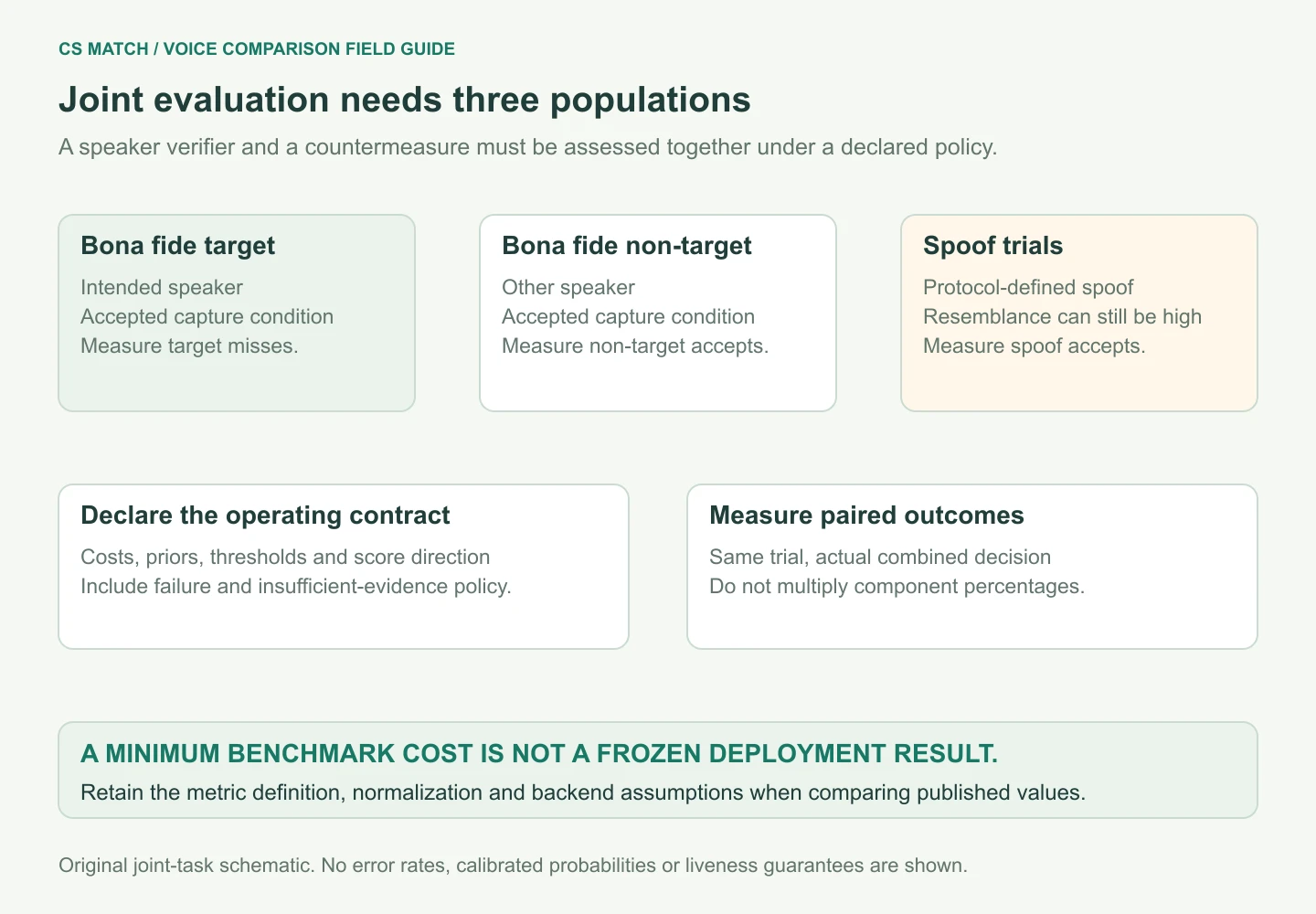
Define score direction, calibration and uncertainty explicitly
A large score can support bona fide speech in one endpoint and spoofing in another. Preserve the documented direction and selected model version, and test it with labelled fixtures before integration. A field rendered as a percentage is especially dangerous when the underlying quantity is an unbounded statistic. Visual familiarity should not replace a correct explanation of the hypothesis being scored.
A log-likelihood ratio, if calibrated for its stated hypotheses, compares their likelihoods. It is not a posterior probability without prior odds. A zero value represents equal likelihood under those models, not automatically an equal real-world chance. An uncalibrated neural output has even less direct probabilistic meaning. Define the operating point using independent development data and the intended decision costs.
Use an explicit insufficient-evidence outcome when the service contract and workflow support it. Short speech, unsupported processing or a missing required reference should not silently become either authentic or fake. Include those outcomes in coverage reporting. A lower false-acceptance rate calculated only after discarding difficult inputs does not describe the complete experience unless the excluded population and its handling are also shown.
Preserve uncertain passages and distinguish screening from attribution
For file review, retain the original source, processing history, model revision and the intervals that contributed to an alert where the detector supports localization. If only a file-level score is available, present it at that level. Do not manufacture timestamps by assigning the same value to every segment or imply that a global alert identifies the edited passage.
Independent source information can change the interpretation of acoustic evidence. A known generation record, a documented capture session or a verified editing history supports a different conclusion from an unexplained downloaded file. These records must themselves be assessed. Absence of provenance does not prove synthesis, just as a favourable model output cannot reconstruct a missing chain of events.
Review should preserve disagreement between listening, source context and model results. Neither a listener's confidence nor a detector's label identifies the author of a manipulation or proves an individual's intent. The practical purpose of screening is to direct examination and describe supported observations. When consequences are significant, the evidential claim should remain bounded by what the evaluated method actually measures.
What CS Match does now, and what a real extension would require
Our current workflow selects speech windows, computes compatible speaker representations where the configured engine is available, and compares analysis speech with a reference profile. Transcription and speaker grouping provide additional review context. None of these components runs a dedicated authenticity detector. A strong similarity label therefore describes the current comparison policy rather than certifying a fresh human response or an unedited recording.
A future countermeasure extension would need a selected licensed checkpoint, an explicit input contract, separate scores and a frozen evaluation on representative genuine and spoof material. It would also need tests for channel changes, unsupported inputs and interactions with speaker scoring. Merely installing a library or displaying an additional confidence-looking value would leave the essential hypothesis and evidence questions unanswered.
For the present recording-review task, keeping those boundaries explicit is a sound design choice. Users can inspect sources and speaker resemblance without receiving an unsupported authenticity certificate. Countermeasure research provides concrete candidates for later evaluation, not a feature already present in this release. Adopt one only when its task, measured behaviour and operational cost justify the additional interpretation it introduces.
Questions about this workflow
Does a high speaker-match score prove a recording is authentic?
No. Speaker resemblance and authenticity are different hypotheses. Replay or generated speech may preserve target characteristics; a dedicated countermeasure needs separate evaluation.
Can every deepfake be detected by one pretrained model?
No universal guarantee follows from a checkpoint or benchmark. Unseen generators, channels, processing and genuine-source variation must be evaluated under the intended task.
Are anti-spoofing scores probabilities?
Not automatically. Score direction is endpoint-specific, and a likelihood ratio still needs prior odds for posterior probability. Neural scores require an appropriate calibration and decision policy.
Does CS Match currently include an anti-spoofing or liveness detector?
No. Its current report compares recorded speech with a reference and supplies review context. The models discussed here are research and evaluation candidates, not installed product features.
Continue with the next useful step
Voice Biometrics Vendors: Products, Deployments and Evidence
Compare Pindrop, NiCE, Phonexia, Veridas and ValidSoft by documented task, integration, score meaning and evaluation evidence. Understand commercial voice platforms versus recorded-audio comparison.
Speaker Verification Metrics: FAR, FRR, EER, minDCF and Calibration
Read voice-verification metrics correctly: trial labels, false accepts and rejects, ROC and DET, EER, detection costs, calibration, uncertainty and the limits of current report scores.
Voice Biometrics in Banking: Enrollment, Verification and Call-Center Authentication
Explore banking voice biometrics: trusted enrollment, one-to-one verification, call capture, fraud controls, replay and synthesis threats, standards, lifecycle and the limits of recorded-voice comparison.