
Voice Comparison for Media, Archives and Recorded Investigations
Learn to review voices in interviews, broadcasts and archives: source preservation, timeline mapping, diarization, cross-recording links, reference selection, population evidence and reporting limits.
Sources checked · Cyber Search MatchVoice comparison can help reviewers locate speech resembling an explicit reference in interviews, broadcasts and archival recordings. Its value comes from traceable sources and inspectable passages, not automatic naming. Diarization, cross-recording speaker linking, recording authentication and formal forensic evaluation are separate tasks. This guide develops a reproducible recorded-material workflow, explains the limits of similarity and likelihood-ratio interpretations, and identifies which parts our current two-source report supports.
Separate navigation, speaker linking and attribution
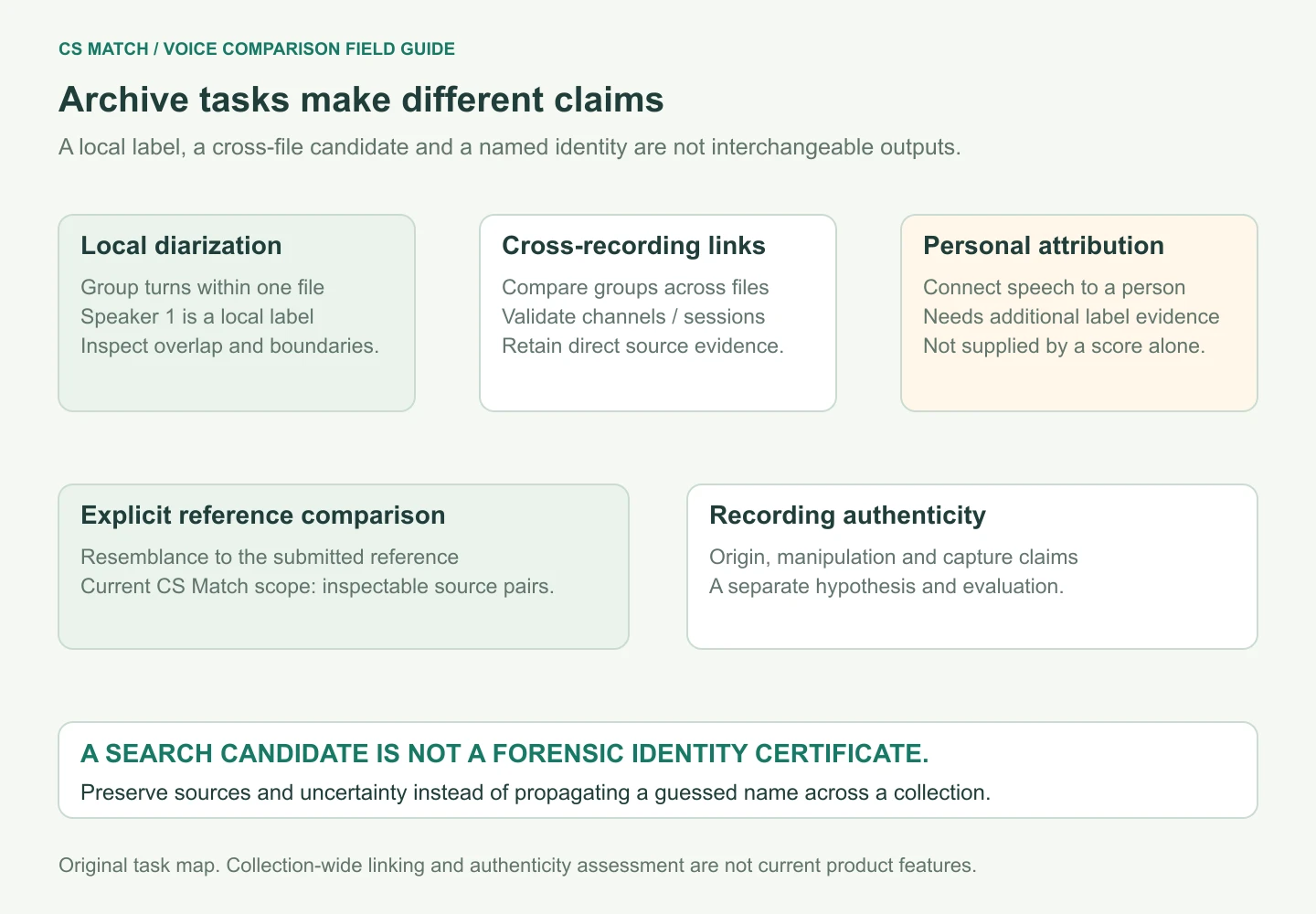
An editor may need to locate a guest's contribution, an archivist may want to connect recurring anonymous speakers across recordings, and a researcher may be testing whether two passages plausibly share a speaker. These are related but different tasks. A transcript finds content, diarization groups turns, reference comparison measures resemblance, and personal attribution requires additional evidence connecting the voice to a named individual.
Start with a narrow question that the available sources can answer. In a hypothetical interview collection, finding a passage similar to a documented reference can prioritize review. It does not establish that every segment with the same diarization label belongs to that person. Nor does an archive catalogue entry automatically establish that the audible speaker is the individual named in the programme title.
Define the intended output before processing a collection: candidate intervals, local speaker groups, cross-file links or a formal evidential assessment. Each requires different evaluation and reporting. Keeping those levels separate allows a useful retrieval tool to remain useful without turning its candidates into definitive identities. The evidence map below shows where a reference score fits within the broader review process.
Keep preservation sources separate from analysis derivatives
The Library of Congress audio format recommendations distinguish native-resolution and metadata-bearing material from altered delivery versions. SWGDE's audio-enhancement guidance calls for working copies and documentation of limitations when originals are unavailable. These sources support a practical separation between retained material and processing derivatives; neither certifies an individual recording's origin or our application as a forensic system.
For a review project, retain a stable source identifier, the received file, available provenance and the relationship to any excerpt or converted version. A checksum can help detect a change to retained bytes, but does not prove that those bytes depict a genuine event. Record what was actually received instead of calling an online repost an original merely because it was the first copy available to the reviewer.
An analysis waveform can use a model-specific sample rate and channel rule while the retained source remains intact. Upsampling cannot restore detail absent from a lower-resolution input. Preserve the distinction when reporting a comparison, including whether a compressed access copy or a higher-quality source was used. That makes later reprocessing possible without pretending that conversion improved the evidence already present.
Make every result traceable to the correct recording timeline
An excerpt has its own local zero point. If it begins at 45 seconds in an unchanged source and a selected passage begins 12 seconds into the excerpt, that passage begins at 57 seconds in the source. This is invented arithmetic for explaining an offset, not an actual detection. Retain the offset with the excerpt identifier so a reviewer can return to the corresponding context.
A simple offset is insufficient after gaps have been removed, segments concatenated or speed changed. Such processing requires a piecewise or otherwise appropriate mapping between derivative and source time. A report should not display converted-file timestamps as if they were broadcast timecodes, wall-clock times or positions in an unedited master. State the timeline explicitly and preserve the transformation history.
Keep enough surrounding material to understand the passage. A short clip may omit a handoff, quotation or playback cue that changes its interpretation. Verify navigation by listening at several mapped positions, especially near edit boundaries. This mapping is a proposed project record; our report links to the uploaded recording's timeline and does not automatically reconstruct an external editorial history or source timecode.
unchanged excerpt: source time = excerpt start + local timeinvented example: 45 s + 12 s = 57 sedited or concatenated derivative: retain a segment-wise mapping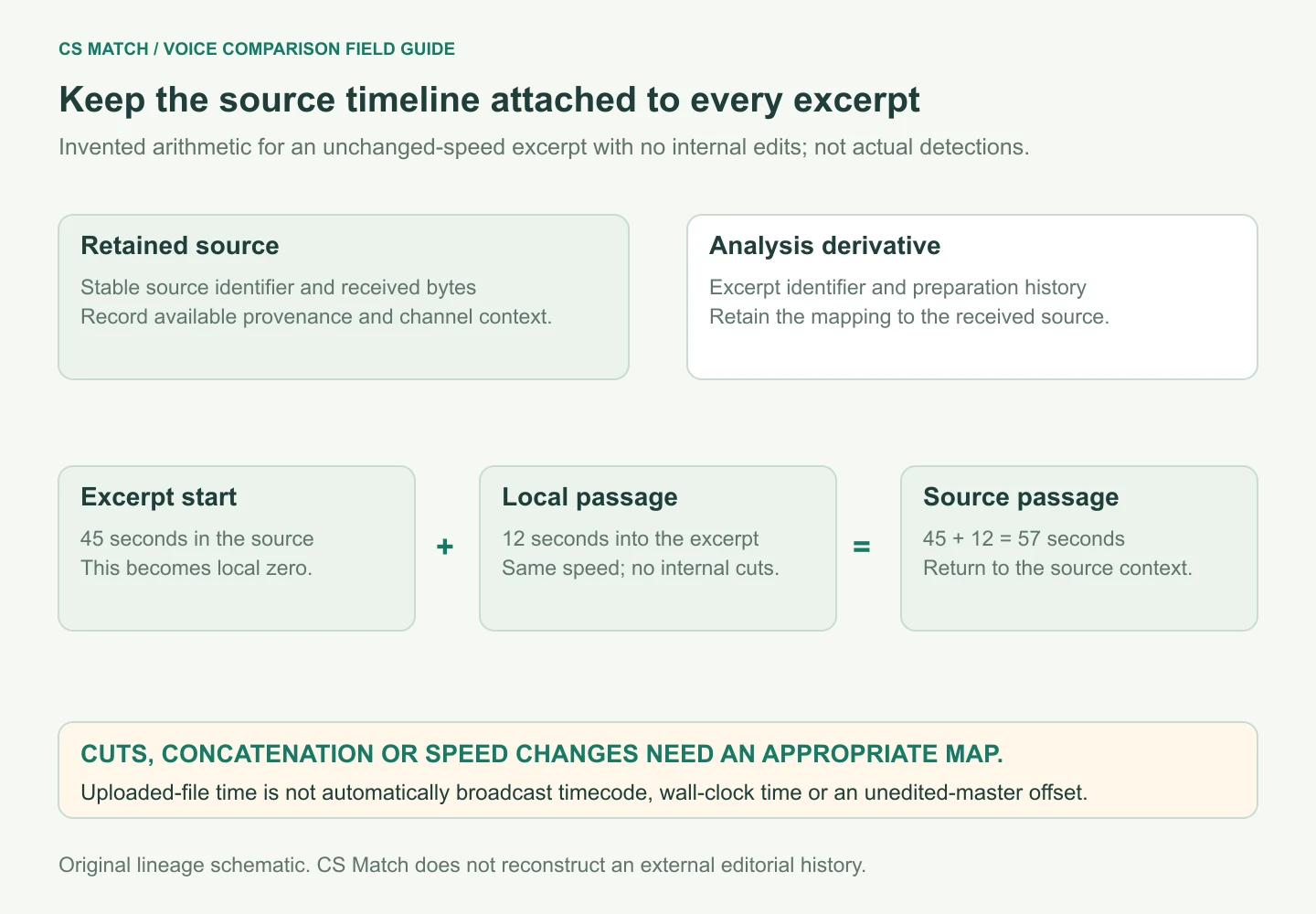
Establish the reference label independently of the comparison
A useful reference contains appropriate single-speaker speech and an independently supported label. In media collections, possible support includes a documented interview session or verified production record, but the reviewer still needs to check who is audible in the selected interval. A host introducing a guest is not necessarily a sample of the guest, and a programme containing a named person can include many other voices.
Avoid choosing the reference solely because it gives the highest score against the questioned material. That selection makes the resulting resemblance partly a consequence of the search procedure. Fix the reference-selection rule before the comparison, record its source and inspect plausible contamination. If several references are used, retain their separate results and explain any aggregation rather than hiding disagreement behind a single attractive summary.
A label can remain uncertain. Marking that uncertainty is more informative than allowing a guessed name to propagate through a collection as ground truth. Our current tool uses the supplied reference to build a comparison profile; it does not independently establish the personal identity of that source. A later review can revise the external label without pretending that the original similarity measurement performed the identification.
Local diarization and collection-wide speaker linking need different validation
Research on a Frisian-Dutch radio archive describes a two-stage system: tape-level diarization creates pseudo-speakers, then linking relates groups across tapes, with known-speaker models used for a further identification step. This illustrates distinct processing levels rather than a capability automatically provided by any diarizer. The study's specific archive and evaluation do not establish accuracy for an unrelated collection.
Within a recording, clustering tries to group speech under its local conditions. Across recordings, the system must cope with new channels, sessions and possibly long time gaps. A threshold that keeps local turns together can merge different people across a larger collection. Treat collection linking as its own task, retaining the source groups behind each proposed connection so incorrect links can be investigated.
Graph-like propagation deserves particular care: one erroneous link can connect otherwise separate groups through a chain. Review a direct comparison and its source before accepting a transitive identity claim. Our current report does not maintain a collection-wide speaker graph or a public voice index. Its local speaker labels and two-recording scores should not be described as that larger archive system.
Broadcast and historical material introduce their own mismatch
A studio interview, a telephone insert and an old tape transfer can represent the same speaker through very different capture paths. Music beds, compression, reverberation and competing voices can affect the available speech. Standardizing the working waveform does not remove those conditions. Evaluate representative source pairs rather than assuming that a clear modern reference characterizes every historical recording equally well.
Playback speed deserves explicit documentation. An incorrect transfer speed changes timing and vocal characteristics, while a later corrective transformation changes the derivative assessed by the model. Do not tune speed until the speaker score becomes favourable and then present the result as independent confirmation. Establish the processing rationale separately and retain both the source and the applied transformation.
NIST's SRE24 plan includes conversational telephone speech, audio from video and cross-source trials, demonstrating that source variation is an explicit evaluation dimension. It is not a benchmark of every tape archive or edited programme. A review project should document its own supported conditions and mark material outside them, including severe distortion or inadequate speech, instead of assigning unwarranted certainty to every file.
Similarity is not the same as evidential weight
Two recordings can share acoustic characteristics that are also common among other speakers. A similarity score describes a relationship under the selected model, while a likelihood-ratio approach evaluates evidence under specified competing hypotheses and a relevant comparison population. The population and source conditions matter to that interpretation; a generic rescaled cosine does not acquire it simply by being displayed as a percentage.
The forensic statistical-models chapter by Morrison and colleagues describes several representation and scoring approaches, including calibration and empirical validation. Morrison's calibration tutorial explains converting suitable scores to likelihood ratios using a fitted procedure. These are evaluated modelling steps, not a universal numerical conversion that makes any embedding score a probability that a named person spoke.
Keep posterior conclusions separate from the acoustic result. Prior information and other evidence affect a posterior assessment, and the chosen hypotheses determine what a likelihood ratio concerns. Our present report provides neither a calibrated forensic likelihood ratio nor a posterior identity probability. A source-review candidate can therefore be useful while remaining insufficient for the stronger evidential statement a different task would require.
Account for how many opportunities produced the best match
A long programme gives a window-search system many chances to find a favourable resemblance. Searching many reference recordings adds more opportunities. The selected maximum is therefore the outcome of a search, not an ordinary preselected pair score. Retain the search scope and selection rule when reporting the result, including how the highlighted passage was chosen from all examined material.
Repeated broadcasts and reposts create another source of false reassurance. Two high-scoring clips can contain the same underlying utterance, so they are not independent confirmations from separate events. Group duplicates and related derivatives in a project manifest, and evaluate independent recording sessions when that is the intended claim. A collection count alone does not describe the amount of independent speaker evidence.
For evaluation, reproduce the full retrieval procedure on held-out material, including the expected number of files and windows. Separate candidate discovery from any later confirmation stage, and do not use the discovered best passage as an independent test of the rule that selected it. This is particularly important when tuning thresholds on a small collection that will later expand substantially.
Use transcripts and images as context with their own uncertainty
Transcription can locate a topic or repeated phrase, but recognizing the words does not identify the speaker. A diarization label attached to a transcript turn can also be wrong around overlap or speaker changes. Listen to the selected source before quoting an important statement, and retain uncertainty about both wording and attribution instead of letting one model's output validate the other automatically.
Video adds potentially useful context, but the visible person may not be producing the audible speech. Broadcasts can contain voiceovers, translated narration, dubbed passages and archival inserts. Associating a face with a voice needs an appropriate temporal and source argument; our current audio report does not perform audiovisual identity binding merely because the uploaded material originated from a video.
Treat contextual evidence as separately recorded observations. A production caption, transcript name or catalogue entry can guide review while remaining subject to correction. An interface should let readers distinguish the source label from a measured comparison result. That separation is more informative than silently copying a visible name into every related speaker group and then treating the resulting agreement as independent evidence.
An unchanged file and an authentic event are different claims
A stable checksum supports a statement that retained bytes have not changed relative to an earlier recorded value. It does not establish that a recording was unedited before receipt, that its speech was generated by a human, or that the named person authorized publication. Those are distinct provenance, authenticity and permission questions, and a speaker match cannot resolve them all.
A familiar voice can appear through replay, synthesis, conversion or quotation. Dedicated authenticity methods require their own hypotheses and validation, while external source records may supply context unavailable in the waveform. Absence of such records should be described as missing context rather than proof of fabrication. Preserve disagreement between source information, listening observations and any model outputs used in the review.
For media work, candidate screening can help prioritize further examination without claiming a definitive fake verdict. The current CS Match comparison has no anti-spoofing detector or editing-history reconstruction. Its result should remain a resemblance observation tied to the inspected source. A later authenticity assessment can add evidence, but should not be implied by the visual confidence of a voice-comparison card.
Document a reproducible review without claiming a forensic certificate
A useful project record identifies the source pair, selected intervals, preparation, model revision, scoring rule and the question asked. Record contradictory passages and insufficient material alongside favourable candidates. Another reviewer should be able to reconstruct which sound produced the observation. A detached screenshot or rounded headline value is usually insufficient to reproduce that relationship after files or labels change.
ENFSI's 2015 automatic and semiautomatic speaker-recognition guidelines address validation, case assessment and evidential interpretation under specified hypotheses. Its separate 2021 speaker-comparison manual focuses on auditory and acoustic phonetic methods and explicitly excludes automatic recognition from its scope. They should not be conflated into one automatic-model certification or treated as endorsement of our report.
For a formal forensic task, relevant expertise, method validation and case-specific assessment extend beyond an ordinary recorded-source search. This guide explains those boundaries rather than certifying admissibility or replacing a qualified examination. For editorial or archival review, the same habit of describing the actual evidence remains useful: state what was observed, how it was obtained and what the available material cannot establish.
Use the current tool for inspectable two-source review
Begin with a permitted analysis recording and a documented reference that contains the intended voice. Inspect the resulting windows and local speaker groups, then return to the recording with enough context to understand the passage. Keep project-level source and timeline notes outside the tool where necessary. The current report helps navigate submitted material; it does not establish the reference label independently.
The implementation's modular stages make this review understandable: source preparation, speech selection, compatible speaker representation, comparison and separate transcription. Engine provenance matters when a preferred learned representation is unavailable. A fallback descriptor should not inherit an ECAPA accuracy claim merely because the report still contains a number. Source inspection and explicit limitations are part of using the result appropriately.
This makes the current design a reasonable starting point for comparing existing recordings against a reference, with traceable passages rather than automatic personal naming. Collection-wide linking, calibrated forensic evidence and authenticity assessment remain separate extensions requiring their own evaluation. Use the report to organize and inspect the available material, and make any stronger conclusion only from evidence that actually supports that conclusion.
| Current report supports | Requires separate work |
|---|---|
| Comparison with a submitted reference | Independent confirmation of the reference label |
| Uploaded-source windows and speaker groups | External edit mapping and collection-wide linking |
| Similarity summaries with review context | Calibrated forensic evidence or authenticity assessment |
Questions about this workflow
Is Speaker 1 the same person across different files?
Not by label alone. Diarization labels are local group identifiers. Cross-file linking requires compatible comparisons and its own evaluation, while personal naming needs additional evidence.
Can a checksum prove a voice recording depicts a genuine event?
No. It can help establish byte stability relative to a retained value. It cannot prove what happened before receipt, whether speech was generated, or who authorized its use.
Does a 100% similarity display establish forensic identity?
No. A rescaled similarity is not a calibrated likelihood ratio or posterior identity probability. Formal evidential interpretation requires specified hypotheses, suitable validation and additional expertise.
Can CS Match search an entire public archive for a named voice?
The current workflow compares the recordings you submit against an explicit reference. It does not provide a public voice index, automatic collection-wide identity graph or forensic certification.
Continue with the next useful step
How to Choose a Reference Voice Sample
Choose a useful voice reference: one speaker, sufficient usable speech, independent recordings, appropriate channels and source context. Understand the current CS Match profile and its limitations.
Speaker Verification Metrics: FAR, FRR, EER, minDCF and Calibration
Read voice-verification metrics correctly: trial labels, false accepts and rejects, ROC and DET, EER, detection costs, calibration, uncertainty and the limits of current report scores.
Voice Deepfakes, Replay and Anti-Spoofing: A Separate Detection Problem
Learn why speaker similarity cannot certify authentic speech. Explore replay, synthesis, voice conversion, AASIST, self-supervised countermeasures, ASVspoof tasks, joint metrics and defensible evaluation.