
Voice Comparison in Contact Centers, Insurance and Customer Support
Explore call-recording review, customer verification and insurance workflows: channel selection, enrollment, transfers, spoof assessment, agent interfaces, service metrics and implementation limits.
Sources checked · Cyber Search MatchContact centers can use voice-related technology for several distinct tasks: navigating recorded conversations, comparing a caller with a reference, supporting an enrollment workflow, or assessing possible spoofing. Each requires different inputs and evidence. A useful design begins with participant selection and recording provenance, then evaluates the complete service decision. This guide develops practical call-review scenarios, distinguishes insurer case reports from independent measurements, and explains where our two-recording comparison fits.
Give each service task its own input and output
A support organization may want to find a returning speaker in an earlier call, verify a claimed account during a new interaction, or locate passages for quality review. These requests sound similar when described as recognizing a caller. Technically, however, one is recorded-source comparison, another is account authentication, and another may only require transcription and participant segmentation. Selecting an encoder before defining the task can create the wrong workflow.
Consider a hypothetical complaint involving two service calls. The review team needs to locate the relevant speech and understand the conversation, not silently enroll everyone who appears in either recording. A comparison can prioritize passages resembling a supplied reference. It cannot establish what permissions the caller had, whether the reference was correctly labelled, or whether the requested account change should have been approved.
The table separates these outputs so a project can specify what success means. Several components may share decoded audio, but that does not make their conclusions interchangeable. Keep the service action explicit, including whether the result is merely shown to a reviewer or influences access. This distinction prevents a useful similarity observation from gradually acquiring an unsupported identity or fraud meaning.
| Task | Useful output | Additional requirement |
|---|---|---|
| Recorded-call review | Source-linked speech intervals | Inspect the participants and surrounding conversation |
| Claimed-account verification | Comparison with a trusted profile | Define enrollment, permitted role and decision policy |
| Conversation navigation | Transcript and participant turns | Verify words and labels; no personal identity implied |
| Spoof assessment | A separate authenticity observation | Evaluate the detector and combined workflow |
Map recording channels before selecting the caller
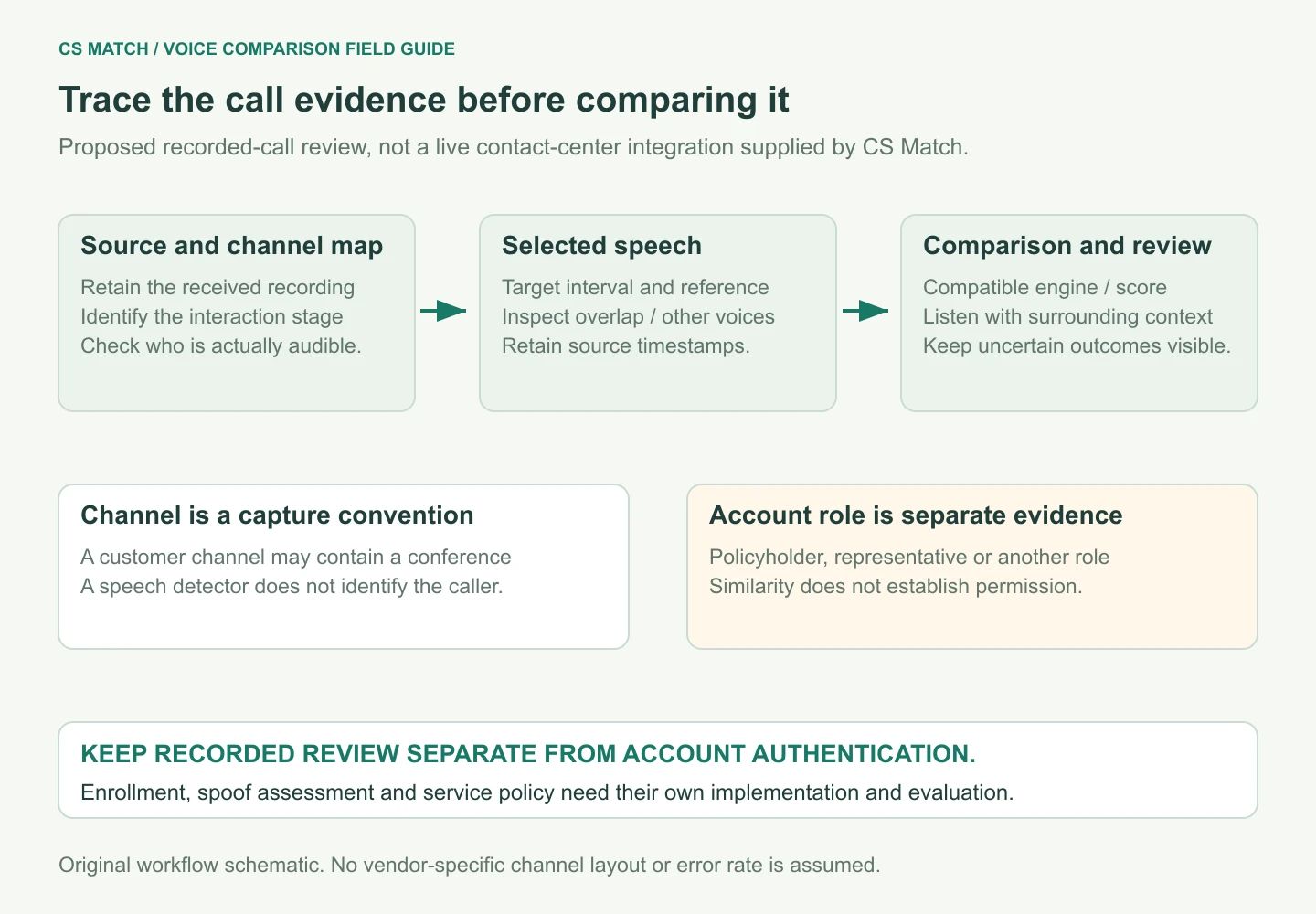
Some call systems preserve participants on separate channels, which can simplify selection. Amazon Connect documentation, for example, assigns customer audio to the right channel during automated interactions, but to the left during agent interactions; the latter may also contain conferenced third parties. That documented distinction shows why a channel name or position cannot be treated as a universal identity label.
Inspect the actual export and its interaction type. A transfer, conference, recording-policy change or mono export can alter what is available. A caller channel can contain a companion or interpreter, while an agent channel may include a transfer conversation. Preserve channel provenance when extracting a working sample, and listen to the selected interval rather than assuming that every speech event belongs to the intended person.
A mono analysis copy can be convenient for an encoder while hiding the original separation. Keep the source so another reviewer can check how the sample was selected. Our present worker prepares a mono working waveform; it does not automatically understand a call platform's participant-channel contract. Preparing a clear single-speaker reference is therefore a substantive review step, not a detail guaranteed by the upload format.
Speech activity is not the same as target-caller evidence
A speech detector can identify activity without knowing whether it came from the customer, agent, interpreter or a recorded announcement. A short interval may also contain overlapping voices. If that interval becomes the reference, the comparison may be anchored to a mixture or the wrong participant. Increasing the recording length does not automatically improve it when additional material introduces another voice.
In a practical review, inspect sustained single-speaker passages and retain their timestamps. Distinguish elapsed call duration from usable target speech. A ten-minute call with hold music and brief replies may contain less useful target material than a shorter uninterrupted explanation. Do not assign a universal minimum from that example; the selected model and recording conditions determine what is adequate.
Keep difficult inputs visible in evaluation. If the intended caller never speaks clearly enough, report insufficient material rather than repeatedly changing the sample until a favourable score appears. That outcome matters operationally: the application needs another review or service route. A benchmark that omits all such calls can describe conditional model behavior while understating the difficulty of the complete call workflow.
A profile must represent a person and a defined service relationship
For recorded review, a reference is an explicitly selected source whose label may still need confirmation. For account verification, enrollment adds a trusted binding between a profile and an account holder. The acoustic model cannot establish that binding by itself. A well-performing verifier can faithfully match a profile that was associated with the wrong person during enrollment.
Insurance and support interactions also involve legitimate representatives: policyholders, beneficiaries, brokers, guardians or authorized assistants. The same account can therefore be discussed by several permitted people. A different voice does not automatically imply an unauthorized interaction. Define the caller's role separately from the voice comparison, and do not collapse every service relationship into a single supposed account voice.
Profile updates need an equally clear rule. Material from an uncertain call should not silently replace a trusted reference merely because it matches the current threshold. Retain the selected model version and aggregation procedure, and define how a profile is withdrawn or corrected. These are application responsibilities; an embedding array does not contain the account history needed to resolve them.
Follow participant changes through the call lifecycle
A service call is not always a two-person conversation. An automated stage can precede an agent, a specialist can join, and a supervisor can take over. The relevant customer may leave while another person remains on the line. A single global participant count or one file-level score can hide these changes, especially when a short highly similar passage drives the summary.
Treat each stage as a source-selection problem. Record which intervals are being compared and what is known about the participants at those times. Diarization can help navigate changes, but its labels are local groups rather than verified personal identities. Speaker 1 in one export need not be Speaker 1 in another, and one participant may be split across several groups.
For a proposed live integration, define when a preliminary result may be used and when participant changes invalidate the collected evidence. For offline review, keep the surrounding conversation available so a reader can hear a handoff or interruption. Our current file report is suited to that inspection; it does not monitor a contact-center session or maintain a live account-authentication state across transfers.
What an insurer deployment report actually demonstrates
Pindrop's September 2025 account of an unnamed U.S. insurer describes combining Passport authentication with Pulse deepfake feedback. The reported workflow includes screening at enrollment and authentication, with flagged calls routed for fraud-team attention. This is a supplier-authored deployment description, not an independent public trial of all insurers or a measured result for our comparison pipeline.
The useful architectural lesson is that reference creation is itself a decision point. If unacceptable material becomes a trusted profile, later comparisons inherit that problem. That general principle does not establish that a particular detector catches every manipulation. Assess the actual capture, model, policy and review process, and keep claimed business savings separate from acoustic error measurements.
In a hypothetical claims review, similar voices across two recordings might justify examining the underlying sources. They do not establish a fabricated claim, common intent or a person's legal role. A reviewer needs the claim context and independently established facts. The same caution applies to a weak match: a difficult channel or unsuitable reference can explain it without demonstrating that a different person made the call.
Use speech content for navigation without turning it into identity
Support teams often need to find where a customer described a fault, accepted a proposed resolution or disputed an earlier explanation. Transcription and time-linked turns can make that review faster. Speaker comparison can answer a different question about resemblance to a reference. Neither capability guarantees that every word was recognized correctly or that a speaker label has been personally verified.
Review important wording against the recording, including negation, names and numbers. A transcript that misses one short word can reverse the apparent meaning of a response. Preserve the turn before and after a selected passage so readers can distinguish a customer's statement from an agent repeating it. A clear timestamp is more useful than an unsupported claim that a model understands the entire service event.
Avoid treating tone or vocal resemblance as a shortcut to credibility. This workflow does not measure honesty, contractual intent or customer satisfaction from the speaker embedding. If a separate text-analysis system supplies categories, keep their method and uncertainty distinct. Combining outputs in one dashboard should help inspect evidence, rather than conceal several different hypotheses behind one confidence label.
Evaluate spoof signals and service decisions separately
Replay or generated speech can resemble a trusted reference because resemblance and capture authenticity are separate questions. A call service considering spoof detection needs a dedicated countermeasure, its input contract and an evaluated operating policy. Prompted content may contribute interaction evidence, but correct wording alone does not certify a fresh human response or authenticate the intended account holder.
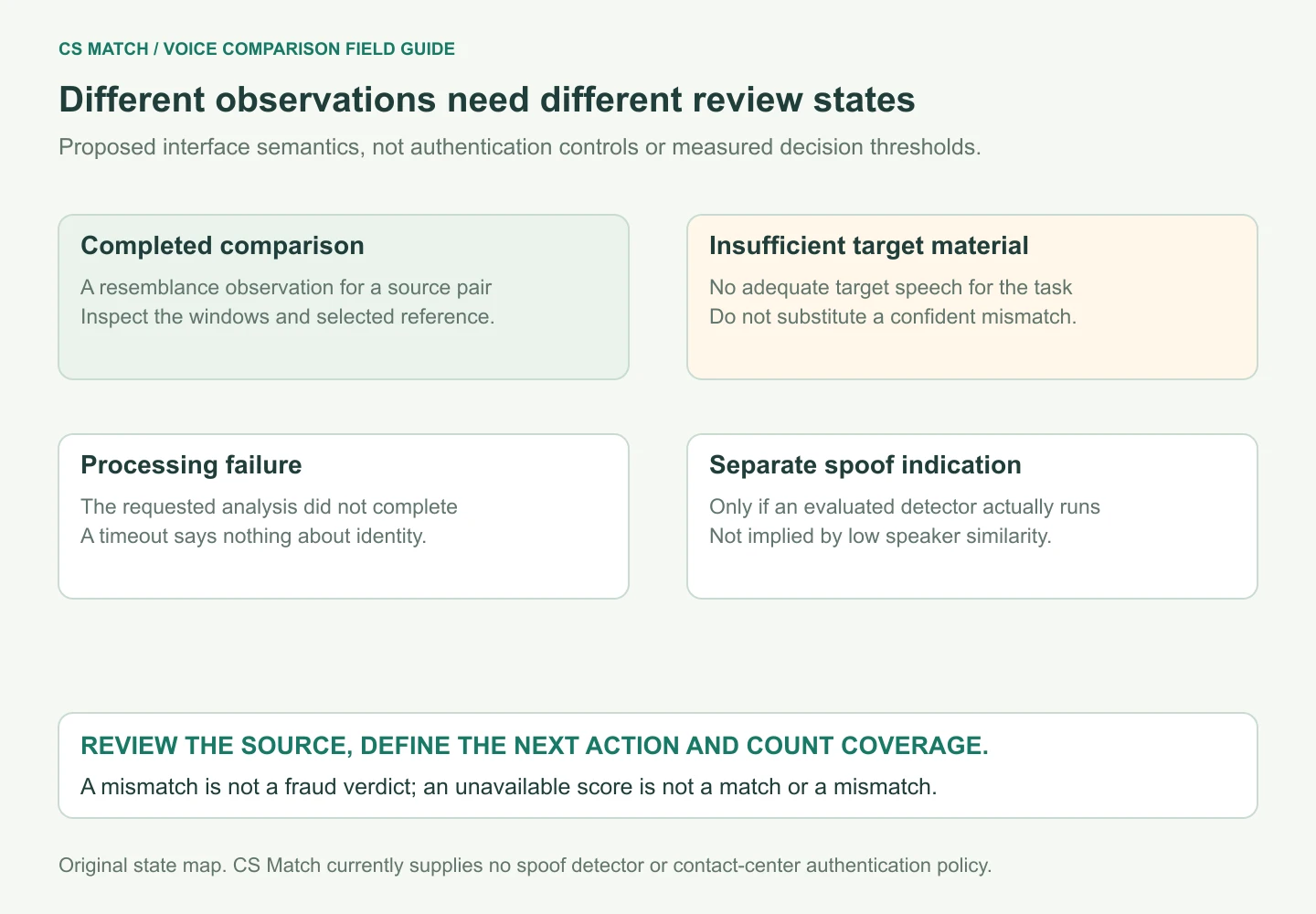
An alert should specify what was observed and what decision follows. Insufficient speech, speaker mismatch and a spoof-related indication should not all become the same red fraud label. Their causes and appropriate next steps differ. Evaluate how legitimate callers complete the service after an uncertain result, and record overrides so the measured system includes the workflow actually used by staff.
Applicable authentication requirements can also constrain the role. NIST SP 800-63B-4 prohibits voice biometric comparison within its authentication framework; this is not a worldwide ban on every support call. A component accuracy result cannot override a requirement that applies to the chosen service. Our current recorded comparison supplies neither a spoof detector nor that broader authentication workflow.
Design the review view around the source and the next action
An agent or reviewer needs to know which recording and interval produced the result, which reference was selected and whether the preferred engine ran successfully. A headline percentage without those details encourages overinterpretation. Show observations in language appropriate to the task, and provide a way to listen to the relevant material rather than making a colour alone carry the decision.
A proposed review view should separate a clear comparison result from insufficient evidence and processing failure. The diagram illustrates those outcomes without assigning measured thresholds or prescribing an authentication policy. A timeout cannot be interpreted as a mismatch, and a mismatch cannot establish spoofing. Keeping these states distinct makes troubleshooting and service recovery more understandable.
For recorded investigations within a support team, retain the reviewer note alongside the selected source location and run version. Avoid exporting just the favourable screenshot while losing contradictory passages. Such a review record is a proposed operating practice, not a feature automatically created by our present report. The product already provides source-linked inspection, while organizational case management remains a separate responsibility.
Measure service completion, errors and time to usable evidence
A pilot should evaluate independent sessions, relevant handsets and channels, interrupted calls, short replies, representative roles and expected conferences. Freeze the trial labels and decision policy before final testing. Report target misses and non-target acceptances at the actual call or service unit, plus any separately assessed spoof outcomes. A window-level result alone does not describe a call that searches many opportunities for a match.
Time to usable evidence includes capture and selection, not only encoder inference. Measure time to a first observation separately from completion of a long report. Count calls that cannot be processed or never provide enough appropriate speech. These outcomes affect workload and customer experience even if they are excluded from a narrowly defined conditional recognition error rate.
Operational measures such as handling time and successful completion can complement model metrics, but should not replace them. A shorter call can still contain a wrong decision, and a more cautious workflow can take longer while reducing a specific error. Compare paired outcomes on the same frozen material and document the service trade-off instead of reducing several objectives to one undifferentiated accuracy percentage.
Preserve the contract when products, profiles and recordings change
Product availability is part of an implementation decision. AWS states that support for Amazon Connect Customer Voice ID ended on May 20, 2026, after new-customer access stopped a year earlier. As checked in October 2026, older tutorials describing its deployment are therefore historical material. They should not be presented as instructions for starting a current supported service.
For any selected service or internal model, retain version provenance and evaluate migration effects. A familiar API field does not guarantee unchanged score distributions or profile compatibility. Plan how references are rebuilt, how unfinished tasks are handled and how a replacement is tested without turning the final evaluation set into another tuning resource. A published integration diagram is not a permanent availability guarantee.
Recording access, retention and permitted use also need an organizational policy appropriate to the actual service. An audio export, a derived embedding and a reviewer note can have different operational lifetimes, so define their relationships explicitly. This guide does not prescribe a universal retention period. The technical aim is to avoid orphaned profiles and unexplained results whose source or model revision can no longer be established.
Where our recorded-source workflow fits
CS Match currently compares user-supplied analysis and reference recordings, with speech windows, source-linked scores, transcription and speaker grouping for review. That is useful when a support or insurance team already has permitted access to the relevant files and wants to inspect a defined comparison. It does not supply live call ingestion, trusted account enrollment or a population watchlist.
The modular design makes the selection, representation and scoring stages easier to examine. It also keeps the limitations visible: a fallback acoustic descriptor is not interchangeable with a learned speaker embedding, and a score is not a calibrated identity probability. A reader can return to the underlying sound instead of depending on a final unexplained label. Those properties support review without claiming a complete service-authentication system.
Choose an enterprise integration when the requirement genuinely includes supported telephony, profiles and live policy execution, and evaluate that whole service. Choose recorded comparison when the task is inspecting existing material against an explicit reference. Our present design is reasonable for the latter purpose; stronger claims about accuracy, authentication or fraud prevention require separate evidence and additional implementation.
Questions about this workflow
Does the customer channel always contain one person?
No. Channel conventions depend on the platform and interaction type, and a customer channel can include conference participants or another nearby speaker. Inspect the source and selected interval.
Can a voice mismatch prove an insurance claim is fraudulent?
No. It is a scoped comparison observation that can be affected by reference quality and recording conditions. Claim facts, caller roles and any fraud assessment require separate evidence.
Can I start a new Amazon Connect Voice ID deployment from an older tutorial?
AWS states that the service became unavailable after May 20, 2026. Check current supported alternatives and their contracts rather than treating historical instructions as a live product offer.
Does CS Match integrate directly with a contact-center authentication flow?
The current workflow analyzes submitted recordings for review. It does not provide live call ingestion, account enrollment, spoof detection or an authentication decision service.
Continue with the next useful step
Voice Biometrics in Banking: Enrollment, Verification and Call-Center Authentication
Explore banking voice biometrics: trusted enrollment, one-to-one verification, call capture, fraud controls, replay and synthesis threats, standards, lifecycle and the limits of recorded-voice comparison.
Voice Biometrics Vendors: Products, Deployments and Evidence
Compare Pindrop, NiCE, Phonexia, Veridas and ValidSoft by documented task, integration, score meaning and evaluation evidence. Understand commercial voice platforms versus recorded-audio comparison.
Voice Comparison for Media, Archives and Recorded Investigations
Learn to review voices in interviews, broadcasts and archives: source preservation, timeline mapping, diarization, cross-recording links, reference selection, population evidence and reporting limits.