
Deploying Voice Comparison: CPU, GPU, Cloud and Data Lifecycle
Plan recorded-voice analysis across CPU, GPU and cloud deployments: stage costs, concurrency, precision, model caches, job failures, storage, retention and reproducible performance evaluation.
Sources checked · Cyber Search MatchDeploy voice comparison as a complete recording workflow, not an isolated encoder benchmark. Decoding, speech selection, embedding extraction, transcription, reporting and file handling all consume resources. CPU and GPU choices should follow measured workload and quality requirements; cloud hosting changes operational responsibilities rather than the recognition hypothesis. This guide explains the deployment trade-offs, distinguishes current CPU execution from possible extensions, and traces the different lifetimes of source audio, temporary work and reports.
Measure the stages that produce the report
A user waits for more than a speaker embedding. The service accepts and validates sources, decodes a working waveform, identifies speech, extracts representations, compares windows, generates text and writes review artefacts. Some stages scale with elapsed recording duration, others with detected speech or output size. Timing only the encoder omits substantial parts of the task and can misidentify the resource worth optimizing.
Start with stage-level measurements on representative recordings. Record source duration, speech proportion, channel count and whether transcription is enabled. Distinguish the analysis and reference inputs: both require preparation, while the analysis may be much longer. A workload dominated by silent recordings can behave differently from continuous speech even when uploaded file sizes are similar.
Measure latency and throughput separately. A configuration completing many jobs per hour can still make a single short request wait behind long work. Include time waiting for capacity, model initialization and report writing. The schematic separates those contributions without assigning invented timing numbers. Optimization should target the measured bottleneck while preserving the evidence and quality the application requires.
report latency = waiting + initialization + processing + outputprocessing includes decoding, VAD, embeddings, ASR and report work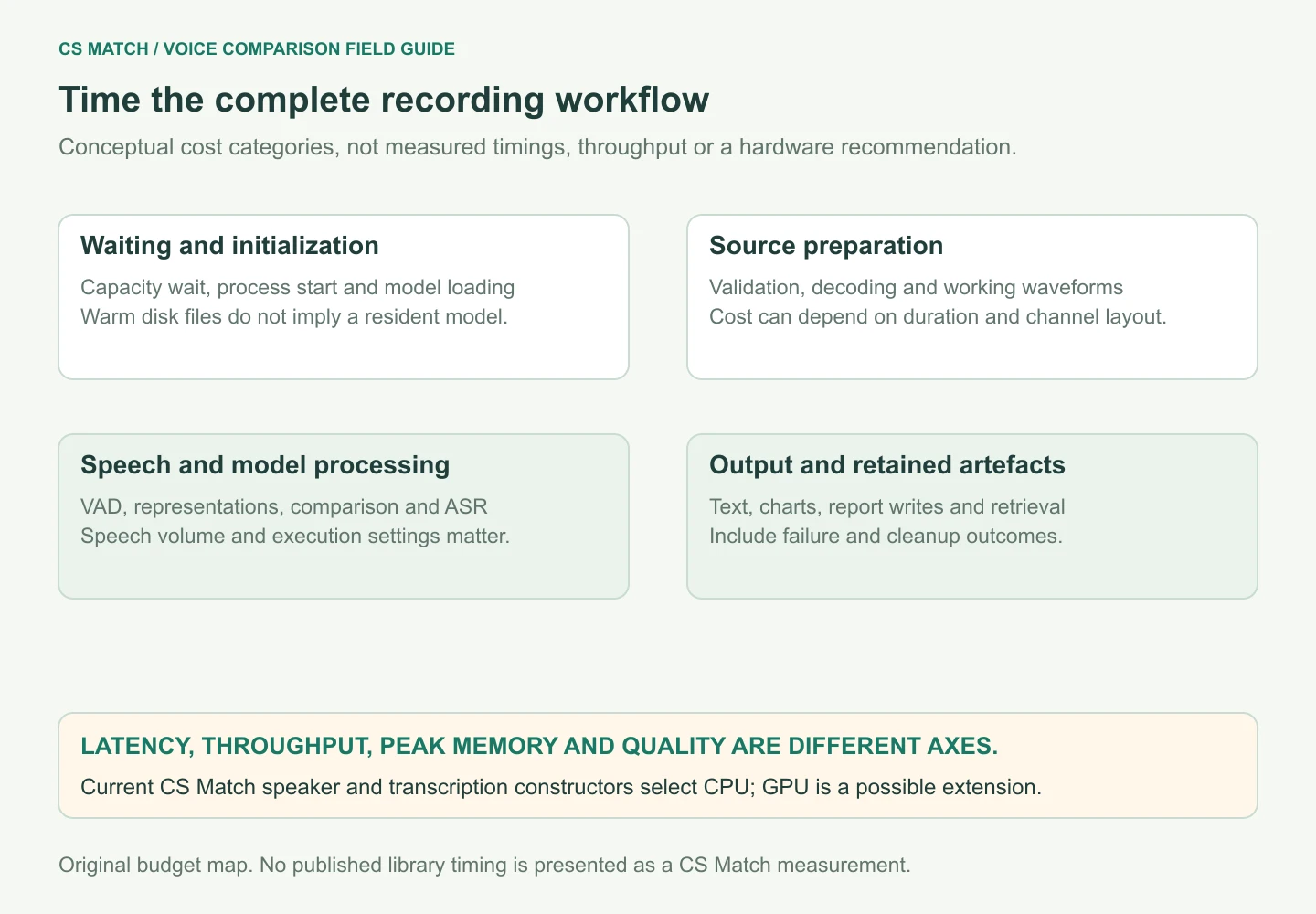
CPU deployment needs a coordinated thread and process budget
CPU inference is a practical option for workloads that fit the available processing budget. The relevant capacity depends on model size, speech volume, decoder settings and concurrent work, not merely the advertised core count. Several processes can each initialize their own models and numerical thread pools, so increasing process count can also increase memory pressure and scheduling contention.
CTranslate2's performance guidance discusses quantization, batching and CPU thread coordination, including avoiding a thread product larger than the physical-core budget in its execution model. That is library guidance rather than a universal worker count for our application. Count other stages and services competing for the same host before choosing how many jobs to run simultaneously.
Our inspected runner supplies configurable thread limits to common numerical runtimes, and the current speaker and transcription constructors explicitly select CPU execution. These controls do not establish a published throughput figure or prove that every dependency uses the same pool. Test under representative concurrency, watching completed work, latency and peak memory together instead of treating full CPU utilization as success by itself.
A GPU helps only when the relevant stage actually uses it
The SpeechBrain checkpoint documentation describes GPU inference, and faster-whisper documents CPU and GPU configurations. Library support establishes a possible execution route, not an existing application feature. Our current worker selects CPU in both model constructors. Adding a GPU to the host would therefore not automatically move those calls onto it or remove CPU-bound decoding and reporting work.
A proposed GPU path needs compatible runtime libraries, sufficient device memory and an explicit scheduling policy. Batching can improve throughput while using more memory or delaying an individual request until suitable work is available. Measure the complete recording workflow, including transfer and initialization, rather than infer a benefit from a large batch benchmark unrelated to the expected request pattern.
Compare alternatives on identical sources and output requirements. A faster transcription stage may have little effect when another stage dominates; a larger model may improve one quality measure while reducing capacity. Treat device migration as a controlled implementation change with rollback and quality checks. This article describes that decision process, not a claim that a GPU-enabled CS Match audio release is already deployed.
Precision and quantization are part of the evaluated configuration
Quantization can reduce storage or change inference cost, but the chosen numerical format must be supported by the execution backend. CTranslate2 distinguishes conversion-time quantization from runtime compute type and documents implicit conversions on load. A file stored with one format is therefore insufficient evidence of the arithmetic actually used on a particular device.
The current transcription path defaults to a configurable small model and INT8 compute on CPU. That does not mean the speaker encoder uses the same precision or that every processing stage is quantized. Retain separate model and compute settings for each component. A deployment description saying only INT8 or GPU hides important differences between transcription, speaker scoring and auxiliary processing.
Evaluate quality alongside resource changes. Check transcription errors and time alignment, and assess speaker-score behavior if its own representation path changes. Do not assume that a rounded similarity display proves numerical equivalence between implementations. Preserve a frozen source set and compare outputs before accepting a precision change, including difficult channels and short speech where small changes may affect a thresholded result.
Separate downloaded caches from live model residency
A downloaded checkpoint cache avoids fetching the same artefacts repeatedly, while a live model object avoids reconstructing and loading the model within its process. These are different resources with different lifetimes. A warm disk cache can still leave initialization cost at every process start, and several worker processes can retain separate model copies despite sharing the same files.
Hugging Face documents version-aware downloads and revision selection. For reproducibility, identify the actual model revision and dependencies rather than relying only on a repository name. A deployment can prepare approved artefacts before accepting work and check that the runtime can read them. That is an operational design option, not a claim that every current CS Match model source is pinned to an immutable revision.
Our Python module caches classifier and transcription objects within a process, while the runner launches a process for each job. Those object caches therefore do not create a persistent model server across jobs. Measure cold initialization separately from later windows in the same job. A persistent-worker redesign might change that cost, but would also need memory, concurrency and recovery evaluation before being described as an improvement.
Treat failed, interrupted and repeated work as deployment cases
A recording job can fail during validation, model loading, inference or output writing. The application should preserve enough state to distinguish those outcomes from a completed low-similarity result. Progress is useful for navigation and diagnosis, but a progress percentage is not evidence that every preceding artefact is complete, valid or safe to reuse after interruption.
The current runner communicates progress and final structured output from a child process and applies a configurable timeout. The surrounding application updates job state and performs temporary-file cleanup. Those inspected mechanisms should not be expanded into an unsupported claim of an automatically resumable distributed audio queue. A restart or cancellation needs its own verified behavior under the actual deployment.
For a proposed retry policy, define which inputs and model revision remain fixed, which partial outputs can be reused and how duplicate requests are recognized. Avoid confusing a second run with independent confirmation of a speaker relationship. Test representative failures and stale work alongside successful jobs, and measure usable completion rather than counting every process launch as productive throughput.
Local, self-hosted cloud and external APIs move responsibilities
Running a model on a local workstation, hosting the same code on a cloud instance and submitting audio to an external inference API are different integration boundaries. The first two can use the same representation while differing in capacity and operations. The third introduces another input, output and data-handling contract. None of these labels determines recognition accuracy by itself.
Define where decoding, model execution and report storage occur, and which systems receive source audio or derived vectors. Upload time and result retrieval belong in latency when they are part of the user workflow. A cloud GPU can be idle between jobs while still affecting cost; a small CPU host can be economical until queueing or competing workloads dominate. Compare the actual workload rather than generic instance categories.
If an external service replaces a component, retain its version, score meaning and failure semantics. A vendor response may not expose the windows or provenance expected by a recorded-review interface. Evaluate the replacement contract as well as its numerical output. Our current architecture is an application-managed processing path, not a promise that all deployments run on the user's device or that no network activity ever occurs.
Source audio, scratch files and reports have different lifetimes
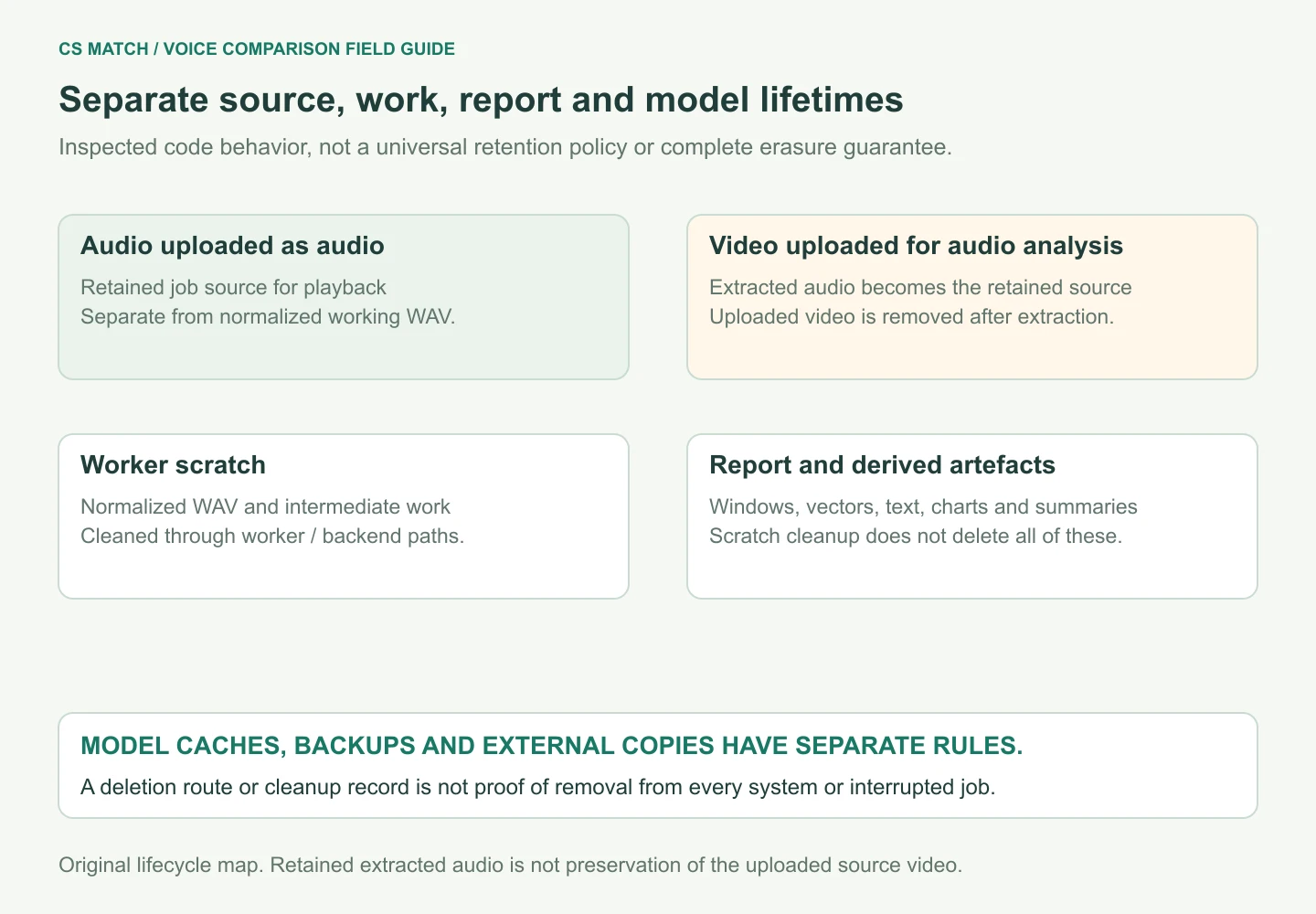
The inspected worker retains uploaded audio sources for playback while deleting normalized working files after processing. The upload path for video extracts an audio track and removes the uploaded video file after successful extraction. Consequently, retaining audio in the job does not mean retaining the original video or preserving every original channel. A media-review project needing that original must manage its own source copy.
Reports and derived artefacts can include transcripts, windows, embeddings and charts, so scratch cleanup is not complete data deletion. The application has a terminal-job deletion route that removes the job record and attempts storage cleanup. This describes the code path, not a guarantee of immediate erasure from every backup, log or external copy. Deployment policy must account for the actual storage systems involved.
Document retention and access separately from recognition behavior. An embedding is a derived representation, not an inherently anonymous substitute for a voice recording. Keep the relationship between sources, results and account access understandable, and avoid claiming a universal retention period from a temporary-file rule. The lifecycle diagram shows the inspected distinctions without promising capabilities beyond the current processing path.
Use transparent storage arithmetic before estimating capacity
For an uncompressed mono 16-bit waveform at 16 kHz, the sample payload is 32,000 bytes per second. One minute is therefore 1.92 decimal megabytes, and thirty minutes is 57.6. These are exact format calculations excluding headers and metadata, not measured RAM usage or a published resource requirement for the application. Two such thirty-minute working files contain 115.2 megabytes of sample payload.
Peak memory can be much larger because decoding arrays, model weights, intermediate tensors and outputs have their own representations. Source compression changes upload size without proportionally changing the decoded waveform. Likewise, two concurrent jobs can each allocate models and buffers. Estimate the full working set from measurements rather than treating the PCM calculation as a safe memory limit.
Storage planning also needs retained sources, reports, model caches and failed-job residue. Track those categories separately so a rising cache does not look like unexplained user data and a growing report store is not mistaken for temporary scratch. Use representative jobs to establish peak disk demand during processing as well as retained size afterward. An average compressed file size alone cannot describe either peak.
PCM bytes = sample rate × channels × bytes per sample × seconds16,000 × 1 × 2 = 32,000 bytes per second30-minute sample payload = 57,600,000 bytes (57.6 MB)| Invented format example | Sample payload only | Not included |
|---|---|---|
| One minute, mono 16 kHz / 16 bit | 1.92 decimal MB | Headers, models, arrays and reports |
| Thirty minutes, same format | 57.6 decimal MB | Source upload and processing buffers |
| Two thirty-minute working files | 115.2 decimal MB | Concurrent models and retained artefacts |
Observe the actual engine as well as processing time
A fast completed task is not necessarily the intended model running successfully. The current implementation can fall back from the preferred VAD or speaker representation to simpler methods. Track which engine actually produced each result. A deployment test that reports only completion and duration can reward an unavailable dependency because a cheaper fallback returns a number sooner.
Measure source rejection, insufficient speech, transcription availability, fallback frequency and output completion alongside latency and memory. Keep these observations tied to model and application revisions. Avoid storing unnecessary raw audio in operational logs merely to diagnose timing; stage identifiers and appropriate structured metadata can often describe a processing failure without duplicating the source itself.
Define alerts around useful symptoms rather than a single utilization target. Rising wait time, repeated initialization failures or shrinking usable coverage can matter before CPU or GPU utilization looks unusual. Compare representative workloads after an update and preserve rollback evidence. Recognition quality and operational health are connected, but neither can be reduced to the other without losing important failure cases.
Version the model, preparation and score policy together
A reproducible run needs more than the application release name. Retain model source and revision, input preparation, windowing, aggregation, scoring and thresholds, plus runtime settings that can affect output. A newer library may change loading, decoding or defaults without changing the user-facing feature name. Recheck the complete contract instead of assuming that familiar labels guarantee identical behavior.
Review licences at the component and checkpoint level separately from the permissions associated with source recordings and evaluation data. An available download is not evidence that every surrounding use or dataset is unrestricted. For a replacement checkpoint, establish compatibility and its applicable terms before comparing performance. This is a deployment responsibility rather than a licence certification supplied by this guide.
A release should make it possible to reproduce the earlier configuration and restore it when necessary. Retain compatible source and result versions rather than mixing old reference vectors with new encoder coordinates. Equal vector length does not establish compatibility. Document which changes require reference rebuilding or threshold reevaluation, and keep a completed report associated with the configuration that actually produced it.
Choose deployment changes from matched quality and workload evidence
Compare candidate deployments on a frozen set of recording pairs and a realistic request pattern. Preserve sources, required outputs and decision policy, while recording device, threads, precision and initialization conditions. Assess speaker errors and transcript quality where relevant, plus latency, throughput, peak memory and usable completion. Keep cold-start and warmed execution results distinct.
Published library benchmarks can show a promising direction, but their hardware, batch size and decoding settings may not match the application. Do not turn them into a CS Match speed or cost claim. Include complete-job behavior when judging a GPU, persistent workers or another model. A component improvement is valuable only if its operational and interpretive trade-offs fit the actual task.
For the present recorded-source workflow, a bounded CPU path with inspectable intermediate results is a reasonable baseline. Adopt a more complex execution design when matched evidence justifies it, not merely because the hardware is fashionable. The next article describes what our implementation actually does, including its fallbacks and limits, so the deployment rationale remains anchored to verifiable behavior rather than an invented performance advantage.
Questions about this workflow
Will adding a GPU automatically accelerate the current audio worker?
No. The inspected speaker and transcription constructors explicitly use CPU. GPU support in the libraries would require an application change and complete quality and workload evaluation.
Does a shared model download cache mean models stay loaded between jobs?
No. Disk artefacts and in-process objects have different lifetimes. The current runner starts a child process per job, so its Python object caches do not persist as a model server across jobs.
Does deleting temporary WAV data remove every copy of a recording?
No. Source playback audio, reports and derived artefacts have separate lifetimes. Backups and other copies also need their own policy; scratch cleanup alone is not complete deletion.
How much RAM does thirty minutes of audio require?
Its mono 16 kHz / 16-bit sample payload is 57.6 decimal MB, but that is not peak RAM. Models, arrays, intermediate tensors and concurrent work add substantial workload-dependent memory.
Continue with the next useful step
Why CS Match Uses ECAPA-TDNN, Silero VAD and faster-whisper
Inspect the actual CS Match audio architecture: source preparation, quality gates, Silero speech windows, ECAPA reference scoring, clustering, faster-whisper transcription, reports, cleanup and fallback limits.
Training and Evaluating Voice Comparison on Real Recordings
Build a reproducible speaker-comparison study: source labels, speaker and session splits, trial conditions, baseline checkpoints, adaptation, calibration, full-recording evaluation and uncertainty.
Voice Biometrics Vendors: Products, Deployments and Evidence
Compare Pindrop, NiCE, Phonexia, Veridas and ValidSoft by documented task, integration, score meaning and evaluation evidence. Understand commercial voice platforms versus recorded-audio comparison.