
Why CS Match Uses ECAPA-TDNN, Silero VAD and faster-whisper
Inspect the actual CS Match audio architecture: source preparation, quality gates, Silero speech windows, ECAPA reference scoring, clustering, faster-whisper transcription, reports, cleanup and fallback limits.
Sources checked · Cyber Search MatchCS Match combines separate components for speech selection, speaker resemblance and transcription because they answer different questions. The inspected implementation prepares two recordings, builds speech-window representations, compares analysis windows with a reference profile and provides source-linked review context. ECAPA-TDNN, Silero VAD and faster-whisper form a practical modular baseline, not a complete identity or authenticity system. This article describes the current code path and explains its choices, fallbacks and unmeasured boundaries.
The task is comparing submitted recordings against an explicit reference
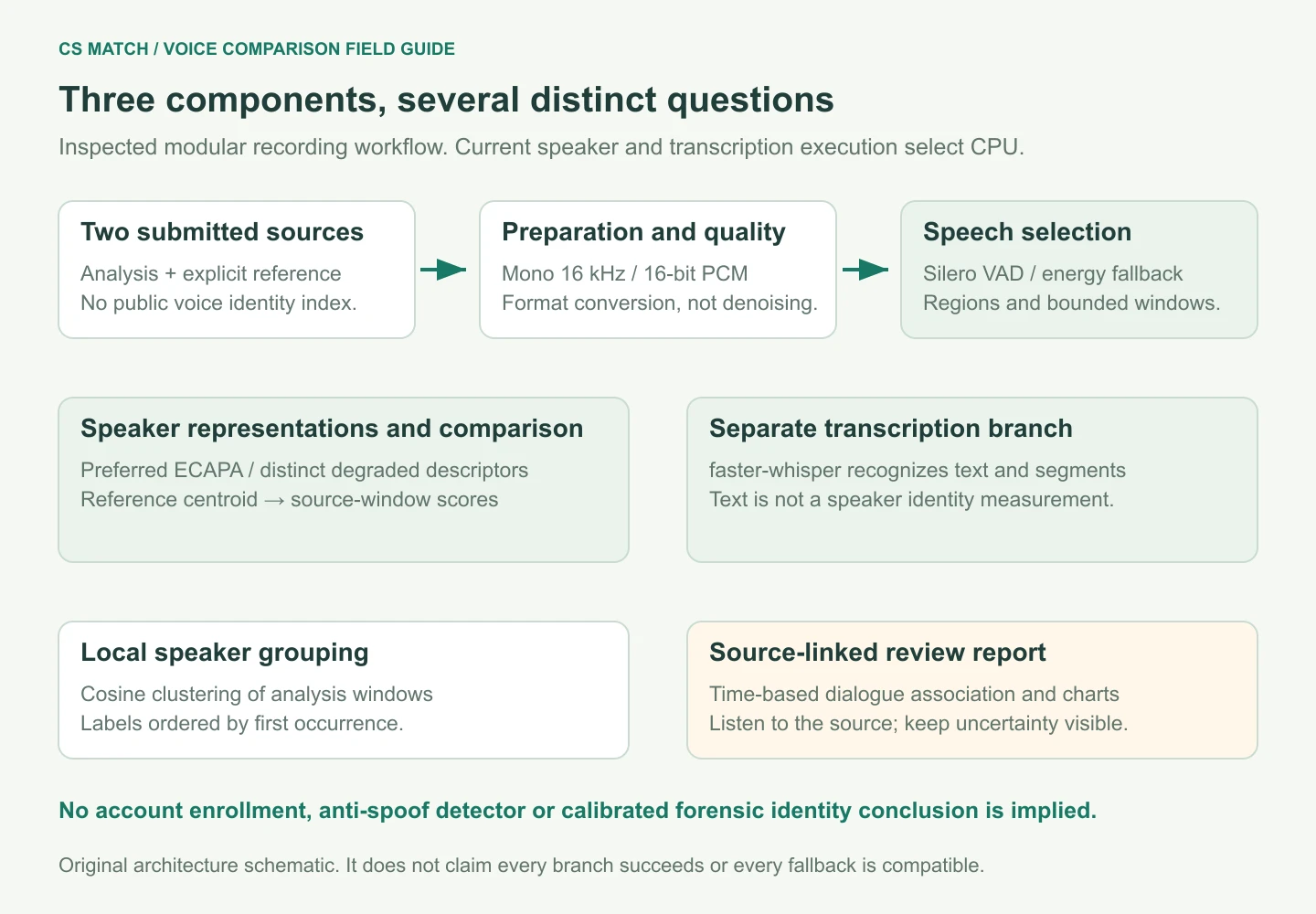
The current workflow receives an analysis source and a reference source. It asks where analysis speech resembles the supplied reference under the configured processing path. It does not search a public voice identity database or establish the reference speaker's name. This narrower task determines the architecture: reviewable intervals and a traceable comparison are more useful than an unexplained final identity label.
The implementation keeps several outputs separate. Speech activity describes where speech was detected; speaker comparison supplies resemblance scores; diarization groups related windows; transcription describes recognized words. A single report can present them together without making their hypotheses interchangeable. For example, correctly transcribing a name does not authenticate the person who spoke it, and a speaker group is not a personally verified account.
The architecture diagram reflects inspected stages rather than a proposed production redesign. It includes separate text and comparison outputs and retains the source for listening. This makes a modular design sensible for existing recordings whose content and capture conditions vary. Claims of superior recognition, forensic identity or live authentication would require evidence and implementation beyond this task definition.
Preparation standardizes the working format, not the recording conditions
The worker decodes both inputs to mono 16 kHz, 16-bit PCM working WAV files. That provides a consistent input format for later analysis. The normalization function does not perform loudness normalization, denoising or restoration of lost bandwidth. A standardized sample rate cannot make a telephone recording equivalent to a studio microphone or recover detail removed by earlier compression.
Quality processing audits properties such as duration, level-related measurements and detected speech, with configurable acceptance gates. A rejected or insufficient sample needs its own interpretation rather than a low speaker-match label. The source and reference have different roles, so a useful reference must contain appropriate target speech even when the longer analysis includes pauses or other participants.
Audio sources remain available for playback while normalized WAV files are working scratch. For a video upload, the storage path retains extracted audio and removes the uploaded video after extraction. Readers needing the original video or its external timeline should keep it independently. This is an audio-review workflow, not a preservation archive that guarantees retention of every original container and channel.
Silero selects speech before the speaker representation is computed
Silero VAD provides a pretrained speech-activity component with documented audio input and timestamp functions. Our worker uses it to obtain speech intervals for each source. The useful property is a separable speech-selection stage, not a guarantee that every detected interval belongs to the intended person. A detector can find an agent, another participant or overlapping speech as well as the desired reference voice.
The code merges nearby speech regions and divides them into bounded windows, with configurable settings. Current defaults use a two-second minimum, five-second maximum, half-second overlap and a 0.35-second region merge gap. Short regions can receive surrounding context, so a window boundary is not always a precise utterance boundary or a promise of uncontaminated single-speaker speech.
If Silero cannot run, the implementation can use an energy-based fallback and records the engine. That fallback uses level information rather than the same learned speech detector, so its selection behavior must be assessed separately. VAD quality affects everything downstream: missing target speech or including an interfering voice changes the material represented by the speaker encoder before any similarity threshold is applied.
ECAPA is the preferred representation, not the identity decision
The preferred speaker path loads SpeechBrain's configurable ECAPA checkpoint, defaulting to spkrec-ecapa-voxceleb, and extracts vectors with its encoder. The checkpoint card describes training on VoxCeleb material and an input contract for single-channel 16 kHz speech. Its published benchmark concerns a specified dataset; we do not present that result as a measured error rate for our users' recordings.
The ECAPA paper develops channel attention, propagation and aggregation within a speaker-verification architecture. These mechanisms concern feature representation, not an application account policy. Our worker normalizes each extracted vector before later aggregation and cosine comparison. It uses the representation component rather than importing the checkpoint's example binary verification decision as a universal rule for long-recording review.
This choice gives us a documented pretrained baseline and a replaceable stage. It avoids training an identity model from the user's reference sample, which serves a different role. ECAPA is not established here as universally better than residual encoders, self-supervised alternatives or commercial systems. A replacement needs matched trials, compatible reference handling and processing-cost evidence before a stronger comparative claim is justified.
The reference becomes a normalized mean profile
The implementation extracts representations for the reference windows, calculates their coordinate-wise mean and normalizes the resulting centroid. Analysis windows are primarily scored against that centroid. It also records the best comparison with an individual reference window separately. The latter is additional context; it is not the primary score silently substituted whenever it looks more favourable.
A profile can be affected by every source window that contributes to it. Mixed speakers, poor capture or unrepresentative speech can change its direction. More reference duration is therefore not automatically better. Inspect the source and window selection rather than assuming that averaging repairs contamination. The current arithmetic is a simple aggregation rule, not a trained enrollment service or a robust guarantee against an incorrectly labelled reference.
The report also records profile-related summaries, but they should remain technical descriptions of this computation. Consistency among reference windows is not proof of personal identity, and a contaminated reference can produce a repeatable result. Retain the model and aggregation rule when comparing runs, since replacing either can change the relationship between the same analysis recording and its derived reference profile.
reference mean = mean of the selected window vectorsreference profile = reference mean / its L2 normprimary window score = cosine(analysis vector, reference profile)Scores describe selected windows, with separate summary and range rules
Each analysis window receives its centroid comparison and a technical bucket. The current configurable default boundaries are 0.82, 0.68 and 0.52; the default match threshold follows the possible-similarity boundary. These are implementation settings, not calibrated identity probabilities or independent estimates of false acceptance. A different source domain needs its own evaluation rather than a borrowed interpretation of the label.
The summary includes the best window score and the median of up to the five highest scores. Matched windows are merged under a separate gap rule, producing inspectable source ranges. A high maximum can represent one short opportunity in a long recording, while the top-window median also describes selected material. Neither statistic automatically characterizes every speaker or every second in the file.
Matched duration and estimated matched-speech coverage answer different questions, especially when windows overlap or merged ranges bridge short gaps. Review the contributing intervals and source context before reading a headline. Our metrics guide explains how a long-file search should be evaluated at its actual unit; the current report does not publish calibrated FAR, FRR or a posterior identity probability.
Fallback descriptors are different representations with different evidence
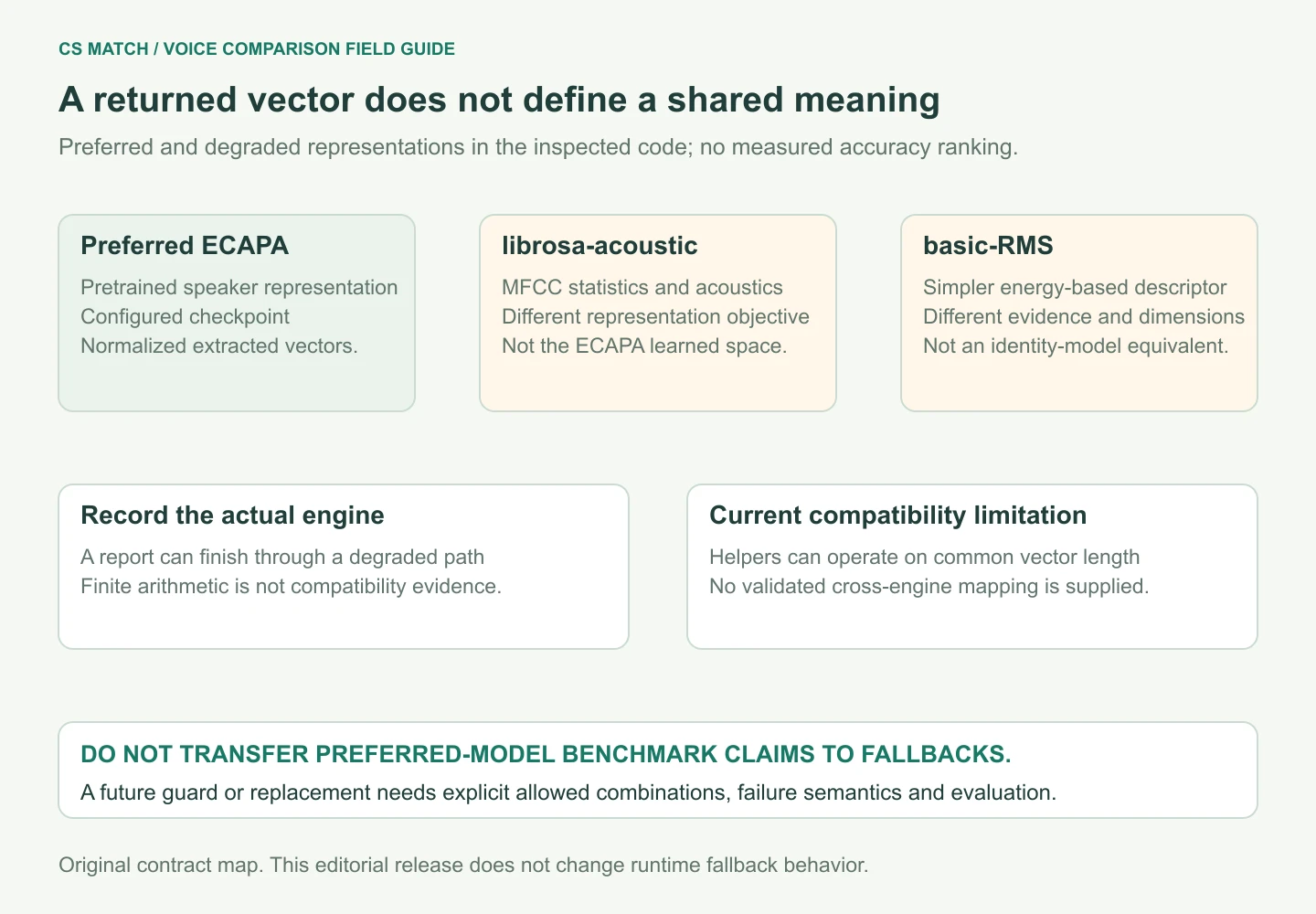
When preferred speaker extraction fails, the code can use a librosa-based descriptor combining MFCC statistics and other acoustic measurements, with an even simpler RMS-based fallback available. These can help diagnose or continue a degraded processing path, but they were not trained as the same identity-oriented embedding. A numeric cosine still being available does not preserve ECAPA's benchmark meaning.
The current vector helpers do not establish cross-engine compatibility: their coordinate arithmetic can use the common available length rather than enforce a shared learned space. That is an important limitation, not a validated mapping between models. Inspect actual engine provenance and do not interpret mixed or fallback results as equivalent to successful preferred-model comparisons. This article documents the behavior; it does not introduce a new compatibility guard.
The diagram distinguishes preferred and degraded paths without ranking their measured accuracy. Any future change should explicitly define allowed combinations, failure outcomes and evaluation. A completed report can therefore need further review even when its arithmetic is finite. Reliable interpretation requires the source, engine and score contract together, rather than treating interface continuity as proof that the intended model ran successfully.
Speaker groups come from window clustering, not personal naming
The analysis windows also feed custom cosine-based clustering. A requested speaker count constrains that grouping; Auto evaluates candidate counts up to a bounded maximum using a penalized silhouette-based selection procedure. These are local organization rules for the submitted analysis recording. They do not create a voice-identity register or establish how many people actually participated under every difficult acoustic condition.
Clusters are labelled in order of their first windows, making Speaker 1 an ordering label rather than a name. Adjacent compatible windows can become speaker ranges. Overlap, short turns and channel changes remain difficult because a window can contain more than one speaker or one person can vary across passages. A fixed count can force a grouping even when the supplied assumption does not fit the source.
This implementation should not be described as an installed pyannote pipeline or an end-to-end overlap-aware diarizer. Those are alternative designs requiring their own integration and evaluation. Current grouping provides useful navigation alongside source listening, while cross-recording linking and personal attribution remain separate tasks. Review group boundaries and the sound before treating a transcript label as a verified participant relationship.
faster-whisper supplies text through a separate model path
The worker uses faster-whisper for transcription, with configurable model and decoding settings; the inspected defaults select the small model, INT8 compute and CPU. The library runs Whisper-family transcription through CTranslate2 and documents multiple execution options. Its role here is recognized text and time-linked segments, not the production of the ECAPA speaker representation or a direct personal-identity decision.
Transcript segments are associated with speaker windows using temporal overlap, with a nearest-window fallback where applicable, and same-label material can be merged into dialogue turns. This is a practical alignment rule rather than a jointly trained guarantee of correct words and correct speakers. A mistake around a short interruption can affect the displayed turn even when the broader transcript is readable.
Keep language behavior and engine availability visible. A configurable application language list does not establish equal accuracy for every language supported by an upstream model, and an unavailable transcription branch should not be confused with a completed text analysis. The report supports listening and correction by the reader; it does not validate a passphrase response or infer contractual intent from the recognized wording.
Reports preserve review context while scratch is cleaned separately
The worker writes structured artefacts for quality, speech windows, embeddings, similarity, diarization, transcripts, dialogue and acoustic features, then renders charts and a combined report. These outputs help explain which material produced a resemblance observation. Acoustic energy or a mel-spectrogram is descriptive context, not an additional independently validated identity test to multiply into a confidence percentage.
Normal completion and handled failures perform worker-scratch cleanup, with backend cleanup providing another recorded step. Playback audio and report artefacts have different lifetimes from that scratch. A forced termination or storage error still needs operational verification, so cleanup metadata should not be presented as a guarantee that every possible interrupted job or backup has already been erased.
This distinction supports source inspection without confusing processing hygiene with preservation or deletion policy. The current job-deletion path attempts removal of job storage after deleting an eligible record, but external copies need separate treatment. The architecture article describes those mechanisms so users understand what a report represents; it does not claim an immutable evidence archive, complete erasure certification or automatic archival chain of custody.
Evaluate an alternative at the stage it would replace
A different speaker checkpoint can replace the representation stage only after preparation, reference aggregation and scoring are made compatible. A dedicated diarizer changes speaker grouping rather than automatically improving reference matching. A transcription alternative changes text output and runtime. Commercial authentication platforms add different surrounding workflows, so comparing them with one local encoder as if they were identical products is uninformative.
A fair trial freezes source pairs, labels and decision units, then measures the candidate's quality and processing cost. Include degraded operation and insufficient inputs, not only clean cases where the preferred model loaded. For long files, evaluate the actual window-selection and summary procedure. A better short-utterance research result may be useful motivation, but it is not a measured improvement for our complete report.
The benefit of the current modular design is that these changes can be assessed explicitly. It does not prove that every present default is optimal or that the implementation is immune to reference contamination and channel mismatch. Keep the measured result bounded by its protocol and make future changes when evidence supports the task, instead of treating a familiar model name as a permanent quality guarantee.
Why this combination is a reasonable baseline for recorded review
Silero separates speech selection from later interpretation; ECAPA provides a documented pretrained speaker representation; faster-whisper supplies text for navigation through a distinct branch. Source-linked windows and explicit intermediate artefacts make the result inspectable. Together, these choices fit comparison of existing recordings whose wording can differ, without requiring a new account-enrollment interaction or a phrase-specific training procedure.
The inspected implementation remains CPU-based and has meaningful fallback and compatibility limitations. It has no dedicated anti-spoof detector, calibrated forensic likelihood-ratio backend, public voice search or transaction-authorization policy. Those are separate capabilities to evaluate, not hidden benefits of combining three libraries. Its rationale is task fit and modular review, with quality claims limited to evidence actually obtained.
Use the report to inspect the submitted sources, selected reference and relevant passages, and retain uncertainty where the material does not support a stronger conclusion. Future improvements can target a measured bottleneck or error condition while preserving that transparency. This completes the field guide's progression from representations and training to applications and deployment, anchored to the current code rather than an unsupported claim of universal superiority.
Questions about this workflow
Does the reference recording train a new ECAPA model?
No. The current path extracts pretrained representations, builds a normalized mean reference profile and compares analysis windows with it. The reference is not a new speaker-model training dataset.
Does faster-whisper identify the speaker?
Its role is transcription. Speaker grouping and reference resemblance use separate processing, and transcript turns are associated with groups through time-based rules rather than verified personal identity.
Are fallback similarity scores equivalent to ECAPA results?
No. Acoustic and RMS descriptors have different meanings, and the current helpers do not establish cross-engine coordinate compatibility. Inspect engine provenance rather than importing preferred-model accuracy claims.
Why choose this stack instead of claiming the most accurate system?
It provides a documented, modular baseline for reviewing existing recordings. Universal superiority would require comparable measurements; current outputs and limitations remain explicit.
Continue with the next useful step
How Voice Comparison Works: From Recording to Reference Match
Follow the complete voice-comparison pipeline: source preparation, speech detection, windows, speaker embeddings, reference profiles, similarity scoring and source-linked review, with the current CS Match implementation explained.
Deploying Voice Comparison: CPU, GPU, Cloud and Data Lifecycle
Plan recorded-voice analysis across CPU, GPU and cloud deployments: stage costs, concurrency, precision, model caches, job failures, storage, retention and reproducible performance evaluation.
Training and Evaluating Voice Comparison on Real Recordings
Build a reproducible speaker-comparison study: source labels, speaker and session splits, trial conditions, baseline checkpoints, adaptation, calibration, full-recording evaluation and uncertainty.