
Voice Biometrics Vendors: Products, Deployments and Evidence
Compare Pindrop, NiCE, Phonexia, Veridas and ValidSoft by documented task, integration, score meaning and evaluation evidence. Understand commercial voice platforms versus recorded-audio comparison.
Sources checked · Cyber Search MatchVoice-biometric suppliers offer different combinations of speaker verification, contact-center integration, fraud signals and spoof detection. Comparing them requires a common task and a versioned product contract, not a league table assembled from marketing accuracy percentages. This guide examines five suppliers through primary documentation checked in October 2026, explains what that documentation establishes, and defines a fair way to evaluate a commercial service alongside a modular recorded-audio workflow.
Compare the task before comparing the supplier
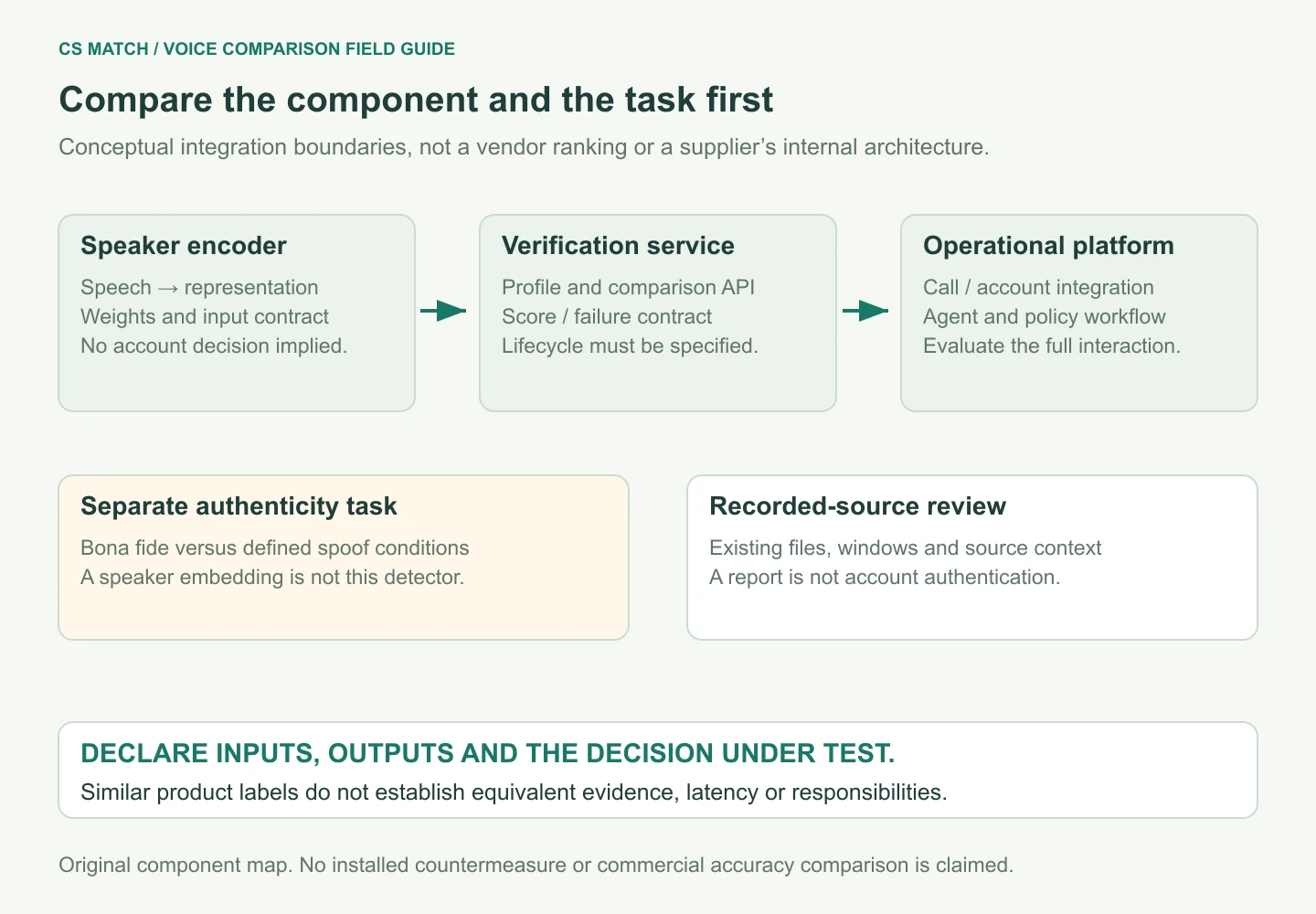
A speaker encoder maps speech into a representation. A verification service may add profile enrollment, scoring and management. A contact-center platform can also connect calls, accounts, agent tools and service policies. Those are different deliverables. A library with excellent published speaker results does not automatically replace the surrounding operational system, and a broad platform description does not reveal the quality of its encoder.
Start with a concrete transaction between components. Does the application submit two files, stream a live call, provide an enrolled profile identifier or request a fraud assessment? What outcome is expected: a similarity value, a candidate, an authenticity score or an account decision? Write down those inputs and outputs before using the word identification, which can conceal several unrelated tasks.
Our comparison concerns documented capabilities and evidence, rather than a measured ranking of suppliers. We have not run their current products on a common private corpus. Public product names can also change without preserving an older integration contract. Record the inspected documentation and revision so readers can distinguish a current description from assumptions inherited from an earlier deployment.
Read the capability matrix as a map, not an accuracy leaderboard
The table identifies the particular public material examined for each supplier. It does not imply that the named page describes every product the company sells. A missing capability in that material means the page is insufficient to establish it here, rather than proof that the supplier cannot provide it. Confirm the selected service contract for an actual integration.
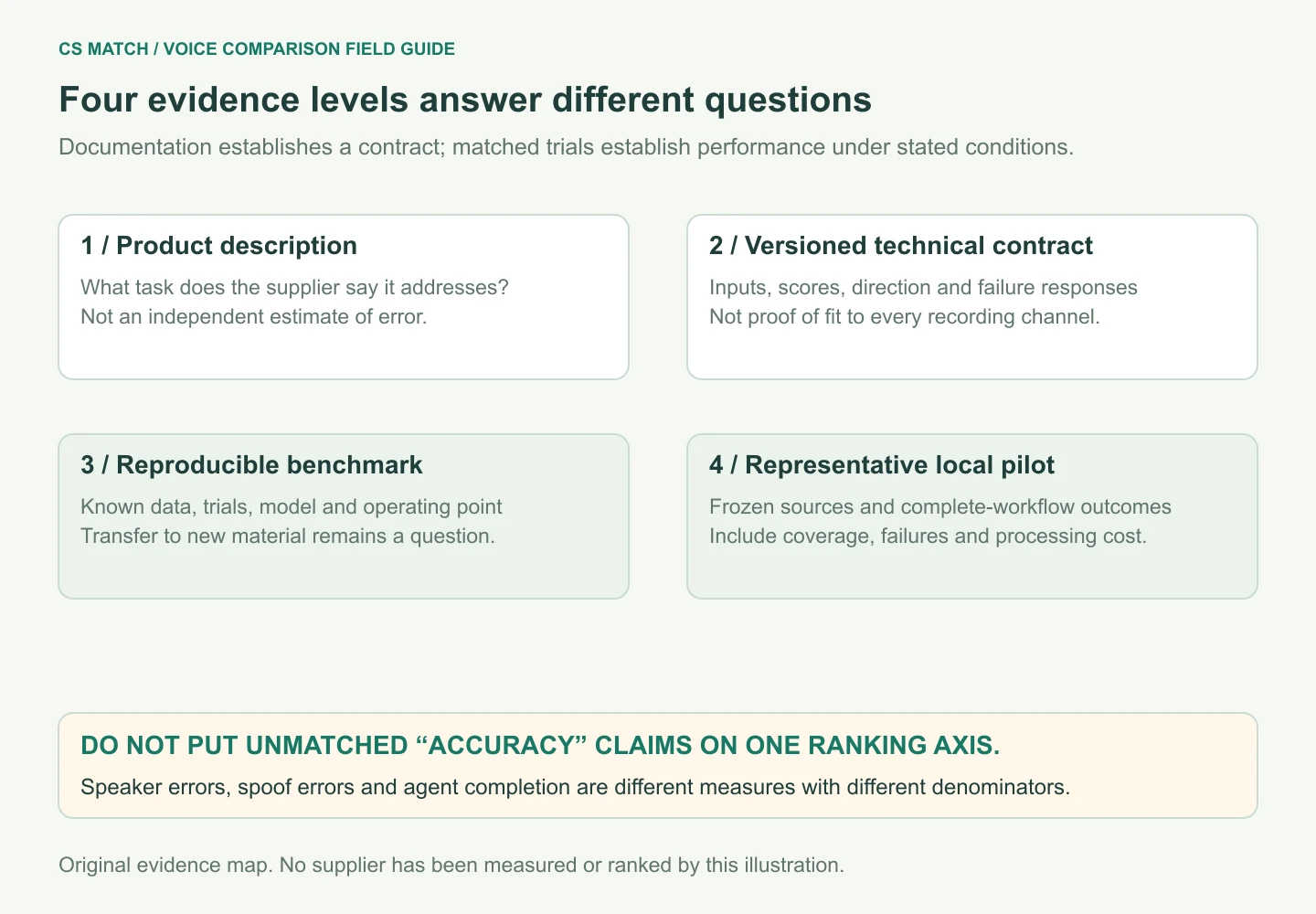
Keep four evidence levels separate: a product description, a versioned technical interface, a reproducible evaluation and a representative local pilot. Each answers a different question. Even a successful customer deployment establishes usefulness in its own context, rather than a universal error rate. The same evidence discipline should apply when evaluating an open model or our implementation.
| Supplier / inspected material | Documented focus | Evaluation question |
|---|---|---|
| Pindrop / Passport and Pulse | Caller authentication and a separate contact-center deepfake product | Which service and decision are being measured? |
| NiCE / RTA for Amazon Connect | Contact-center authentication integration | How does capture-to-decision work in the call flow? |
| Phonexia / Speech Platform 4 docs | Standard and referential deepfake detection | What hypothesis and score direction does the endpoint use? |
| Veridas / VCSP Echo v1.17 docs | Voice verification, credentials and stated spoof features | Which model, profile and feature configuration is enabled? |
| ValidSoft / technology overview | Passive and conversational voice features plus spoof controls | What technical contract supports the selected workflow? |
Pindrop: distinguish caller authentication from deepfake assessment
Pindrop positions Passport as an authentication engine for enrolled callers. Its separate Pulse for Contact Centers page describes deepfake-related protection in contact-center interactions. These are supplier descriptions of distinct products; they do not provide a common independent benchmark. Selecting one product name is therefore insufficient to specify the complete system being evaluated.
For an authentication pilot, define the profile-binding route, the speech supplied by the call integration and the exact event the application receives. For a deepfake pilot, define the countermeasure outcome separately. A single user-facing decision may combine both, but the test should still expose which component rejected a genuine caller or allowed an unacceptable signal through. Otherwise diagnosis becomes a comparison of opaque final labels.
Keep convenience and operational outcomes distinct from recognition errors. Reduced agent handling time can be valuable without demonstrating a particular false-acceptance rate, while a strong model can still be difficult to integrate. Measure both under the proposed workflow. A warranty or commercial remedy is likewise a contract term, not a transferable scientific estimate of how an unfamiliar recording will be classified.
NiCE: evaluate the contact-center integration as a complete path
NiCE documents Real-Time Authentication for Amazon Connect as a contact-center integration and describes shared voiceprint capabilities. That establishes a platform-oriented workflow, rather than a downloadable encoder benchmark. It is useful evidence about the intended deployment surface, but does not by itself establish accuracy for uploaded archives, other telephony routes or an arbitrary enrollment process.
An integration evaluation should follow a call from capture to usable evidence. Identify which participant is recorded, when enough speech becomes available and how the agent interface handles an uncertain result. Count interruptions and incomplete sessions. Measuring only the last scoring request can hide delays earlier in the flow, including speech collection and profile lookup, that matter to a customer and agent.
Also distinguish the voiceprint service from its surrounding routing and permissions. A shared profile capability introduces questions about version compatibility, account association and withdrawal across applications. Document those relationships for the selected deployment. This is a general integration requirement, not a claim that the product necessarily mishandles them or that an alternative library supplies profile governance without application work.
Phonexia: the reference changes the detection hypothesis
Phonexia's inspected Speech Platform documentation distinguishes standard deepfake detection from referential detection, with the latter using a bona fide reference recording. It documents positive log-likelihood-ratio scores toward deepfake and negative scores toward genuine. These details establish an endpoint-specific task and score direction; they are not evidence that a generic speaker cosine measures the same thing.
Two inputs do not make two algorithms equivalent. Our reference comparison asks about speaker resemblance; a referential countermeasure is designed to assess authenticity using additional source context. An integration must therefore retain endpoint identity with the score. A field called similarity would be especially misleading if a larger countermeasure value actually supports a different hypothesis than a larger speaker-match value.
For evaluation, specify how the reference was obtained and independently establish its permitted label. Include legitimate changes of channel and recording session, rather than comparing only identical capture conditions. A reference contaminated with generated or unrelated material changes the experiment. Test absence or inadequacy of a reference as an explicit workflow case instead of assigning a confident authenticity result when the required evidence is missing.
Veridas: a versioned verification service has a profile lifecycle
The inspected VCSP Echo v1.17 documentation describes text-independent voice verification, credentials and groups, alongside stated anti-replay and deepfake features. A versioned interface is valuable because it provides a concrete integration reference. This description does not establish that every configuration enables every feature, or that the inspected version is the latest available deployment.
Profile management should be included in the design review rather than treated as administration after the model has been selected. Record how a credential becomes associated with a user, how model changes affect existing profiles and what deletion means for source audio and derived representations. A verification result depends on the selected reference, so lifecycle mistakes can invalidate an otherwise well-executed acoustic comparison.
Keep benchmark requests precise. If a supplier offers several scoring or protection options, freeze the combination before testing. Evaluate voice verification and spoof controls both separately and through the final decision rule. Changes in a service revision can justify rechecking calibration and compatibility; a familiar API field name alone does not establish that its numerical distribution has remained unchanged.
ValidSoft: conversational features still need an explicit contract
ValidSoft's technology overview describes passive voice biometrics and conversational approaches involving speech content, as well as synthetic-voice and replay-detection capabilities. The overview is evidence of the company's stated feature categories. It does not specify a matched head-to-head recognition study, nor does a feature list certify every deployment's authentication or data-governance requirements.
For a conversational system, separate the speaker hypothesis from any content hypothesis. Does the application require particular words, use ordinary dialogue or issue a prompted response? Which output indicates speaker resemblance, and which checks wording? Those distinctions determine the relevant trial conditions. Correct words from another speaker and wrong words from the intended speaker should remain separate cases when content is required.
A pilot should also distinguish a complete response from insufficient speech, an unavailable service or an interrupted interaction. Collapsing these into a generic failed verification hides useful evidence about coverage and latency. Apply the same scrutiny to a custom implementation: combining transcription with a speaker encoder does not automatically create the conversational verification workflow described by a commercial supplier.
Live services and uploaded recordings require different evidence
A live-call product may receive session metadata and a controlled capture route that an uploaded file lacks. An archive-review tool may instead need timestamps, long-file processing and links back to uncertain passages. Neither requirement is captured by a single encoder score. Compare the surrounding workflow against the material the application actually receives, including what is unknown about its origin.
Latency also has several meanings. Time to first usable speech, time to a preliminary result and time to a completed report can differ substantially. Evaluate the appropriate one under realistic concurrency and file lengths. A fast short-utterance request is not evidence about processing a lengthy interview, just as a detailed offline report is not a demonstration of interactive call authentication.
Choose an integration boundary that preserves useful evidence. A final accept or reject label may suit one service while being inadequate for research review, where source windows and score provenance matter. Conversely, returning numerous acoustic values does not establish a trustworthy account decision. Document what the application must supply around the chosen component instead of assuming that either commercial breadth or model openness solves every layer.
Make accuracy claims comparable before putting them in a chart
An accuracy percentage needs a task, denominator, trial population and operating point. A speaker-verification error rate, a deepfake-detection rate and an agent completion rate cannot share one meaningful ranking axis. Even two verification results can differ because they use different impostors, speech lengths or thresholds. Preserve those conditions before deciding that one number is better.
A reproducible benchmark helps establish a controlled comparison, but transfer to a new channel still requires evidence. Customer reports add deployment context without replacing independent trials. The August 2026 industry-academia experience preprint involving Phonexia discusses deployment challenges including distribution shift and unseen attacks. It is a useful experience report, not an independent ranking of the suppliers in this guide.
For a fair local pilot, freeze recordings and labels before scoring, keep development and final evaluation separate, and record rejected or unprocessed inputs. Report results by meaningful condition as well as in aggregate. Avoid repeatedly adjusting a threshold on the final set until it looks favourable. The evidence ladder below shows why product documentation and measured deployment fitness should remain visibly separate.
Assess the interface, lifecycle and permitted role together
A technical contract should identify input preparation, supported capture routes, score meaning, versioning and failure responses. Operational review adds capacity, update policy and recovery from unavailable dependencies. Data review adds the relationship between original recordings, profiles and logs. These requirements apply to both an external API and an internally hosted model; the allocation of responsibility changes, not the need to define it.
Authentication requirements also have a scope independent of recognition accuracy. NIST SP 800-63B-4 prohibits voice biometric comparison within its authentication framework. That is not a worldwide statement about every telephone service, but an accuracy claim cannot override the restriction where that framework applies. Product descriptions should not be read as certification of an unrelated application.
Write the intended decision in the integration specification. An assistive similarity observation, a fraud-review signal and an authentication factor have different consequences and requirements. This prevents a later interface change from turning a recorded-source review into an identity claim without evaluation. The practical goal is a traceable division of responsibilities rather than a list of reassuring but untested security adjectives.
Evaluate the whole workflow while retaining component results
Use a pilot matrix covering the intended speakers, independent sessions, relevant channels, short and interrupted samples, and the expected presence of other voices. If spoof protection is in scope, add separately labelled conditions for that task. Count target rejections, non-target acceptances, spoof acceptances, unavailable results and processing time. Keep the unit of decision consistent across suppliers.
Retain the component scores alongside the final outcome when the interface permits it. A genuine caller rejected because of poor capture suggests a different remedy from a wrong profile association or countermeasure error. Review false decisions without exposing the final set as another tuning resource. A replacement version should be evaluated against the same frozen protocol, including cases where the previous system abstained.
Why a modular recorded-audio workflow fits our current task
For CS Match, the reasonable current choice is a modular recorded-audio workflow: speech selection, a compatible speaker representation, reference comparison and source-linked review. It is inspectable and suited to existing files without requiring account enrollment. This is a task-fit argument, not a claim to outperform commercial authentication platforms. A stronger claim needs comparable measurements, and adding authenticity assessment would require a separate evaluated countermeasure.
The report can expose the passage behind a resemblance observation, letting a reader inspect duration, other voices and recording quality. That evidence is useful for source review even when the result remains uncertain. An enterprise service may solve a different problem with a different interaction contract. Evaluate that service against its intended workflow rather than penalizing it for not being an archive-review interface.
Keep engine provenance with the interpretation. A learned speaker representation and a fallback acoustic descriptor do not become interchangeable because they both return vectors. Versioned components make it possible to investigate such differences and replace a specific stage when evidence supports the change. The benefit is a manageable, inspectable design; measured reliability still depends on the complete processing and evaluation conditions.
Questions about this workflow
Which supplier is most accurate?
This guide does not establish a winner. That requires a matched task, versions, recordings, operating points and complete-workflow evaluation. Product percentages drawn from different conditions are not a fair ranking.
Can a commercial voice platform be replaced by one pretrained encoder?
An encoder can replace only a defined representation component. Enrollment, account association, capture, policy, lifecycle, integration and any spoof assessment require additional implementation and evaluation.
Does reference-based deepfake detection mean the same thing as our two-file comparison?
No. The presence of a reference does not define the hypothesis. Speaker resemblance and authenticity require different task definitions, models, score meanings and evaluation labels.
Why use a modular implementation for CS Match?
The current task is reviewing existing recordings against a reference with inspectable intervals. Modular components fit that task; this does not establish commercial-platform superiority or supply live authentication and spoof protection.
Continue with the next useful step
Speaker Recognition Libraries Compared: SpeechBrain, NeMo, WeSpeaker, Kaldi and pyannote
Compare five speaker-audio toolkits by task, checkpoints, training recipes, scoring, diarization, deployment contracts and evaluation, with the reasons behind the current CS Match baseline.
Voice Biometrics in Banking: Enrollment, Verification and Call-Center Authentication
Explore banking voice biometrics: trusted enrollment, one-to-one verification, call capture, fraud controls, replay and synthesis threats, standards, lifecycle and the limits of recorded-voice comparison.
Voice Deepfakes, Replay and Anti-Spoofing: A Separate Detection Problem
Learn why speaker similarity cannot certify authentic speech. Explore replay, synthesis, voice conversion, AASIST, self-supervised countermeasures, ASVspoof tasks, joint metrics and defensible evaluation.